I once again smiled mysteriously at my screen. My eyes stayed glued to the screen as the tarot reader passionately promised my bright future in an online prediction video: I might become a famous published writer.
Public opinion tends to take a false binary view of tarot reading, calling it either a superstition or an absolute truth. However, for stressed-out high school students, a third option exists: treating tarot as a useful, reflective tool.
How can an occult practice be useful to people who don’t fully believe in it? Recent research explains this seemingly contradictory middle ground. A 2025 quantitative research project concluded that tarot reading has become detached from its older mystical implications. The same study suggests that industries have increasingly “secularized” and “commodified” tarot. Nowadays, it acts to satisfy our need for guidance under pressure. Tarot can construct distinct life narratives for us, providing a sense of certainty in our often chaotic lives.
Personally, I remember debating whether to take a creative writing or an art class in my junior year; it’s always hard to sacrifice a dream for another. So, I did a tarot spread, using it as a structure to organize my thoughts. In the process of interpreting the cards, I gradually realized my true desire — writing. I have loved it since middle school, but I never took any classes to give it a formal space. For painting, after years of incessantly creating new works, my love for it gradually transformed into a responsibility, into a stressful routine.
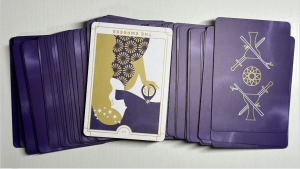
Image Source: Congran(Emily) Yang
I realized that I needed a break from art and a new exploration of writing—having now finished my junior year, I confirm that creative writing rejuvenated me.
With self-reflection, tarot can narrate our fear, worry, desire and uncertainty into a clear storyline that alleviates the anxiety of making life decisions.
Similarly, sociological researcher Cătălina Enoiu discovered that tarot relies on emotional resonance in social platforms. Enoiu states that tarot has a social function in interpreting symbolic readings into shared forms of support and motivation. In a separate study of Reddit discussions, Enoiu summarizes that users tend to describe tarot as emotional reflection rather than supernatural prediction. This critical distinction implies tarot’s value in helping people think through their future.
That said, useful doesn’t mean harmless. Overreliance can make any tool into a crutch that, after leaning on it too long, we may forget we can run without it. Dependency or unhealthy obsession with tarot can lead us to indulge in fantasies without focusing on reality.
Frankly, I sometimes get trapped by the successful future that tarot predicts for me, like publishing my short stories. I periodically lose my motivation to write and work. The blank pages seem too frustrating when I imagine the far-reaching, savoury moments of my name on a cover and my hand signing the preface.
We have to pull ourselves back into reality instead of surrendering our agency to this tarot “authority.” After all, only action brings change, not daydreaming.
With the warning in mind, we must still recognize the profoundly irreplaceable human component to tarot.
Image Source: Unsplash
Some online tarot services now market themselves around communication with deceased loved ones, including pets. Tarot readers often have monetary incentives (such as pleasing their consumers so they return for services) to reassure their consumers that their pets enjoy an afterlife. And many times, the consumers need exactly this simple reassurance. In a sense, tarot readers serve as therapists, though in an occult aspect.
Scholars argue similarly. Research indicates spiritual practices can sustain “continuing bonds” with the deceased, allowing bereaved people to reinterpret loss as a changed relationship. Labelling tarot as a “silly superstition” undermines its rich philosophical depth and the death education it provides.
Tarot settles pain in a designated spot, so that when grieving people become ready, they can directly combat their pain. It acts like a tablespoon stirring in a cup of hot tea (our messy emotions), helping to dissolve our painful sugar cube until the feelings turn into something we can finally swallow. It teaches us to embrace loss.
So try tarot, but try it responsibly. Try it as a tool that questions us, that comforts us while exposing our desires, fears, and uncertainties. Try it as a mirror to our present selves, but never as a map directing our future.