When you hear the word “tariff,” what comes to mind? “Tariff” is used daily in the news, and everyone is expected to know its meaning. Despite early understandings of tariffs, President Donald Trump seems to have shifted away from regarding tariffs as economic measures to something more political and nationalist. In particular, Trump has shown that tariffs can be used as nationalistic weapons for political wars between nations by influencing changes to foreign policies unrelated to trade.
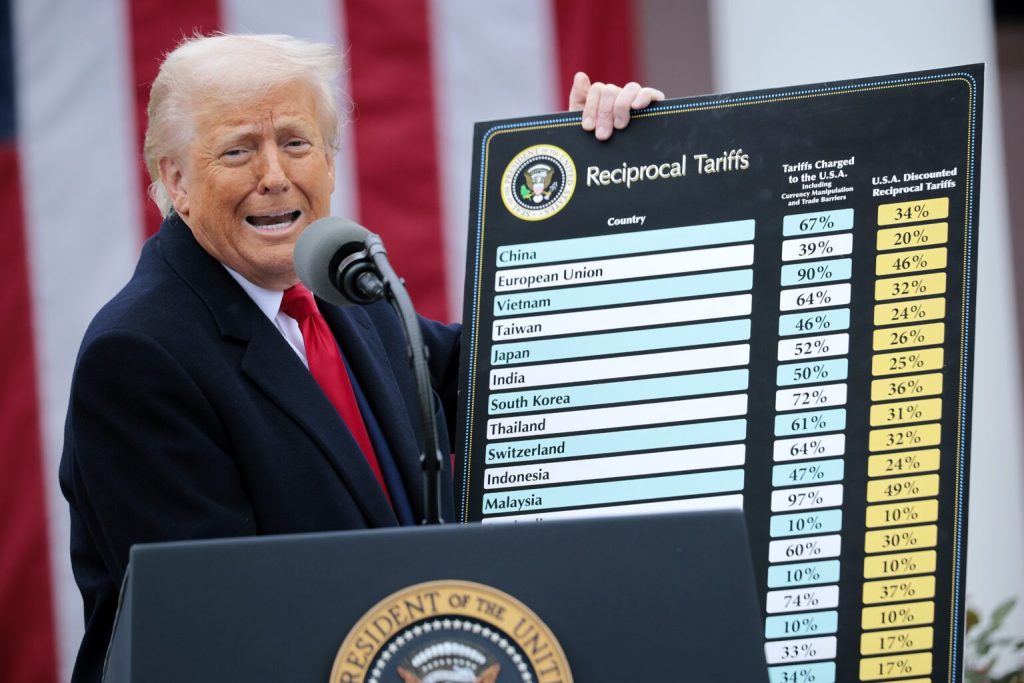
Image Source: Nevada Current
The official website for the American Congress sheds light on the historic and current uses of tariffs. Specifically, tariffs are defined as “a tax levied on imported goods and services.” Historically, tariffs were sources of revenue for many countries – in fact, they were often the prime contributors to federal revenue. Today, other taxes account for the majority of government revenue in developed countries. Since the main purpose of tariffs has been fulfilled through other national taxes, one question remains unanswered: why is the United States enforcing countless tariffs on numerous countries? Trump has stated that there are many reasons for imposing tariffs, such as expanding the manufacturing industry in the United States and strengthening trade negotiations.
There is, indeed, a time and place for tariffs, as they are crucial for protecting certain businesses, but does every industry in America need to be “protected” from competition outside of the United States? An article by CNN published in February 2025 stated that the United States “has frequently used tariffs to protect its manufacturing industry, farmers, technology and national security interests.” As a result, Trump’s decision to impose these targeted tariffs does not seem far-fetched. However, much of the controversy around Trump’s tariffs is the attempt to target several key industries with hefty penalties, such as a 50% tariff on Canadian aluminum. Further, tariffs are being placed, “on many goods that the United States doesn’t even produce,” suggesting not all tariffs are useful for the economy.
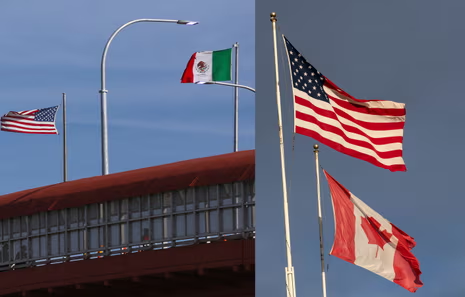
Canada and Mexico are experiencing heavy tariffs because of “immigration” and “drugs.” (Image Source: The Guardian)
While Trump’s tariffs are not necessarily helping American industries grow, do they help with trade deals? On the official website of The White House, Trump’s administration discusses that their high tariffs on Canada, Mexico, and China emphasize Trump’s commitment to America by prioritizing a trade policy that serves “national interests.” Specifically, these tariffs will stay in place until Canada, Mexico, and China change their policies to address the supposed issues of fentanyl smuggling and illegal immigration. If these targeted governments do not stand against the tariffs, they are indirectly acknowledging the validity of what the Trump administration is claiming. Choosing to negotiate without retaliation validates these claims and American values. In this way, the tariffs are used to force other countries to change their foreign policies to suit the concerns of the American government. Additionally, Trump’s insistence that these tariffs will not stop until there is no more “invasion” indicates that these tariffs are not solely put in place for economic reasons or trading leverage but to influence the policies of other countries.
While the tariffs attempt to initiate policy changes that promote the Trump administration’s perspectives on illegal immigration and drug smuggling, this may not represent the views or interests of many Americans, contrary to what the administration implies. For example, many small businesses are suffering from tariffs so much that they are suing the Trump administration. These tariffs are also likely to impact daily consumers, as inflation is likely to increase over the typical 3%, and most lower-class and middle-class people who spend most of their income on groceries will have to pay much more. The University of Pennsylvania predicts these tariffs will have even worse long-term effects, projecting they “will reduce long-run GDP by about 6% and wages by 5%.” Small businesses are suffering from tariffs, many economists have warned against them, and American consumers will suffer mostly from the rising prices. These effects can be seen through the different ways Americans have spoken out against tariffs.
The White House insists these tariffs represent American values, but the disadvantages and pushback against the tariffs prove otherwise. Specifically, the Governor of California insists that he believes in the value of international trade despite the national tariff policies. Americans have also been protesting with signs reading “Hands Off” to show their disapproval of the tariffs. The clear lack of positive reception from Americans to the tariffs represents the disconnect between the Trump administration’s tariffs and American values. So, why is the Trump administration insisting on implementing tariffs?

Americans protest the Trump administration and tariffs. (Image Source: Charles Criscuolo)
The unclear benefits of tariffs for Americans and American businesses suggest that Trump’s tariffs are not rooted in economic gain, but in his administration’s idea of nationalism. According to Jennifer Clarke, Trump believes America has been taken advantage of by foreign countries, so he wants tariffs to promote American products and businesses rather than foreign products. This keeps foreign competition out of the American marketplace. Despite this, the only American businesses that benefit are steel manufacturing companies and other big businesses alike. The lack of foreign competition is not necessarily beneficial for the American economy; it simply keeps foreign products out of America, implying that non-American products are not worthy of receiving financial wealth and growth. This is inherently nationalist, and the effects of this nationalism can be felt on a global scale.
Regardless of the non-physical combat, the tariffs have had international economic impacts. In Canada, the financial company Deloitte projects a small recession, wherein business investments and jobs are stalled. Specifically, they predict the unemployment rate will reach 7.3% towards the end of 2025. Canada is just one of the many countries facing backlash from these tariffs. Chinese economists predict a 0.5% decrease in their expected GDP growth for 2025 and 2026, and, as of June 2025, Mexico’s steel exports to the United States have been halved in the past month. Mexico’s GDP is also only expected to increase by 0.3% this year. Enforcing tariffs suggests that Trump’s administration does not care for the economies of the United States’ main trading partners.
Nationalism plays an important role in this “trade war,” as it encourages the war to escalate, and encourages global leaders to demonstrate acts of non-physical war that are rooted outside of trade relations. We see this through the assertion of dominance in the tariff exchanges between the Chinese and American governments. Goldman Sachs discusses that a tariff of 60% on Chinese imports may reduce China’s real GDP by around 2%, but a 120% tariff will not decrease their real GDP by 4%; there is a limit on just how effective these tariffs can be, so increasing them past this limit will not change GDP statistics. This back and forth between China and the United States imposing very high tariffs can be seen as a nationalist-driven, non-physical war because there is almost no point in raising tariffs past 60% other than trying to demonstrate power. Similar tactics were used during the 2018 trade war between China and the United States, as some scholars believe this trade war was actually a cold war because it was rooted in one nation trying to become more powerful than the other without physically fighting.
Image Source: Markus Winkler
The tension created between China and the United States has led China to strengthen its relationship with other countries, similar to forming alliances in war. According to Goldman Sachs, China’s president has been meeting with other presidential leaders, such as the Spanish prime minister, to discuss strengthening their trade ties. China may create closer bonds with Vietnam, whose economy relies on 30% of their exports going to the United States. The implementation of tariffs has even led the ministers of China, Japan and South Korea to meet in March 2025 concerning the tariffs. Acquiring trade allies is reminiscent of allyship during physical wars. It highlights that nations are reliant on one another, and suggests that coming together throughout this financial stress can combat Trump’s tariffs. Since these tariffs cause tension between the United States and many nations, the tariffs suggest that America’s economy is strong enough to stand alone. These tariffs may, then, be implemented to show off the American economy, almost implying that America does not need allies to thrive as a nation.
The negative impacts projected in Canada, Mexico, China and Vietnam highlight that the tariffs are used to punish foreign countries for not being American, as they do not deserve to be sold in the American market. This promotes the idea that this “trade war” is more so a non-physical war. Trump emphasizes that tariffs are used as a non-physical war weapon, as he asserts that if another country wanted to go to war because of the tariffs, “We’re going to charge you 100% tariffs“. And all of a sudden, the president or prime minister or dictator or whoever the hell is running the country says to me, ‘Sir, we won’t go to war.’ ” In this way, tariffs are being used in place of a military threat. This is why the United States’ trading partners in Japan and the EU are “wary” of how largely their steel, auto, and drug industries will be impacted by these tariffs. These tariffs will impact every country’s economy in one way or another, and yet Trump continues to impose tariffs to incite financial fear.
This article has asked why Trump is imposing tariffs when we see that this is negatively impacting Americans, American businesses, and America’s trading partners. The best explanation is nationalism and war. It looks like tariffs will “protect” some industries within America and eliminate foreign competition, but at the expense of Americans and America’s partners. Trump’s tariffs imply that these negatives are worth it if it means that the only products sold in America are made in America. While the American Congress website gives a strong definition of “tariff,” it should expand to include this drastic display of nationalism in Trump’s tariffs. While talks of trade and tariffs are still continuing as we speak, the way Trump is using tariffs as a weapon against trading partners like Canada, Mexico, and China to assert dominance over “American” values is a different way to use tariffs, and we should change the definition to better reflect and understand this.