I was born in 2011, ten years after the September 11 attacks. By the time I was old enough to spell “Afghanistan,” the United States had been at war there my entire life.
Picture a nine-year-old boy standing in front of the rubble where his home once stood, holding remnants of what was once his teddy bear. Around him, a drone still hums somewhere in the distance. The strike was “successful.”
For Americans, those words often mean a terrorist was neutralized. For the child on the ground, it means his mother is dead.
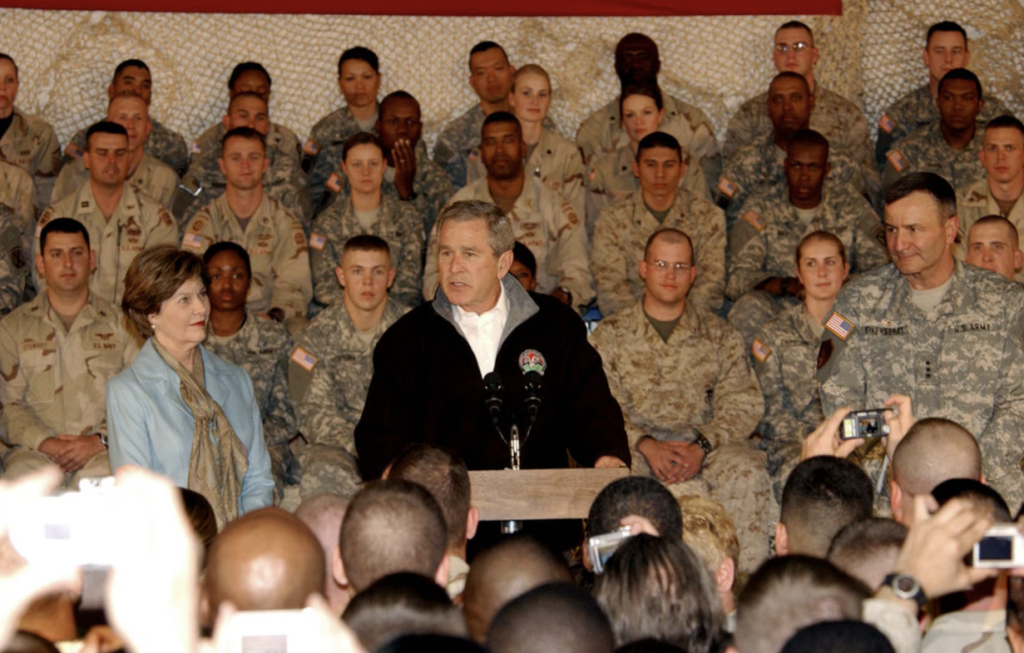
President George W. Bush, the First Lady, Laura Bush, and Lt. Gen. Karl Eikenberry, Combined Forces Command — Afghanistan commander, pay a surprise visit to troops here March 1. (U.S. Army photo/Pfc. Brian Schroeder) Public Domain Copyright Free
I am now 15 and have seen almost the entire “war on terror” play out in the news. I didn’t vote for these wars. I never sat in a meeting where our officials planned the next strike. And yet, I am part of a generation whose coming of age has coincided with our nation’s airstrikes and apologies that land only after their bombs have already turned homes into dust.
For as long as I’ve been able to form opinions, our elected representatives and leaders have supported military action abroad with the same three motives: deterrence, security and hegemony. I am told that bombs and covert operations create a protective shield for the United States, keeping us safe from terrorism. But if you look closely and trace these policies and decisions to the foreign countries where they land, such as Afghanistan and Iraq, another narrative becomes apparent: toppled governments, shattered economies, displaced families and militant groups growing faster than the ones our own nation claims to defeat.
The war in Iraq was still a fresh memory in the minds of my parents by the time I could understand it as more than a phrase. It was marketed to us as a mission to remove a dangerous dictator and his regime, which, at first glance, may seem reasonable from a global peace standpoint. However, inside Iraq, it dismantled the state, unleashed a sectarian bloodbath and helped pave the way for the Islamic State. My generation did not start this war, but we inherited its afterlife with more hatred for the United States, more propaganda and the notion that successful missions are often anything but.
This same pattern repeats at a smaller scale with drone strikes, which we see even today. On the ground, when our intelligence system is wrong, that “success” is a street market turned into a crater, a school reduced to body bags. In 2021, U.S. officials reported a drone strike in Kabul, Afghanistan, that killed 10 members of an Afghan family, seven of them being children. The Pentagon called it a tragic mistake, but for the Afghans, “mistake” cannot even begin to describe what it feels like and what has been stripped away from them in an instant.
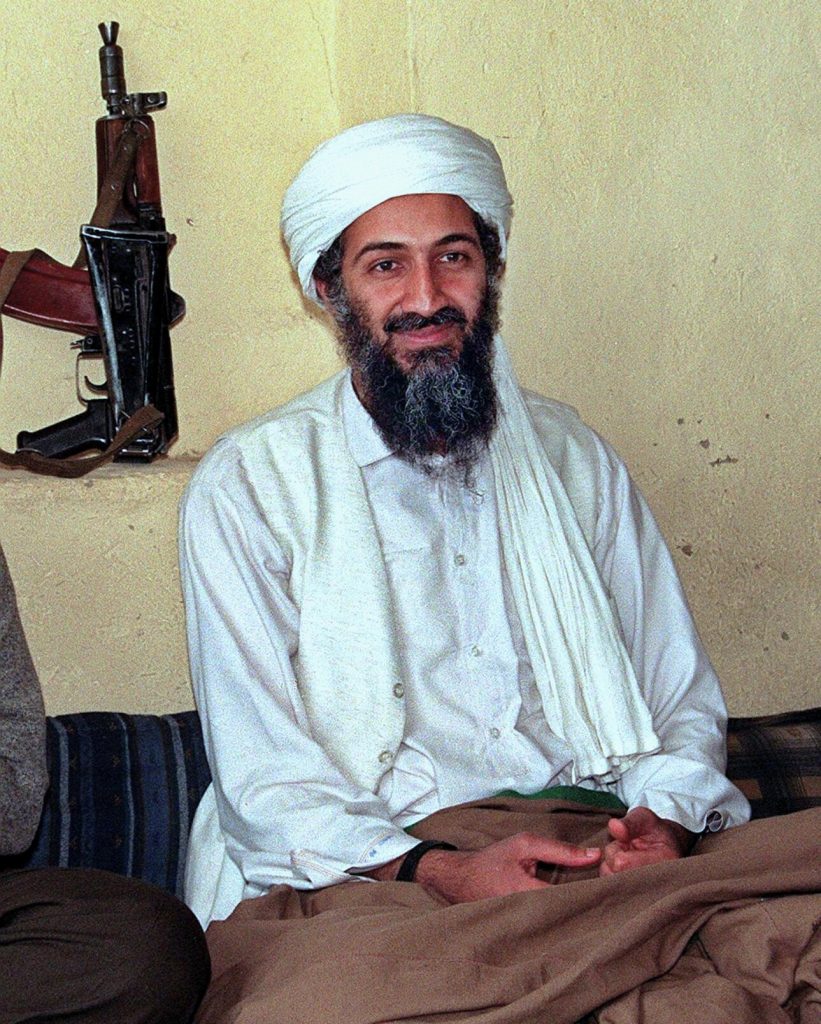
Wikimedia Commons contributors, “Osama bin Laden full portrait.jpg,” Wikimedia Commons, https://commons.wikimedia.org/w/index.php?title=File:Osama_bin_Laden_full_portrait_(cropped).jpg&oldid=1039031369 Copyright Free
It is no secret that I am not an expert, but it does not take a Ph.D. in terrorism to see how quickly that becomes the recruitment material our elected officials say they are going to stop. Photos of burned homes and dead children because of U.S. foreign missions are proof that the United States is at war with us, not just a few terrorist groups. A study by Eugen Dimant at the University of Pennsylvania shows that increased U.S. military involvement in regions such as the Middle East often correlates with more hate speech towards America and more terrorism, not less, as we were promised. The idea that sending more force will shrink threats abroad simply does not match what reality suggests. Instead, it sparks more hatred and resentment towards us. That is the start of terrorist groups like Al-Qaeda and ISIS, who seek to attack our nation.
For many young people around the world, “The United States” is not a utopian nation. It is the country whose jets and soldiers help decide whether they have a family and a bed to sleep in. In that context, chants like “Death to America,” while hateful and negative, do not appear out of nowhere, as the United States likes to frame it. This hateful climate around even the thought of America grows from years of watching decisions made in distant capitals affect their lives more negatively than their own leaders ever have. Rage like that is not morally justified, but it isn’t incomprehensible. It has roots, and those roots are called American foreign involvement.
That same chaos and discord echoes back across our screens to how a teenager like me sees my own home country. Civilian casualties abroad tick upward; drone strikes get rebranded but not rethought. Newly elected officials promise change and deliver the opposite. Young people watch these stories unfold and often end up feeling a mix of guilt, anger and numbness towards the government as a whole and not just coming and going administrations.
In public spaces and discussions, the widespread unease seeps out quietly through small jokes, dry statements about being the bad guys and quiet signs when headlines about civilian deaths labelled as “mistakes” float by. For many of us, patriotism in these moments does not feel like pride. It feels like homework for morals we were never assigned or given an instruction manual for. As our country’s power crushes cities, loyalty becomes a complicated concept, not a given, comfortable emotion.
If the goal of U.S. foreign policy is to make the world safer and to protect us, then the current model of foreign policy needs to be held up to a brutally honest mirror. You cannot bomb your way into our hearts. You cannot sanction or drone strike your way into our trust. The kids my age who have grown up in countries torn apart by U.S. intervention did not choose the conflict; they unfairly inherited it. Their rage is forged from watching bombs fall from the sky onto their homes. Our challenge is to recognize that, even from here in our comfortable homes, we have the power to demand a different story.
That nine-year-old boy from the beginning may never know the names of the people who said that a strike on his town was a good idea. He will only know the name of the country whose drones killed his mother. The question for us is simple but scary: if we are going to be the inheritors of this war machine we call our government, are we also willing to be its toughest critics? Can we ask whether the shield we have is for safety or to block our own view of what we have done?
We cannot and will not solve the evil in the world by replacing one brand of violence with another. But we might at least refuse to call everything we do security when it keeps staining our nation with rubble and blood. So next time you say that the United States is the best country on Earth, don’t take that for granted and don’t forget the humans who have to die for that.