“A goddess warped a crevice of inferno on herself, tears fleeing her sulfur-clouded cheeks.”
Often regarded as Earth’s twin, the evening star boasts a hellish atmosphere rich in carbon dioxide, adorned with sulphuric clouds that are hypothesized to host life. With a pressure system almost 93 times that on Earth, and a mean temperature of 464° C, Venus hosts nucleic acids and other amino acids that are considered to be the molecular backbone of life, forming systems homogenous with the astrochemistry of Venusian clouds[1]. And that ultimately raises the question of the possibility of extraterrestrial life in this acidic hothouse.
Venus’s geodynamic history is fascinating because it presents compelling potential to sustain life. Venus’s extreme conditions put forward an interesting set of astrochemical factors that are proven to support organic life.
But Venus may not have always been like this, two contrasting theories have emerged about Venus’s primordial interiors—one of which speculates that Venus may have had a temperate, wet climate—based on its high deuterium-hydrogen ratio (suggesting that Venus may have once had large amounts of liquid water on its surface, potentially in oceans)and the other being the dry Venus scenario . Specifically, the ratio was approximately 1.6 × 10⁻², pronouncedly greater than the ratio found on Earth’s oceans, which is about 1.5 × 10⁻⁴[2]. This enrichment in deuterium suggests that Venus once had abundant water that has since been lost, likely due to evaporation because of its scorching temperatures and hydrodynamic escape.
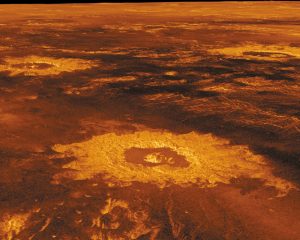
Magellan radar image of three large craters in the northwestern portion of Lavinia Planitia
However, about 3 billion years ago, when Earth had not even developed continents, Venus likely underwent a runaway greenhouse effect (a self-reinforcing cycle of warming that causes a planet to become uninhabitable), where solar radiation broke down water vapor in the atmosphere into hydrogen and oxygen.
The weak magnetosphere of Venus further enriches this hydrochemical frailty, not protecting the planet from solar and other stellar winds. Consequently, ultraviolet radiation breaks apart the water molecules if present, producing ions of hydrogen and oxygen. These ions are energized by the solar wind, with some gaining enough velocity to escape the planet’s gravitational pull. This process steadily stripped Venus of lighter ions like hydrogen, helium, and oxygen, while heavier molecules, such as carbon dioxide, remained largely unaffected and persisted. Atmospheric erosion accelerated by solar winds plausibly caused Venus to lose most of its water budget within its first billion years. Unlike Mars which gloriously displays evidence of hydrological sculpting, Venus most likely underwent a global resurfacing event that erased all its water footprints (the lack of highly cratered areas on its surface supports this argument too).
In contrast to this theory is the more scientifically backed dry Venus scenario. This theory posits that Venus ended its molten magma phase (the period of a planet’s formation) in a desiccated state, thereby accounting for the low levels of water vapor observed in its volcanic emissions. Marked by a deficiency of moisture, Venus’s atmosphere has likely never had the levels of water vapor necessary to support a stable, liquid-water environment.
Thermochemical and atmospheric evolution models suggest that during and immediately following the magma ocean phase, water was either inefficiently degassed from the mantle or rapidly lost to space, preventing the accumulation of surface oceans.
Volcanic outgassing is crucial in determining a planet’s climate, atmosphere and surface processes. It is the key mechanism that accounts for the planet’s carbon dioxide saturation. Sulfur dioxide from volcanic emissions reacts with water in the atmosphere to form sulfuric acid, a cardinal ingredient of Venus’s reflective cloud layers. These clouds both reflect sunlight and trap heat, stabilizing the planet’s extreme temperatures[3].
This is where Constantinou, Shorttle and Rimmer come into play. In their research published in Nature Astronomy, they presented an approach based on the observations of Venus’s current atmospheric chemistry to distinguish between the dichotomous climate scenarios[4]. By calculating the amount of volcanic outgassing required to sustain Venus’s existing atmospheric balance, Constantinou and her team estimated the planet’s internal water content, a key driver of volcanic activity. The researchers found that volcanic efflux cannot retain significant quantities of water due to atmospheric conditions, and that water is also lost when it exists in solid or mineral forms. They concluded that the magma released during volcanic eruptions is generally dry and contains only trace amounts of water at the moment of eruption, painting a principally dry interior.
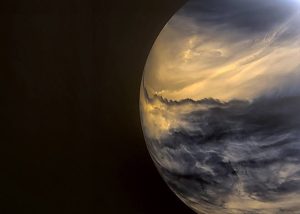
Due to volcanic outgassing, the Venusian atmosphere is now dense with noxious gases like carbon dioxide and sulfur dioxide. Venus’s atmosphere is 96.5% CO2 and 3.5% N2 with trace abundances of SO2, OCS, H2O, HCl, HF, and HBr[5], as well as their photochemical and lightning-induced products acting as a restorative flux of such gases. This raises the question of whether there are atmospheric sinks for these gases that help maintain the intense chemical equilibria. Gas species like CO2 could oxidize when being exposed to igneous rocks. However, given the surface temperature, pressure, and composition of the Venusian lower atmosphere, the equilibria of each of the redox reactions favors reduction of the surface. CO2 removal could occur by oxidation of pyroxene into magnetite (Fe3O4) and magnetite into hematite (Fe2O3)[4]. Talking more about the endogenic suppliance of these gases (to replenish their content)—without planetary-scale tectonic burial, volcanic burial remains the only viable mechanism. In such a scenario, the gases released directly from volcanic magmas are just as equipollent in understanding the atmosphere, if not more so, than those produced through metamorphic degassing. Therefore, if Venus’s atmosphere is in a steady state, the gases needed to counteract photochemical destruction must predominantly originate from volcanism.
What does this say about the potential of life to thrive on Venus? While there is research suggesting that the ammonia present in the Venusian atmosphere could be a fingerprint of life trying to create an environment conducive to its growth[6] (basic ammonia neutralizes the acidic compounds prevalent in Venus’s atmosphere); for now there is ample evidence to safely claim that Venus interior was most likely dry from its primeval origins, dry accretion and other astrogeological processes supporting the claim. While all of this is true, planetary science research indicates that the upper cloud layers of Venus—roughly 50–60 kilometers above the surface—have temperatures ranging from 30°C to 80°C and pressures of about 1 atm[7], conditions similar to those found on Earth’s surface. In this case, this particular cloud layer presents a potential niche for microbial life. Astrobiological research into the existence of life matters because it addresses one of the most profound questions humanity has ever asked: Are we alone in the universe? In this context, Venus becomes a laboratory of immense value, its extreme conditions pushing the boundaries of our understanding of habitability.
Venus, with its sulfuric acid clouds and superheated surface, presents an extreme far beyond Earth’s, but it is precisely this extremity that makes it riveting. If life were to be found in the planet’s cloud layers, it would change our understanding of life’s tenacity and its willingness to exist.
References
Petkowski, J. J., Seager, M. D., Bains, W., & Seager, S. (2024). General instability of dipeptides in concentrated sulfuric acid as relevant for the Venus cloud habitability. Scientific reports, 14(1), 17083. https://doi.org/10.1038/s41598-024-67342-w
Venus Was Wet: A Measurement of the Ratio of Deuterium to Hydrogen. T. M. Donahue , J. H. Hoffman , R. R. Hodges, Jr. , and A. J. Watson
https://lasp.colorado.edu/pdr/pioneer_venus/PUBS/Esposito,%20Venus%20II,%201997.pdf
Constantinou, T., Shorttle, O. & Rimmer, P.B. A dry Venusian interior constrained by atmospheric chemistry. Nat Astron 9, 189–198 (2025). https://doi.org/10.1038/s41550-024-02414-5
https://www.aeronomie.be/en/encyclopedia/venus-atmosphere-mainly-composed-carbon-dioxide-and-nitrogen
Bains, W., Petkowski, J. J., Rimmer, P. B., & Seager, S. (2021). Production of ammonia makes Venusian clouds habitable and explains observed cloud-level chemical anomalies. Proceedings of the National Academy of Sciences of the United States of America, 118(52), e2110889118. https://doi.org/10.1073/pnas.2110889118
https://doi.org/10.48550/arXiv.2401.04708
Salvador, A., Avice, G., Breuer, D. et al. Magma Ocean, Water, and the Early Atmosphere of Venus. Space Sci Rev 219, 51 (2023). https://doi.org/10.1007/s11214-023-00995-7