Linda Kooluris Dobbs — you may not know her name but you know her. From the corridors of Mount Sinai hospital to government buildings, you’ve definitely seen her portraits hung around Toronto, Vancouver, New York or beyond, whether it be on commission or in a museum in the almost 60 years that she has put on exhibitions. At 77, Linda has a zest for life, an infectiously creative scope and a sophistication that just seems to effortlessly emit from her! We became unlikely friends on the Spadina TTC streetcar. We were sitting next to each other when I noticed her, holding her DSLR camera, sitting next to me. She was wearing the most gorgeous hairpins and her makeup was so classy; I could tell she was a kindred spirit and just had to tell her how gorgeous she was. We got to talking and I found myself incredibly inspired. She had lived a life I could only dream of, like many of her students. By the end of this interview, she will salsa her way into your heart and you’ll be thinking what I thought after our first meeting: “I hope I’m like you when I grow up.” It is my pleasure to introduce you to one of my friends and inspirations: artist, photographer and dancer — Linda Kooluris Dobbs.
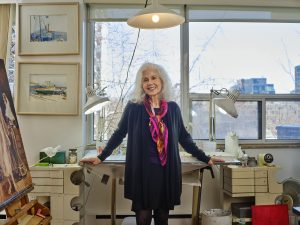
Linda Kooluris Dobbs (Image Source: Eden Schwinghamer and Linda Kooluris Dobbs)
On Art: When did you know you wanted to pursue art as a career?
Actually, even though I was studying in France and seeing the work of great, important artists, I saw how difficult it was for them to make a living and find their way — I decided that I would not become an artist — it would be too difficult. But when I came back to the States, I turned tail and applied to the School of Visual Arts and was accepted. At the time, conceptual art and abstract expressionism was in, and I wanted to do beautiful, realistic images. That was what the illustrators were doing so I got my degree in that. Part of my program was to take a year of photo-graphics — learning photography graphically — and I was taken with that as well! I loved getting lost in the development of pictures in the dark room, and seeing something emerge from that water slowly turning into an image.
Thinking back to your early days studying at the Sorbonne in France, what was the most important thing you learned?
I learned the importance of language and communication. I have always loved to learn languages. I studied French since I was a little girl, and this was of course very important when I studied in France, but I also learned Italian, Swedish, Spanish and Greek over many years. Connection and clarity has always been important to me in my conversations, relationships and even my artwork. I love to learn, and it translates to my art as well — art is a language.
How has photography helped you as an artist?

Image Source: Eden Schwinghamer and Linda Kooluris Dobbs
Photography became a shortcut. When I worked for Nous Magazine in Montreal I would have three day turnarounds, and I found that I could work with my camera as a sketch pad, take the pictures in and draw them up and then do the paintings. I was tempted to go into photography, but when I looked at all the popular magazines it was all so technical, and I got so intimidated. It was just the emperor’s new clothes. Illustration felt right for me.
Did photography touch other parts of your life?
My late husband, Kildare, was a travel writer, and he used to take his shots by himself. But there were times that I went with him and took photos for him, and then it grew into me writing my own articles and putting pictures to them. I was able to make these lateral moves — fine art, photography, illustration — it was all coming together in my life.
How did you get over a big rejection or art block?
During the recession of 1982, I went to see a big shot founder of a graphic arts magazine in Toronto, and when I showed him my portfolio, he literally yawned! I came home weeping!!! My husband consoled me and, to prove I still had a gift, I started a painting of him. I had wanted to move away from illustrations for publications and corporations because of the deadlines — illustrators are the last to get the call, and it interfered with my life. Once I finished that picture of Kildare, I knew I had something special, but I went into hiding for three years and taught at what was Ryerson at the time (now Toronto Metropolitan University). I was able to make money at night, and have time to paint for myself during the day.
You’ve told me that there was a span of many years when you weren’t painting — what finally reinvigorated your spirit?
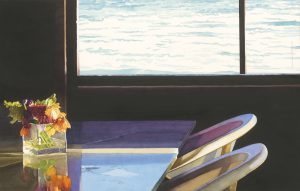
Image Source: Eden Schwinghamer and Linda Kooluris Dobbs
A week shy of the anniversary of my husband’s death in 2013, I went to Puerto Rico. I knew something was going to tell me to paint it — I just felt that. One morning I was sitting, and there was a table with a beautiful arrangement of flowers all collapsing in on themselves. The light fell in from the side, and there was a window behind it all where I could see the sea. I looked at the scene and I said to myself, “That’s what it is, that’s the image that is going to get me back to painting.”
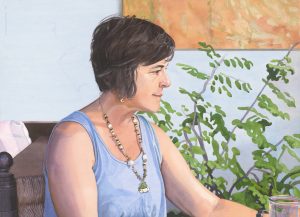
Image Source: Eden Schwinghamer and Linda Kooluris Dobbs
Roberto, a friend of mine, told me to meet The Widow, and I was brought to this beautiful house in Old San Juan — a week after I returned home I realized I needed to paint the widow. This was in 2014, and it was the first portrait I did voluntarily since my original portrait show in 1985. It was a large water colour, and it was the first one to get me going again.
How did you get your big break in the art world?
There was a women’s club called The 21 McGill, I joined it and put on a show that really put me on the map. Lots of newspapers and stations covered it, The Sun did a full page on me, the AGO asked for files on me and that really helped me. I started painting prevalent, important Canadians, and I did this strategically. I wasn’t just gonna paint someone’s kid or friend — I felt it was important to focus on things that would get me some press. I became established, and for several years I did portraits on commission, and that freed me; I was finally able to paint my travel artwork.
One amazing work of yours that I often think about was your photography of the Vatican Gardens. I’m sure there’s a story there!
Image Source: Eden Schwinghamer and Linda Kooluris Dobbs
I got this opportunity to meet a friend of my brother’s, Father Allen Duston, who was coming to Canada for the Angel show at the AGO. My brother said, “Father Allen wants to meet you when he comes up to Toronto.” I said, “What am I gonna do with a Catholic priest?” My brother replied, “Don’t worry, what he loves most is to sit around in shorts and a t-shirt around the pool drinking martinis.” That I could deal with. We hit it off, and at one point I invited them to have Irish Black Bush and Plymouth gin, and we were having a grand old time. Father Allen looked at my paintings and invited me to shoot the gardens of the Vatican.
What did you learn from this experience?
A year before, I had learned about polaroid transfers, and I was so excited about it, like I was a kid again learning. I realized I wanted to try it out with all my new material from the Vatican. I included some of these transfers with my own photographs and timed The Vatican Gardens and Roman Reflections Exhibition at First Canada Place to coincide with the Pope’s visit to Canada — they were so happy, it was a perfect time! They had never seen such a crowd, and kept it going for an extra month.
This was a very important project for me, because I was at a very low ebb; I had gotten a few bad reviews and hadn’t painted for five years. This project allowed me to take on something new. I learned digital by the end of my time visiting the Vatican. I had taken multiple classes, one was so cold I left feeling old and stupid, but in just an hour with another teacher I was off to the races with digital shooting and have only gone higher and higher with my equipment. I visited the Vatican four different times, from 2000 – 2008, and it was a very exciting and meaningful project for me. Life had been so full of ups and downs — it came into my life when I needed it.
You said in the Distillery District Magazine that your “penetrating portraits… will last.” What makes a lasting portrait?

Image Source: Eden Schwinghamer and Linda Kooluris Dobbs
I asked myself, “What is something I do well?” As a child I was never the centre of attention, I was the observer, and that was very important in developing me as an artist — to look from the outside in. As a portrait artist I need to get inside the person. It is not just a likeness, I have to translate who this person is so in 300 years someone can look at this portrait and understand that individual’s character. That is so incredibly important to me. The downside is that when I’m done, I am exhausted, because for months and months I was living inside that person. It really tires you out. I would take breaks by doing water colour landscapes with no people in them because I really needed that break.
What do you want people to understand about your artwork?
I’m not the type to put every emotion on the page. I don’t want or need to put big emotions out on the canvas. I want to set up questions that make you wonder about things. I can create a mood, evoke a place, make you feel at peace or slightly disturbed, but it’s important to me that I don’t give you all the information, to have you as the viewer have some input in a work.
On Teaching: At one point in your career you taught art at Ryerson, now Toronto Metropolitan University. Did this experience change anything about your creative process? Did you learn from your students as they did from you? Were there any particularly memorable students?
What I can tell you is that what’s good for me is that I discovered my greatest strength is to inspire others. I’m a loose cannon due to being an Aquarius — I always wanted my students to be fired up! I never treated each person the same; I made them all tell me their birthdays. I knew if they were a fire or a water sign, and that would help me know how to approach each student as an individual — paying attention to their personalities. If I had a class of all water — Scorpio, Cancer, Pisces — and no fire, it would be flat, but if there was fire, there would be sparkles. I always want to put people forward in the world.
What was your favourite artistic skill to teach?
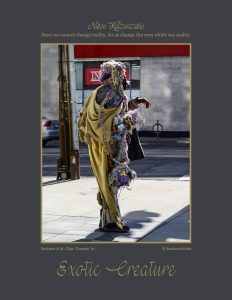
Image Source: Eden Schwinghamer and Linda Kooluris Dobbs
I taught fashion illustration, communication drawings, life drawing, colour and graphic design. When I got to Ryerson, there was a marvelous colour course that was beautifully done, and there were times when I would get to take over that class and solidify my understanding of colour. Teaching it to other people helped my knowledge of colour theory deeply — teaching colour to others has helped me immensely as a painter. You as an artist, or a student, can control what the viewer sees with colour, depth and brightness. It’s satisfying to know that I can teach such an important skill unto others. My students often tell me that I should write a book about teaching adults, but I just wouldn’t be able to do it because it’s the hands on, that personal interaction, that helps me know how to cater to each and every one of my students. It’s satisfying to see others grow and gain confidence.
How have experiences with your own art teachers shaped you as a teacher?
When I was eleven, this teacher stood over me and pointed at my art and said, “That’s no way to draw!” I was so shocked that I never took another art class in public school. But every summer, I went to dance and art camp where I would take art classes, and even though I was excelling, I still heard the voice of that creep in my head. I wish I could have seen him years later and said, “Can you do what I do?!” It had such an effect on me — not everyone is a good teacher. I vowed that when I got out of school, if I ever became a teacher, that people would have the technical knowledge and confidence. My water colours certainly have it! I never had to answer to anyone else’s curriculum. I learned the importance of technique, and the need to create a safe environment for my students, because if you do, they will dare to do things they never thought they could do! My job is to make sure they’re as free of me as possible, to be able to stand on their own!
When did you stop teaching and why, if you don’t mind me asking?
At the beginning of COVID I realized that I was giving too much of myself to my students, and I wasn’t painting enough. A friend told me that “parents teach their children how to walk, but they also need to teach them to walk away,” so I wrote this to my students, and told them they were ready to move on with their art without me — I wasn’t gonna teach anymore. Towards the end of COVID they all got together, they were all good friends, and they said if we find a space, and do all the organizing, and pay you would you agree to come back? And so I did, and I’m glad that I did! It was so nice to have such a connection with them.
In life, it’s important to assess what is feeding you, and your spirit. You need to find balance in your life.
Something people may not know about you is that you are a patron of all the arts, not just visual arts, and this includes dance. Can you tell us a little bit about that?
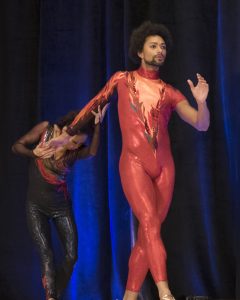
Abdiel & Kristine (Image Source: Eden Schwinghamer and Linda Kooluris Dobbs)
I danced all my life, not for performance, just for my own enjoyment. I just love dancing! It brings a lot of balance into my life. Usually I work alone at my easel, but to go out and be social with people I’m fond of, and with young people in their 20’s and 30’s is invigorating. They are filled with hopes and dreams. They’re fearless like I used to be. When you get older, things happen to you, and you adapt by becoming more cautious, weary, you’re not as daring as you used to be. It helps for me to be in that lively environment, with those people who are fearless — it keeps that side of me fresh.

Antonio & Jasmina (Image Source: Eden Schwinghamer and Linda Kooluris Dobbs)
Jennifer Aucoin founded the Step Dance Studio 25 years ago. I ended up taking her classes from 2005-2009, she has known me for over 20 years now; she knew I was depressed when my late husband became very ill for five years. It was such an overwhelming experience with emergency hospital visits, and caregivers — for five years I didn’t paint. It was 2009, my husband died in 2013. Halfway through, when Jennifer founded The Canada Salsa & Bachata Congress in 2009, she asked me to photograph the Congress, I said “yes,” and went in with an open heart. I went in at 60 years old with nothing to lose. For those 4 nights and three days I could not stop smiling, my mouth hurt from smiling. I knew I was in my element. I understood how to photograph dance, because something that remained in my head for so many years was something a photographer said when he took pictures of my mother, she was a dancer: “Capture the moment just before the pivotal point.” I always remembered this in the back of my mind, and having been a Latin dancer, I understood the moves and the timing, and it was so rewarding when the dancers told me “Linda, you’re in the moment” when they saw my work, and my ability to catch those movements. It fired me up again, having fun capturing these great performers, when I needed it most!
In 2016, I had a show of dance photography. Unfortunately, dancers have no money, so it wasn’t a great sell out, but it made me realize I had a great body of work that was valid.
On Life: Was it ever difficult to balance personal responsibilities with your career?
It was very difficult. An art dealer was a real jerk! He complained to me that I work too slow! He said, “Philip Craig could put together a show in 3 months!” and I said, “Phillip Craig must have a wife to do it all for him! I am the wife!” And that was always the problem with me, I’m a people pleaser, a giver, I’ve always been responsible. My husband was a very amazing intellect and writer, so incredibly brilliant! But he wasn’t practical, so I had to be practical. I did a lot more teaching than I ever wanted to do, to bring money in, because I wasn’t being funded by my husband. I ran the household, the taxes, the cooking, and it interfered with my times as a painter. But sometimes when he was away, whether it was one week or five, I would have condensed time for me, when I didn’t have to be “schlepping” around buying food and all that kind of stuff. That imbalance I had with my students followed me into my work life balance. Keeping one’s life in order, and juggling those balls requires so much organization, and understanding what comes first, what are your priorities.
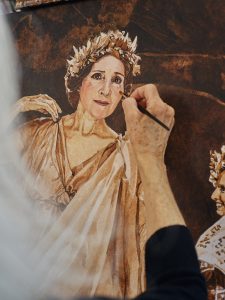
Image Source: Eden Schwinghamer and Linda Kooluris Dobbs
What is something you’d change about your life?
I wish I was more confident from a younger age, to feel more self-confidence would have changed everything, from early relationships with boys to my own feelings of security. I had a friend, Neil Eric Weiss, we were in art school together, he was an amazing graphic designer. He was one of those super self-confident people who would just say what he thought he was worth when we first started selling our illustrations out of art school. He died of AIDS now, but I always admired his confidence and secure sense of self.
Something I would never change is my fearlessness! I was always willing to take on anything and jump into a project head first! I’d ask any professional or expert I’d need to in order to get the job done. When I was in Montreal, an art director got in touch with me and she said she never forgot me, Eric and Mary Anne Kowalski when we walked into the Montreal Star and we just believed everybody would love us! I would never take that away from myself!
You are truly such a lifelong learner.
You have to be the fool at first to get over any artistic hump and learn something new! I’ve been a fool all my life! You have to make blunders and mistakes, it helps you absorb new knowledge, and the great part is, you probably won’t make those same mistakes again.
You have a kindred spirit, a timeless energy to your soul. It seems as though when people age there is a temptation to shut out the world. How do you stay so active and up to date, not just in knowledge, but in attitude to life and the world? How have you preserved that zest for life?
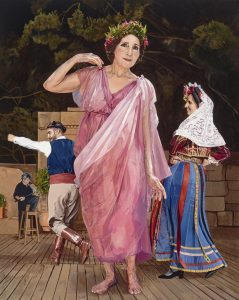
Image Source: Eden Schwinghamer and Linda Kooluris Dobbs
People can get pretty reclusive, and I don’t want to become that person. Luckily, in my family I never had the example of a bitter old person. My great aunt Aida teamed up with a friend and they hung out like Harold and Maud going to concerts and country houses. My parents never walked slumped over like old people, my father walked with a pep in his step, and I’m sure my mother would have danced right off the face of this earth if she could have. Fortunately for me, I had this lively example of how to age with so much zest for life! I don’t want to be a lonely person. If you don’t have children, and I don’t, it can get lonely because all your contemporaries are with their families, and that’s a problem, but I never had the calling to have a child, but it’s ok, because you make friends, you go out, you find and create your own community.
For reference, when Linda and I have met up for coffee, her phone goes off so incredibly often with friends and acquaintances checking up on her, confirming meetings, and making plans! As an outsider looking in, she is definitely the life of the party! She goes on:
Young people tell me, “I want to be just like you when I grow up.” They can’t believe I’m 77. In a previous apartment, I had a friend, Edna, she was 86, and I asked her, “Edna, tell me the truth, how old do you feel inside?” and she said, “Twenty.” My inner self is not an old woman! I had a terrible experience in the hospital when I hurt my arm badly in Greece, when I had to be bathed by nurses, and I realized… This is what it’s like to be an old person. And I do not want to be like this, as long as I can I’ll be active. My friend Wendy came to get me, and she said, “Linda is a very bad patient, she leaped and bounded her way off the plane and up the stairs!” It’s in my nature. My husband used to call me “a fast moving object.” It’s what got me into trouble with my arm, but it’s part of who I am and the enthusiasm in my spirit.
Do you remember an “aha moment”, or a turning point in your life? A defining moment that shaped your future?
When I was attending The School of Visual Arts in New York, I used to go to classes with the instructors, and I always remember how in awe they were of how I went about painting. Considering what that other teacher said, and the ebbs of self-confidence in my younger years, it helped me with my self-confidence. I have flaws as an artist, and a lot of people can do a lot of things better than me, but when I go to sleep at night, when it comes to my paintings, I feel confident that I know when a painting is finished and it has all the integrity I can possibly put in it.
It’s a cliché question, but it has to be asked: what would you tell young people today, from such a wise, admirable perspective?
Don’t be influenced by the crowd! Think for yourself. Get your information from several sources so you can make up your own opinion. Don’t let people put you down, question them! Act in the moment! It’s hard when you’re young, you always want to be liked. For me having been a teacher, and as I’ve gotten older, I’ve gotten better at calling people out on their behaviour. I don’t care about being liked, I care that I’m giving people what they need. And be sure to develop your own skills! Whatever it may be, whether it’s being a plumber, author, artist — whatever it is, build it! You will gain a baseline of self-confidence that will follow you all throughout your life.
You don’t have to answer for anyone but yourself!
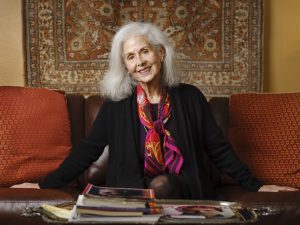
Image Source: Eden Schwinghamer and Linda Kooluris Dobbs
The life of Linda Koolris Dobbs is an inspiration. She continues to paint and explore Toronto with her camera, ready to capture humanity in moments. So next time you’re in Queens Park or the University of Toronto look out for her portraits, you might just get a taste of her remarkable presence.