CW: General Discussion of Suicide and Violent Deaths
Although it is a cliche to say, death is an inevitable part of life. An individual’s relationship with death will differ based on things like culture, religion, and lived experience. The ways we cope with losses have changed dramatically over time, particularly with globalization and the increased prevalence of death in our daily consumption of media. According to John Tercier in “The Pornography of Death” chapter of Pornographic Art and the Aesthetics of Pornography, the average American has seen countless on- screen deaths but has never stood at a deathbed. This begs the question; what do we know about dying? Globalization, defined by Anthony Giddens is the “intensification of worldwide social relations which link distant localities in such a way that local happenings are shaped by events happening many miles away and vice versa” (pp. 254). Throughout this article, I will discuss how I believe that globalization, social media, and spectacle are at the root of our relationships with death being shaped by sensationalized/politicized happenings all over the world rather than immediate deaths, in the community, right in front of us.
Joe Amato summarizes Philippe Ariès’ arguments about how death has been constructed in the past in Western Christian societies. Our previous cultural perception of the soul as immortal and how all of our actions on earth are towards the inevitable death of our bodies made death a lot more accepted. He talks of how we had “tamed” death, and made facing it more tolerable through the comfort of religion. This has shifted over time with the transformation of culture to be more individualistic and less communal so that death is no longer something accepted as a part of life but rather something alien and separate from everyday happenings.
I would argue that this has impacted the portrayal of deaths in media as something “other than life” rather than a natural part of it as evidenced by the lack of natural deaths in the media. We do not often think about how our life will come to a natural conclusion, due to our exposure to deaths that are harsh, sudden, and unforeseen. We do not cope with the reality that we are going to die, so when we are faced with age, sickness, and dying, will we be prepared to face it?
Tercier talks about how Geoffery Gorer compared modern representations of death to be more akin to pornography, offering dramatized portrayals of violence and blunting the viewer’s sensitivity. Think back to the media you have consumed in the past couple of weeks and how that media has dealt with death. Was it natural death at the end of life? Or was it a news report showing thousands of deaths across the world, a television show depicting a murder, or a movie where the main character kills faceless bad guys?

Person with a bowl of popcorn watching television Source Andrea Piacquadio: https://www.pexels.com/photo/man-with-a-bowl-of-popcorn-watching-tv-at-home-3811867/
Source Andrea Piacquadio https://www.pexels.com/photo/man-with-a-bowl-of-popcorn-watching-tv-at-home-3811867/
80% of deaths on television are violent deaths, this makes me think that we have not accepted death by portraying it so often, but rather sensationalized it and made it something else entirely, severing it from our daily lives and contemplations. Ariès says that ordinary death is not surprising, we are familiar with death. My question is, why are we hiding from portraying this relationship with a death that most of us will face in exchange for a dramatized, violent death?
Joe Stratton quotes Guy Debord on the concept of “The Spectacle”, saying “in societies dominated by modern conditions of production, life is presented as an immense accumulation of spectacles. Everything that was directly lived has receded into a representation.” Death is played as theatre, as a means of furthering a plot or agenda rather than an event that is a milestone worthy of exploration in itself, like having a child or falling in love. We hide real death away in hospitals and allow sensationalized death to take over our screens. When death is hidden or viewed from afar rather than felt, or lived, that person’s life is incorporated into the spectacle. I think an excellent example of this is true crime. We are not particularly invested in the victim/victims’ character, or the impact that their life had on the world, but rather the violence of the crime, the personality of the perpetrator, the spectacle of it all. We watch these horrible things happen because the dead are not like us, they are part of the spectacle, and they are, according to Gorer, pornography. Violent death is a form of death we can swallow because it is not encroaching on us, it is likely not similar to the deaths we see in our real life, it is “content” like television or movies.
Social media mediates this pseudo world, it makes death unreal, no longer social, a hidden affair with no distinction or prejudice. Real people dying in wars or being murdered by serial killers are no longer distinguished in our minds from characters dying on scripted TV. Sumiala and Tikka talk about how through social media people are not drawn together based on location but rather form communities based on symbolic communication practices, meaning we imagine others like ourselves when interacting with people in the media. YouTube, for example, can draw people together from different cultures and backgrounds through visual representations of violence creating globalized communities of fear and horror (the article uses school shootings as an example). Our comfort in the performance of violent acts/death perpetuates the avoidance of the fact that our life will likely come to a natural and expected conclusion. We are comfortable following true crime cases or violent global conflicts with a ghoulish interest, but are we comfortable dying alongside our loved ones? Facing a slow and expected fade into the unknown? I would argue that we are not.
Another way we hide “natural” death from the eyes of the public is by relegating the sick and dying to hospitals, we shy away from the moment of death, and we manicure the dead to look like they are asleep. The pornographic spectacle of death is much easier to stomach than the actual death most of us will face; it is more socially acceptable to closely follow a murder case happening on the other side of the world than to gather around the deathbed of someone dying peacefully in our community.
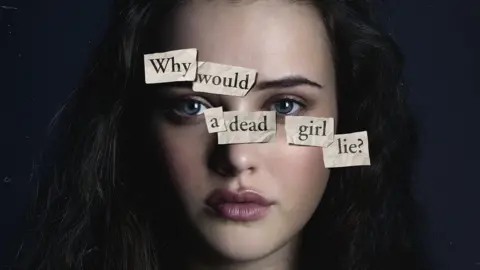
Netflix poster for the show “Thirteen Reasons Why” Source: BBC News from Netflix: https://www.bbc.com/news/newsbeat-43514605
A consequence of this blurred line between real death and scripted, violent death, is that if we are raised without a distinction between the two, death becomes romanticized and fetishized to those who have not come in contact with it in real life. I think of the Netflix television show Thirteen Reasons Why, in which the main character takes her own life, and leaves messages to the people she considers responsible for her death. I was in middle school when the first season of this show came out, and my school had released a notice about mental health and resources to contact if you are considering suicide, as there had been in increase in teens who had tried to harm themselves since the show’s release.
This makes sense if you consider that these young people, with no concept of death outside of these symbolic representations, have just been given a message that their death can be something bigger than themselves, they too can be incorporated into The Spectacle, by dying a death which is not real to them. Death is a performance to someone who has not been made aware of its permanence, and it is no fault of these teens who, when faced with violent television deaths and media coverage of violent crimes, turn their death into content, another story to shape this globalized, unreal world.
However, those who have been touched by death know that it is real. It is painful. It is permanent. It is time we explore death for what it is, a part of life rather than something “other”. We gawk at mass destruction and murder across the earth without interrogating our relationship with loss in our everyday lives. It is easier for us to use deaths happening across the globe as “representations” or “symbols” of our values and arguments, the horror and violence being a point of fascination, disgust, and shock. Still we forget that to someone out there, that death is not just a story, but something deeply personal and tragic. We must look around us, at the people in our lives, and prepare ourselves for the inevitable end. We all have a part in creating this “representation” of death based on the stories we spread and engage with. If we start engaging with the people in our lives and the end of life locally, rather than engaging with the globalized spectacle, maybe we will be a bit more prepared when the time comes, and death claims us or those close to us.
Cover Image by: Cottonbro studio
https://www.pexels.com/photo/body-marking-on-the-pavement-of-the-crime-scene-10464545/