Kate Carter is a creative arts instructor at Yorkville University and a practicing artist, mostly working with textiles, who often jokes about being a metaphysical knitter. With her background in education, she developed a new course called “arts, activism, and social engagement.” In this interview, we shall dive deep into the main question of the course: Does art need to be useful?
Why did you want to put this course in the Bachelor of Creative Arts?
Last year, 2025, our program chair, Sandy Carson, approached me about co-authoring a new course: an activism course. And I will tell you quietly that the university administration was a bit nervous about it. We had to reassure them that we weren’t going to be teaching people how to protest since that wasn’t the objective. Sandy’s solution was to frame the course around this debate between Jean Paul Sartre and Theodor Adorno, around whether or not art should be useful.
There’s been a ton of academic debate around is all art political. A lot of people argue that art is innately political, whether the content is or not, just because art is created within a political system. So that’s one question we had to address. Should art be political? Should art be useful? And that’s where we come back to the Sartre versus Adorno [conversation.]
Yes, please tell me more about these two people.
As you know, it’s not that we wanted to start off with two old white guys. But it did create this interesting tension for the whole course. Following World War II, Jean-Paul Sartre released some writing, talking about how all art must be committed. Your art must be committed to a cause, essentially. And, he was speaking mostly about literature, so we’ve kind of extrapolated it to be more broadly about the arts. It’s important to note historically that they were both reflecting on the horrors of the Holocaust, which had been revealed to the world following the end of World War II, and Sartre’s response was to say that every artist has an obligation to use their work to promote the freedom of their fellow human beings. He used quite militant language, and that put a lot of people off. “If I am given this world with its injustices, it is not so that I might contemplate them coldly, but that I might animate them with my indignation, that I might disclose them and create them with their nature as injustices.” (Jean-Paul Sartre, 1947)
I think that he’s trying to suggest that artists, writers and creatives are uniquely positioned to talk about that stuff because it’s kind of what we do anyway. It’s our bread and butter. We’re sort of looking around the world, looking at life, and we’re making creative work about it. Sartre’s vision of committed art is really narrow and prescriptive. That’s the opposite of freedom of expression. He goes so far as to say, if you’re not calling out oppression, you’re no better than the oppressor. That’s not a lot of room for creative folks who need a lot of room to work through their ideas and express them in their own ways…
Adorno, he wrote in direct response to Sartre, which is a super like philosopher thing to do, where they have these like arguments through published work. He published a response criticizing Sartre’s position, saying that committed art is no different than political slogans. That if your artwork is telling people what to think, that’s still a pedantic message that doesn’t leave any room for critical response on the part of the person reading it or seeing it.
Adorno argued for autonomous art. “Art is not a matter of pointing up alternatives, but rather of resisting solely through artistic form the course of the world, which continues to hold a pistol to the head of human beings, to the heads of human beings.” (Theodor W. Adorno, 1962)
He’s a big proponent of abstract expressionism, which was the big American movement. New York was kind of the center of that in the mid-19th, mid-20th century, 1950s. And that the existence of that kind of artwork is a truer reflection of the nature of the world, and can be an alternative for all of us, when you know he’s saying this world keeps holding a pistol to our heads. We don’t need art to tell us what to do or tell us what to think. My one caution around Adorno is always that idea of accessibility. He was speaking to a small group of very privileged people who were mostly white men, and was a proponent of artwork that was totally just the world of white men at that time. Moving into the 50s and 60s, and I’ll use abstract expressionism again, but even the stuff that followed abstract expressionism, post painter’s abstraction, there were not a lot of women, not a lot of people of colour doing that kind of work.
While art for art’s sake is a beautiful idea because it is totally about freedom of expression and, importantly, trusting your audience. Trusting that your audience has agency and intelligence to come to their own decisions about what you’ve made and how they’re going to feel about it and think about it, that you don’t have to just take that “Sartrarian” type stance… Adorno says, trust people to be human and to respond to you, humanly.
“When even genocide becomes cultural property in committed literature, it becomes easier to continue complying with the culture that gave rise to the murder.” (Theodor W. Adorno, 1966) This idea, genocide as cultural property, means you make a painting about genocide, and it’s a committed work of art that is telling people exactly what to think about genocide. He’s like, you are now entering that imagery and that message into cultural form, into cultural memory, and it risks normalizing it, it risks removing the immediacy of that lived experience from the people who are victimized. Who are you to be making art about their pain? and profiting in some way from something that’s not yours? Is that actually honouring what they went through?
Do you have any examples for Sartre and examples for Adorno?
Ruth Cuthand. “Don’t drink, don’t breathe.” She is a First Nations artist who lives in Saskatchewan and does a lot of beading. She uses materials that have a cultural connection to her indigeneity and to Indigenous women, because beading was a practice traditionally done by women to embellish clothing, not just clothing, like medicine bags, all of these things. And then there were also economic uses where Indigenous women could have their own source of income by selling their beadwork to sellers. In this project, she beaded waterborne viruses and displayed them in glasses. The glasses are actually full of resin, but they’re made to look like water on a table covered in a blue tarp.

Don’t breathe, don’t drink by Ruth Cuthand (Image source: Galleries West)
They were using blue tarps to cover their roofs because they were falling apart, and the boiled water, the number of cups on the table, matched the number of boiled water advisories that were in effect at that time. It’s a specific work of art speaking to a social issue that’s anchored in Canadian politics. Definitely committed. The title is a strong message. Your air is full of mold, and your water is full of toxins and bacteria that will make you sick. It’s a very clear statement about the way First Nations folks are being treated on reserve in terms of the responsibility of the federal government to make sure that they have proper housing and access to clean water, like the government is dropping the ball, basically.
Nadia Meyer is also an Indigenous woman. She works in Montreal, and she did a project called “Indian Act” (2002) where she beaded over the entire document of the Indian Act, which in Canada, it’s still called that. It is the piece of legislation that controlled and continues to control First Nations people’s lives in Canada. She printed out the entire legal document, [put] bead over it, and she did this with the community of people helping her. A lot of First Nations folks came and donated their time to help her bead this project.
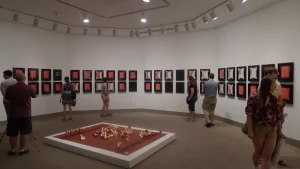
Indian Act (Image source: Nadia Myre.net)
All of the text got covered with white beads, and then the background of the document was covered with red beads. You have this visual code that’s not hard to interpret, that the text is the language of the white man, so it gets the white beads, and the background being red is of the First Nations peoples, sort of enacting that law to control everything that they do, restricting their access. And they’re human rights. It’s overtly political. Pretty committed. Those, I would say, are pretty “Sartrarian”.
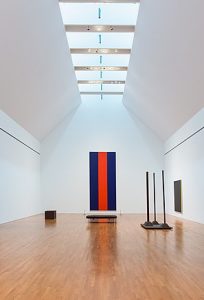
Voice of Fire by Barnett Newman (Image source: Plymouth State University Library)
Luanne Martineau, she’s a Canadian artist also based in Montreal. She teaches at Concordia University. She’s from Saskatchewan, grew up in the 70s. This piece is called “Parasite Buttress” (2005). At this point in her career, she was working with a lot of industrial felt and felting techniques. She would probably argue this is anti-Adorno, but it also kind of proves Adorno’s point because this is extremely abstract. If you had to just describe that to somebody… It’s roughly edges, weird globule forms… It looks like a piece of felted bacon. But what she was actually referencing is “Voice of Fire” by Barnett Newman. This is post-painterly abstraction and minimalism, the kind of stuff that Adorno champions. For Barnett Newman, it had spiritual connotations, and it was a protest against the Vietnam War. But when you just look at it, it’s three stripes of colour.
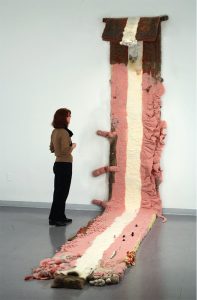
Parasite Buttress by Luanne Martineau (Image source: Sculpture magazine)
At first glance, we could say that “Parasite Buttress” is equally as abstract. It’s not meant to signify anything specific, but there’s a little bit more to work with in Martineau’s piece than in Voice of Fire. This is actually a criticism of post-painting abstraction. She’s criticizing that because that boys’ club had a negative influence on the art culture in Saskatchewan when she was growing up, that everybody wanted to be the next Barnett Newman, and Clement Greenberg actually went to Saskatchewan to foster that kind of painting there when things were losing steam in New York. So for her, she felt the impact on folk artists, on artisans, people doing craft based work. Clement brought his boys club to her world, and she resented the hell out of it, so she made pieces like this, where she made modernism fleshy on purpose. These are supposed to be penises hanging off the edges. It’s kind of gross when you really start to get close to it. Everything starts to kind of look like organs. She kind of bridges that divide a little bit, but I would say, whether she means to or not, it’s still kind of “Adornoan”. It’s telling us what she thinks about modernism.
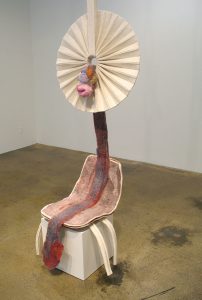
Form Fantasy, by Luanne Martineau (Image source: Sculpture magazine)
“Form Fantasy” (2009) It’s a chair totally made of industrial felt that is suspended from the ceiling. This is kind of shaped like mid-century modern furniture. But without support, there’s nothing. It collapses into these random shapes. At this point in her career, she was sort of creating a body of work that was critical of the sexism of the 1950s art world. She used materials intentionally, attached to women’s work. It was a clear feminist decision on her part. But if you don’t know what you’re looking at, it’s totally abstract art. She’s not telling us what to think. She’s telling us what she thinks. In terms of totally “Adornoan” artwork, it would be something like “Voice of Fire.”
What role does art play in our current political climate? Should it even have a role?
I mean, I’m totally biased because I’m, like, yes. This is my protest hat. I knit it last week or two weeks ago in support of folks in Minnesota. An anti-ICE protest. These red hats and specific patterns are from World War II, from Norway. They were worn under Nazi occupation, as a silent protest, because these are traditional little folklore characters who could do good or do evil, but they all wore red. They were these mischievous little helpers or hinderers. At first, the Nazis didn’t know. But then they figured it out, so a red toque would be confiscated, and you’d be arrested.
In Minnesota, a month and a half ago, when everything started going horribly sideways with ICE in Minneapolis, knitters started to fundraise, selling the patterns to then donate to anti-ICE community organizations supporting the immigrant communities and to date, the last I saw, they’ve raised $650,000 through knitting pattern sales. Five dollars for this knitting pattern. Red yarn is selling out everywhere, much like when [Donald] Trump was first elected president, in the women’s March, a lot of women knit their own pussy hats. You couldn’t get pink yarn anywhere. I personally think yes. It’s not an obligation, though. It’s not a “Sartrarian”. Inevitably, the art of the time will reflect the politics of the time, and in the future, help those historians to understand how we were all feeling about this stuff, how we were managing it.
I personally do think that part has an important role to play, but I really like stuff that’s hidden in plain sight. Like the Nazis, it took them a while to figure out that the hats were a protest against them. It’s in a language they don’t understand. Art is a language. Music, dance, all different forms of performance, through how you write about something, through the visuals. That can be a coded language, right in somebody’s face.
There was an open rehearsal at the Kennedy Center where Trump shut it down for two years because so many artists are backing out of their contracts to perform there. That he’s, well, he needed renovation anyway, so we’re going to close it for two years, but it’s because nobody will play nor perform there.
The cast of Les Misérables at an open rehearsal, the song One Day More, they performed it as One Gay More and transformed all the lyrics so that they were direct criticisms referred to Trump, not by name, but by mannerisms and behaviour. Through art and insisting on queer presence in that space. Have you ever been to a musical, buddy? Do you even know what Les Misérables is about? and what happens to the leaders in the end? Like, hello, it doesn’t work out well for them, but also, you know how many queer people are in music theatre?
Now more than ever, we all need art. It’s not just that we can sort of use our art in a “Sartrarian” way to talk about politics directly, but that we can also use art to defy the chaos, which is part of the strategy to keep us disengaged from the politics that are happening around us. That sort of chaos strategy that we see coming out of the Trump administration, the smoke and mirrors. It’s just never ending. Look at this new horror, new horror, new horror! So finding ways to still be creative is an act of joyful resistance and potentially also community building. I’m just knitting a hat. But you’re not doom scrolling. You’re doing something healthy for yourself in multiple ways. You get a thing at the end, whether it’s political or not, doesn’t really matter. Which is kind of the Adorno approach.
Plus, art is also going to keep a record for historians. Just like the Chilean embroideries. This stuff needs to be documented, but it’s not safe for you to document it in traditional ways. You have to come up with this solution within your own economies, within your own safety zone, within your community of safe people and fellow creators.
Whether or not it’s Sartre or Adorno, deep down, I think it’s time for us to move past that debate. I think there’s a lot of much more interesting nuance now. Don’t tell me what to do. Let me think for myself so that I can decide how I’m going to use my energy, my labour, my attention, while also keeping myself in my community safe. It’s moved into different territory, which is interesting, given that we are in this weird cycle of history repeating.
Do you have one final message to artists after this conversation?
Oh, my God. Oh, my gosh! Make what you want to make. That’s what I’m telling myself these days. I’m working on a new piece, and I don’t even know what this is going to be, but it’s making me happy right now. I’ll give you one little tidbit from my master’s. “You got to make this shit first before you know what it means.” And then once it exists, then you kind of contend with it. See what it was that you have pursued. You know? In the meantime, just make it. Just write. Write it all down.
Featured Image Source: Unsplash