After minutes of me mentally begging time to pass, the bus finally pulls into Wellesley Station with a chuff. It’s a perfect opportunity for me to persuade my mother to hang up the phone. Her worry for me ratchets as the days grow shorter and the frost earnestly creeps up the Toronto sidewalks. I know better than to be annoyed; it’s a sign of love. But I’m in a hurry.
My leather boots are intermittently lit up by the shop signs projected onto the pavement. As I weave through pedestrians and teeter at crosswalks, my eyes track another person rushing down Yonge Street. I tap her on the shoulder to confirm that, yes, we’re both scrambling to get to the 23rd Regent Park Film Festival (RPFF). Thankfully, the screening is still being set up by the time we enter the YMCA. I sneak a peek at the chic T-shirts designed by artist Julien Balbontin, which proudly state “make art accessible”. It’s a fitting slogan.
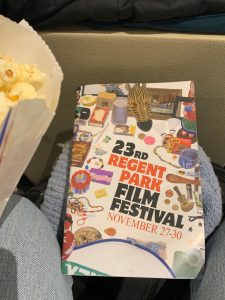
My program and popcorn secured for the Regent Park Film Festival. (Image Source: Sandini Kodikara)
The Regent Park Film Festival has always had free programming, for both adults and children. The festival offers workshops with local artists and opportunities for filmmakers. Most importantly, it has prioritized bringing BIPOC-centred films to marginalized community members since 2003. The current Manager of Programming, Sarah-Tai Black, steps up to the podium after a land acknowledgement to introduce the two films for today, the last screening of the festival.
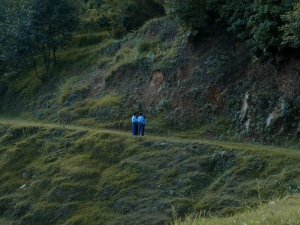
Eternal Kinship (Image Source: Arbin Rai)
Eternal Kinship is only 11 minutes long and has sparse Hindi dialogue, but it doesn’t need more time nor more words. Its beautiful cinematography takes up space in your mind instead. Filmmaker Arbin Rai captures the rippling green hills of rural Nepal under cloudy skies. His subjects, 10-year-old Suresh and his sister, have character colours of blue and red respectively. The tension between the siblings’ bond and the expectations of the outside world is heightened through alternating close-ups and some extreme wide shots. We’re close in on the siblings as they argue about their piggy banks together, but we’re far away when Suresh looks for his sister, his robin’s-egg blue shirt a speck against the vegetation.
The film also sets up a satisfactory problem and a resolution — a small-stakes conflict rooted in childhood anxiety that ties the film together. Suresh realizes that in running away to be married, his sister chose to grow up. That’s a choice he has to make now as well.
We head right into Cutting Through Rocks, which has already been generating buzz over the past year as a potential Oscars contender. The documentary focuses on Sara Shahverdi, a former midwife in Iran’s Zanjan province. Sara runs to become the first councilwoman in her small rural village and is soon elected. The remaining hour chronicles her attempts to enact change and the resistance she faces from male village elders.
The documentary was painstakingly assembled by Sara Khaki and Mohammadreza Eyni, who served as its directors, producers, cinematographers, and editors. The small crew was necessary, as they received hesitant permission to film in intimate locations such as village homes, a girls’ school, and the local courthouse. Furthermore, the documentary took seven years and eight shooting trips to complete. In an interview with Hammer to Nail, Khaki recounts how she discovered Shahverdi through “extensive research.” Khaki and Eyni began filming in 2017, but with each subsequent trip to Iran, new developments in Shahverdi’s life had to be incorporated.

Mohammadreza Eyni (Image Source: Gandom Films Production)

Sara Khaki (Image Source: Gandom Films Production)
Still, I’d argue that although the 95-minute film is full of conflict, its ending leaves me wanting more. It makes me glad that Shahverdi is a real person. Her presence is larger than life. Even the various “side characters” — her nitpicking brothers, her mollifying mother and 12-year-old Fereshte seeking escape from her arranged marriage — are thoroughly established. What audiences can take away from Cutting Through Rocks is that stories about extraordinary people can be found anywhere.
Pairing these two films together was an excellent decision on the part of the RPFF. One topic they both seek to raise awareness about is child marriage. Although Nepal’s Criminal Code Act of 2017 set 20 years as a minimum age for marriage, the country still has one of the highest rates of child marriage in the world. In Iran, young women are the responsibility of their closest male relative and they can be married at 13 years or younger with a guardian’s consent. Cutting Through Rocks portrays young women missing out on education as their parents marry them off, often because they can no longer financially support their child.
Eternal Kinship offers a less examined perspective, that of the love marriage, where underage couples chose elopement over traditionally frowned-upon romance. Ultimately, it’s tradition, legalized or not, that creates the tension in both films, particularly when it comes to the shifting cultural roles of women. Suresh’s older sister has a responsibility to take care of him until she chooses to take on a different role, that of a wife. Sara’s late father is why she rides a motorcycle and knows her way around a construction site. yet these qualities don’t secure her leadership. Instead, they become reasons for her ostracization, even as her womanhood already disqualifies her from respect.
Overall, both films are moving explorations of the interplay between women’s rights and familial expectations.
I stop by the merchandise table one last time before I leave: I can’t help it. The shirts are colourfully embellished with back-of-shelf and bottom-of-purse items from the homes of RPFF members, referencing an aesthetic known as “immigrant clutter core”. Vandana Pawa of Joysauce notes that immigrant households often retain “clutter” as a way of reserving resources in an unfamiliar country or holding onto memories of life before migration. Second-generation immigrants might imitate their parents’ clutter out of comfort. Alternatively, Pawa writes, reconciliation with clutter can become a method of forgiveness, a way to “finally accept their parents for who they are, mess and all.”
I think about the older couples, new parents and diverse friend groups that were seated around me at the screening. Although familial relationships are often defined by tradition, they can persist beyond it or even defy it. Suresh’s sister will always be his, even though, in Nepali marriage custom, she belongs to her husband’s family. Sara builds sisterhood with the other village women and becomes a parental figure to the young girls, even as it exposes her to criticism by her own brothers.
Though others in a cultural group may not recognize unconventional forms of familial love, they remain valuable tools for exposing the prejudices and injustices embedded in tradition. Being “family” isn’t a status automatically granted through blood relation or marriage certificate. Family is built through time and mutual appreciation of character, values and lived experience. The process is often messy, particularly within ethnic communities and households, but the result is a bond stronger than anything formally assigned.
The Regent Park Film Festival (RPFF) is a nonprofit organization committed to accessible film and culture programming since its creation in 2003. RPFF showcases the work of marginalized emerging and established artists and promotes opportunities in the film and TV industries. The 2025 RPFF is the 23rd iteration of the festival and ran from November 27–30.
Eternal Kinship is a 2025 short film by Nepali filmmaker Arbin Rai. It was a nominee at Philadelphia’s Blackstar Film Festival for “Best Short Narrative” and has since been screened at the Nordic International Film Festival, Festival Internacional de Cine de la Provincia de Buenos Aires, and RPFF.
Cutting Through Rocks is a 2025 documentary by Iranian directors Sara Khaki and Mohammadreza Eyni, produced through their company Gandom Films Production. Cutting Through Rocks won the World Cinema Grand Jury Prize: Documentary at the 2025 Sundance Film Festival and had its Canadian premiere at the 2025 Hot Docs Festival. It has also been screened at the New Zealand International Film Festival, Visions du Réel, and RPFF. It began a limited theatrical release on December 5th.