Introduction
I never thought I would be in a position to watch the slow, painful death of women and young girls across an entire country. I didn’t think it was possible. I ask myself constantly how something like this could happen. How could education become so out of reach for women and young girls? How could they be viewed as undeserving of something as beautiful and fulfilling as the act of learning?
I grew up hearing the phrase “children are like sponges, absorbent and retentive.” They learn so much in the first few years of their life, demonstrating a remarkable capacity to absorb information as well as adapt and respond to new experiences. As a result, children must be indulged and nourished. Their questions, curiosities, and universal wonders should always be met with positive responses. Their hopes, dreams, and aspirations should be followed by guidance and encouragement, and when they believe they can’t do something, there should be a voice in their ear telling them they can.
While this sponge metaphor has been mostly associated with children, I don’t think we ever stop being sponges— at least I don’t think I ever did. In the early stages of my childhood, I was intensely curious with a never-ending yearning for knowledge. Something my father was always willing to indulge. I loved math, science, history, and especially English literature. This passion for learning has not left me, even as I enter my twenties.
I believe that education and learning should be endless and never lose importance, especially for women, at any age. I attest this belief to my beloved, longtime hobby of reading.

Image Source: Ava Tsarynnyk
For as long as I can remember, the authors of books I read have secretly disguised the importance of education for women in the novels they wrote. Throughout the fantasy stories of wizards, witches, and magic to the coming of age tales of love, friendship, and family, there are traces found attesting to the importance of education and learning for women and girls.
As a child, I read authors such as Louisa May Alcott and L.M. Montgomery who made it a point to highlight the importance of education for women. Alcott’s world-renowned Little Women paints a picture of a strong female character named Jo who uses education, specifically writing, to shape her life. Writing becomes a way for Jo to assert her independence. She earns her own money through publishing stories, which was a big achievement for women in the 19th century (Chapter 27). In Anne of Green Gables, Anne finds pleasure in thinking “of all the things there are to find out about”, once again showcasing the importance of lifelong learning (Chapter 2).
These little seeds were planted in me from my favourite childhood writers and watered by the authors, I now read as an adult. In Mary Wollstonecraft’s A Vindication of the Rights of Woman, Mary says that strengthening “the female mind by enlarging it…there will be an end to blind obedience” (Chapter 2). Jane Austen in Mansfield Park writes that by “giv[ing] a girl an education and introduc[ing] her properly into the world, and ten to one but she has the means of settling well” (Chapter 5).
As a child, I learned that a girl’s education and learning, in its many forms from reading, writing, and questioning, were something to take pride in, cherish, and preserve. As an adult, the novels I now read preach the same message: that education and learning for a woman is something to be indulged in. It’s a never ending experience.
I now understand that the belief that education is important for a woman has been a universal feeling amongst women for centuries. Additionally, education should also be a universal experience for women, and this made me think of the women less-privileged than me.
I wonder if this is how I feel, and if this is how women from centuries ago felt, how are the women of Afghanistan feeling? And what happens now that their education has been halted?

Image Source: Ava Tsarynnyk
Where are Afghan Women?
From the early hours of the morning into the quiet hours of the evening, shadows of blue will walk the streets of Afghanistan’s cities. Men will roam, drive, walk, talk, and laugh. Shopkeepers will sell their goods and children will run and play. But where are the women to be seen?
The city is empty of them.
The shadows continue through the streets— azure, indigo, cobalt. Some will follow the men, while others will roam with the little peace and freedom they have left. Silent, ignored, invisible, the shadows move through the bustling city streets like ghosts. They don’t laugh, they don’t speak.
But, they whisper. To one another. Amongst each other. These are the women of Afghanistan.
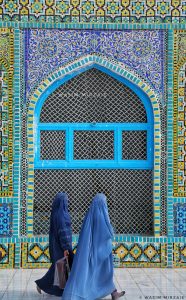
Two women walk past the Blue Mosque (Shrine of Hazrat Ali) in Mazar-i-Sharif, Afghanistan. (Image Source: Pexels)
Afghanistan’s Fall to the Taliban
On the morning of August 15th 2021, the city of Kabul was met with the arrival of the Taliban at their front gates. By nightfall, Afghan president, Ashraf Ghani, and his vice president had fled the country, while the Taliban would seize the presidential palace. In just a matter of days, the Taliban had gone from capturing their first provincial capital to establishing a new Islamic Emirate in Afghanistan.
After almost four years of regaining power in Afghanistan, the Taliban has created the most consequential women’s rights crisis the world has ever seen. The Taliban’s promises of progressiveness and inclusion, an idyllic future where women are active in society and working shoulder to shoulder with men, were quickly dismantled by their oppressive impositions on the lives of girls and women across the entire country.
Within a matter of weeks, female journalists, judges, lawyers, medical workers and business owners were pushed out of their professions. Restrictions were placed on women’s freedom of movement, and rules instated detailing how far they were allowed to travel without a male guardian. Strict restrictions on women were established within areas of work, movement, public life, and media, all areas that affect the course of a woman’s life.
The Taliban, however, did not stop here. Their restrictions stretched into other areas of life too, such as political and civic participation, and mandatory face veiling. Women could no longer be a part of the Taliban’s cabinet or uphold any major government roles. Women’s rights commissions, shelters, and legal aid centres were closed. Women were ordered to dress in head-to-coverings, risking imprisonment , punishment from male guardians, and public shaming if they failed to comply.
Throughout these four years and the multitude of rules and regulations established, the Taliban have now effectively systemically erased Afghan women and girls from public life. However, out of all the things that I have named, the one that I have missed, which binds all of these issues together is education.
The education of women and girls has been treated as a parasite that needs to be eradicated. Girls have been barred from schooling past the sixth grade level, while women have been banned from attending university and can no longer study abroad.
Nazaneen, 16, is one of the many secondary school girls that was banned from school when the Taliban reinstated their reign over the country.
“It was a black day when the schools were closed. We had exams but my mother said we couldn’t go to school because they were closed. That was the day my heart broke. Whenever I think about that day, I cry because it was the day that my future and hopes disappeared.”
Another young woman in Afghanistan recounts the day the Taliban prohibited women from attending university.
“We saw the Taliban were there and only allowed male students to enter,” Parnian recalls. “I wanted to go inside the university, and at that moment, one of the Taliban fighters pointed his gun towards me.”
Shortly after, the Taliban’s Higher Education Ministry Spokesperson posted an image on social media instructing all public and private universities and educational institutions to suspend access to female students immediately.
Why is this the case? Again, I ask this question. How can women and girls be viewed as so undeserving of education?
A History of Women’s Education
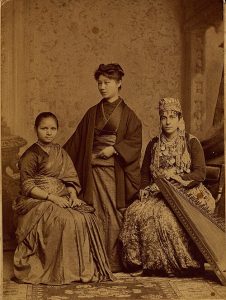
Anandibai Joshee from India (left) with Kei Okami from Japan (center) and Sabat Islambooly from Syria (right). Three women who completed their medical studies and were the first to do so in their respective countries. (Image Source: Wikimedia Commons)
Although the issues taking place in Afghanistan are considered one of the most extreme documented cases of crimes against women and girls, the prohibition of education on women is a recurrent theme throughout history. For centuries, many societies across the world have implemented restrictions on formal education for women, with the reasoning often being rooted in cultural, religious, or political beliefs about gender roles.
In many ancient civilizations, education for girls was limited and focused exclusively on boys. Instead of formal education, girls were taught basic and domestic-oriented skills by other women of the family, such as sewing or cooking. By the late 19th and early 20th century, significant progress was made in women’s educational rights, with more women attending colleges and universities.
However, the belief that a woman’s place was inside the house was still deeply ingrained and used against women to limit their access to higher education. Women faced cultural expectations that their primary roles involved being a wife and mother. Discriminatory practices were implemented to keep education limited to preparation for marriage and motherhood, along with medical misconceptions that rigorous academic work could harm a woman’s health.
By the 21st century, female education has made remarkable progress, with more girls enrolling in primary and secondary school, as well as higher education. However, serious challenges still remain. While millions of girls across the world are actively pursuing an education, at present, girls in Afghanistan have been barred from obtaining a formal education. While this seems shocking, it is not the first time such extremes have been put in place.
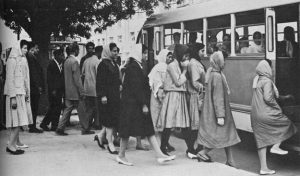
Kabul, late 1950s-early 1960s. (Image Source: Wikimedia Commons)
The First Taliban Regime
On September 27th, 1996, almost 30 years before the current events taking place in Afghanistan, the Taliban captured Kabul. In a matter of days, they would showcase their plans for women and girls within the newly established Islamic Emirate of Afghanistan, foreshadowing one of the most extreme and systematized cases of women’s rights violations to take place over the next several decades.
The Taliban’s original regime took place from 1996 to 2001, which implemented highly restrictive policies surrounding women’s and young girls’ education. Before the militant group seized control of Kabul, girls made up over half of the student population. However, as the Taliban took over towns and villages in 1994, such as Kandahar, they imposed strict interpretations of Sharia law, one of which included shutting down girls’ schools in these newly controlled areas. At this point, the banning was regional, not yet national. It wasn’t until after they captured Kabul in September 1996 that the ban would become nationwide and an official policy across the majority of the country. Women and girls caught teaching, attempting to attend school, or simply carrying books were punished, as doing so was now considered an act of transgression. Women’s voices no longer existed in the conversations surrounding their education.
What Happens When Women Stop Being Educated?
When a woman is not educated, decisions are made for her, not by her. The consequences of this are far-reaching and pervade every aspect of her life.
It begins as isolation and loss of independence. Without education, many women are excluded from public life and confined to their homes. Rather than read and write, women are limited to responsibilities traditionally associated with the home. They are then discouraged or forbidden from going out alone, restricting not only physical stimulation but intellectual stimulation too, as they are not introduced to new ideas, information, or opportunities. Moreover, women are deprived of familial and platonic relationships, unable to form new connections or engage in environments where communal learning takes place.
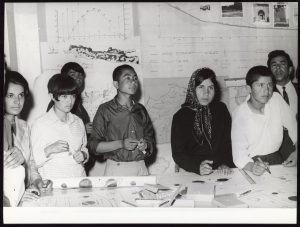
School in Kabul, 1968. (Image Source: Wikimedia Commons)
For Asiya and many girls like her, autonomy is lost in a sea of caregiving, homemaking, and nurturing family life.
“This is my message for the world: I used to be holding a pen and book and now I’m holding a broom – it’s a symbol of hopelessness,” she says. “For anyone who is seeing me and hearing me, please give equal rights to boys and girls for education. Please reopen our schools. We want to go back to school.”
When a woman’s mind becomes crowded with the hows of taking care of children and what needs to be done to keep the household running, it leaves little to no room for her personal and intellectual growth. Education provides us with so much, including critical thinking skills, confidence, self-worth, agency, and the development of values. Without it, we lack a sense of self, are unable to make our own decisions and become dependent on our counterparts. This can perpetuate a cycle of internalized helplessness and loss of autonomy.
Furthermore, as the gap between women and education broadens, women with no formal education are significantly more likely to experience child, early, and forced marriages, as well as intimate partner violence, than those who have attained secondary education. Education challenges harmful gender norms and stimulates questions, conversation, and examination of current worldviews surrounding women and their place in the world, especially their place in comparison to men.
A 15-year-old Asma dreamt of a future full of endless opportunities. Once a secondary school student told “It’s better to get on with your life and get married,” she is now 18, married, and expecting her first child.
“When I discovered my baby is going to be a girl, the world became dark before my eyes because being a girl here in Afghanistan is not worth it,” Asma said. “She will never achieve any of her dreams. I wish I was having a boy.”
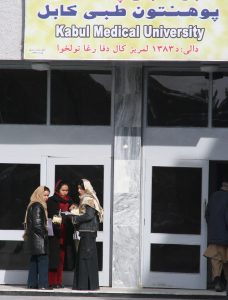
Kabul University Medical School, 2006. (Image Source: Wikimedia Commons)
Education has given women the power to challenge traditional gender roles. Without access to education, it is harder for women to develop personal beliefs and challenge the rules set in place to limit them. When women and young girls cannot learn freely, they are less likely to learn about their rights, gender equality, and what constitutes abuse, which makes them susceptible to harm and violence in many ways. This can range from the internalization of harmful beliefs to the acceptance of traditional patriarchal norms that justify violence. Ultimately, lack of education keeps women silent, docile, and accepting of systems meant to control them.
Moreover, denying women and young girls their educational rights impoverishes the world of their creations. It denies us their creativity, their originality, and their contributions to society. When the gap between women and education is not bridged, the world loses women: women doctors, lawyers, teachers, engineers, politicians, inventors. They become extinct in areas of science, medicine, literature, law, education, activism, and so much more. In an alternate world, had women not been allowed to learn much of the social progress we benefit from today would simply not exist.
Marie Curie was groundbreaking in her success for her work in radioactivity. Ada Lovelace is recognised as the world’s first computer programmer. Savitribai Phule opened India’s first school for girls. Without equal access to education, these women might not have been able to accomplish such meaningful and impactful achievements. If women like Marie, Ada, and Savitribai were able to give us these kinds of contributions, what is the world being deprived of when Afghan women like Asiya who dreamt of being a doctor or Asma who planned to attend university are not allowed to pursue an education?
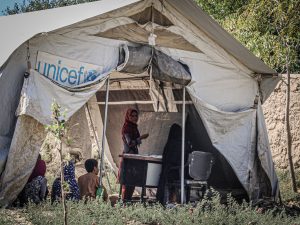
Children attend school in a refugee camp in Afghanistan. (Image Source: Pexels)
I try to imagine myself in the shoes of Asiya and Asma and the millions of others experiencing this tragedy. I try to think of myself now and as a little girl. What would I do? What would I have done? Would I have been quiet or loud in my disapproval? When I try to define myself I struggle to do so without my education. Of course, I can say that I have a deep commitment to empathy, I value compassion and growth, and I am someone who comes alive through storytelling. But there are so many bits and pieces of myself that are irrevocably tied to my education. I am a student, writer, creative, and advocate. I amplify the voices of those unseen and unheard, I write fiction and poetry through a confessional lens, and I advocate for women’s rights.
I am not sure I could label myself as such or have done these things without the help of my educational background. It’s hard for me to think what I would have done–almost painful. I struggle to think of myself without my education. I don’t think I would know who I am.
I believe that not only do we lose Afghan women and young girls like Asiya and Asma, but they lose themselves too. They lose who they are. Their hopes, dreams, and aspirations are crushed under oppressive assumptions of what a woman should be. More importantly, what a traditionalist patriarchal society can force her to be.
Currently, almost 80% of Afghan school-aged girls and young women are out of school, that is 2.5 million people believed to be undeserving of education and their right to learn.
2.5 million dreams lost.
2.5 million opportunities taken away.
2.5 million futures destroyed.
2.5 million women and girls were made voiceless.
Back to the Now
After the Taliban was overthrown in 2001 significant progress would be made over the next 20 years for the education of women and young girls. Young girls slowly returned to primary and secondary schools, universities reopened their doors to women, and a whole generation was able to earn degrees. By 2018, there were 2.5 million girls enrolled in primary school compared to 0 in 2001. Women with higher educational backgrounds grew 20x, from 5000 to 100,000 by 2021. Dreams were restored and recovery was in progress. Women could finally return to a sense of normalcy, the days of being prohibited from learning were a thing of the past.
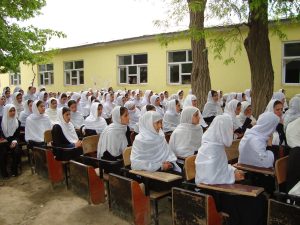
Afghan girls write final exams in Charikar, Parwan province, March 2009. (Image Source: Wikimedia Commons)
Unfortunately, many women who fought for education led classrooms, and served as role models have been forced back into silence. A whole generation of women and young girls who were raised on hope and progression are now finding themselves banned from the same freedoms their mothers had been denied two decades earlier.
Denying education to women and young girls has made significant contributions to generational disparities. Millions of girls were allowed to go to school following the fall of the first Taliban regime in 2001. Flash forward to the present and girls above grade 6 are now banned from school. The current generation has been stripped of the same opportunities as the women before them: their mothers, aunts, and grandmothers. Presently, the older generation must watch their daughters, nieces, and granddaughters be denied the opportunities they had. A generational divide has been created.
Dr. Najmussama Shefajo is one of Afghanistan’s top gynecologists. She has offered crucial services to thousands of women, built a clinic in Kabul, and pioneered advanced medical technology for expectant mothers. She has daughters and hopes their futures are filled with educational and career opportunities similar to hers.
“For my eldest daughter, I want her to be a pilot…for the other’s they are interested to be a doctor…my kids are three, and they should have a bright future.”
An Imagined Future for Afghan Women
Zarifa Ghafari once said “Educate a girl, and you educate a generation.”
When I imagine a future for young Afghan girls, I think of a place where their laughter echoes freely in schools, where classes are full and faces yearn, where pencils and rustling paper fill the silence, and their only worry is the question: “What do you want to be when you grow up?”. When I imagine a future for Afghan women, I like to think of a place with crammed lecture halls and stuffed libraries, where they speak openly and passionately about who they are and what they want to be, not in whispers where no one can see, where their voices are not a rarity but the ordinary.
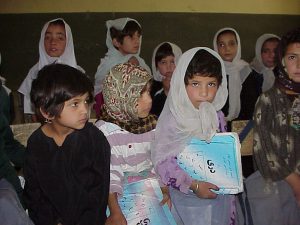
First-grade girls at the Ashaqan Arefan school, July 2002. (Image Source: Wikimedia Commons)
Afghan women and young girls deserve to learn in a place absent of barriers placed before them simply because they were born a woman. Their education should be free of gender inequalities and discriminatory practices. Books should be put in the hands of girls rather than stripped from them. Women should be free to go to school instead of forced to remain within their homes. Pens should be put in their hands and determination in their hearts.
Women and young girls should get to go to school to decide who they want to be, not imprisoned in their homes partaking in what has already been chosen for them.
But what happens if this future is not achieved? Banning girls from school does not only hurt the present generation but disrupts the future generation of women and education as well. The prohibiting of women’s education not only strips them of their current roles as doctors, teachers, lawyers, etc. but it also perpetuates a future where there are fewer women in professional roles. Girls grow up without opportunities and role models, a process which if not changed will repeat itself for years. This cycle of oppression then becomes locked in for decades, to a point where women and girls will no longer know or remember what female representation within society looks like.
Generations of women, and young girls, and their contributions to society will be forgotten. Their only knowledge of women doctors, teachers, and engineers, will be from the word of mouth of those who remembered. Pictures and representation will be painted in their minds by women who knew, passed down by women who never knew until eventually, no one knows.
This is not just a crisis for Afghan women but a problem for all women, everywhere.
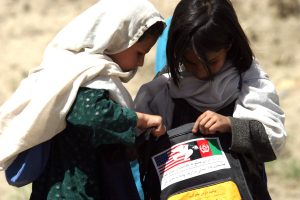
Afghan girls eagerly look through school supplies, May 2004. (Image Source: Wikimedia Commons )
While uncertainty lies ahead for Afghan women, young girls, and their educational rights, I believe a future filled with women politicians, poets, artists, surgeons, architects, and so much more is possible. Women and young girls have proven themselves brave, resilient, and steadfast in their pursuit of the restoration of their educational rights. From protests to secret schools to advocacy, these women have accepted this future for themselves too.
Through persistence in hope, dedication, and courage, I believe education can be possible for generations of women and young girls to come. No longer will education be made possible for one generation and stripped from another. No longer will a mother’s reality be a daughter’s dream. And soon enough, Afghan women’s voices will be for brilliance, not just bravery.
Featured Image Source: Wikimedia Commons