In the early 15th century, English philosopher Francis Bacon developed the “Baconian method,” or what is commonly known today as the “scientific method.” This method established a universal, organized and empirically powerful approach to acquiring knowledge about the natural world. This method would then become the backbone of the successes of the Industrial Revolution and modern science. Objective truth-seeking is the cornerstone of science as we know it, but Bacon’s method — though tremendously influential for its success — fails to provide a framework to understand how social and cultural forces shape scientific knowledge and whose stories are told.
Like most things, the scientific method and how science is taught in educational spaces is shaped by power, biases and layers of intersecting histories that have hindered the full involvement and perspectives of many marginalized groups — including women and gender minorities. Patriarchy is both an ideology and a structural system that upholds men’s domination over women. Bacon, as a white and economically privileged man, and many after him who have also contributed to the scientific tradition, did not understand how patriarchy influences science; they did not understand that scientific truth is greatly influenced by gender, race and class.
Reproductive biology — or the science of how sexual reproduction works — is a prominent field of study where intersections of race, gender and class manifest to shape scientific understanding and consequences — especially for women. Advances in technology, along with more funding and research towards reproductive science in the past few decades, have given scientists a clearer picture of the complexities of the female reproductive system.
Just last year, a ground-breaking study established that hormonal changes during menstruation shape the structural matter of women’s brains and may reflect varied psychological changes throughout one’s hormonal cycle. Studies like this are a testament to the scientific tradition. However, it is equally important to evaluate science through a feminist, non-patriarchal lens. If we don’t, then we not only risk erasing women’s stories but also reinforcing systemic injustices.
How Patriarchy Misrepresents Fertilization
Human fertilization is a series of intricate biological events that lead to a sperm cell (male sex gamete) uniting with an egg (female sex gamete) to eventually form a zygote. As the first cell of a newly formed embryo, the zygote carries genetic material from both parents equally to create a unique genetic combination. The meeting of the parent sex cells happens in the fallopian tubes; the zygotic cells then multiply rapidly, travel down the tubes and eventually implant into the endometrium of the female uterus — a layer of the uterine lining that provides a nutrient-rich and supportive environment for the developing fetus.
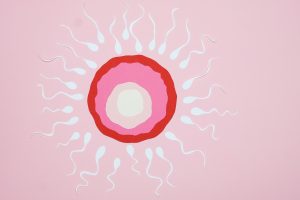
During human fertilization, the sperm must meet the egg in the fallopian tubes. From there, the fertilized entity travels down the tubes towards the uterus, during which its cells rapidly multiply. (Image Source: Pexels)
But what happens before the two cells are fated to meet? The way fertilization works is that the contents of male ejaculate — with each milliliter of semen containing roughly 40-60 million sperm — compete with each other as they transverse the “dangerous” environment of the female reproductive system. The end goal here is to be the strongest sperm — the winner — to reach and fertilize an egg. In high school biology textbooks and even in introductory university courses, students will learn what makes sperm swimmers as they move towards the egg.
Historically, the over-representation of male experiences — also known as androgenic bias — has shaped the language and assumptions used to study and teach reproductive science. In science textbooks around the world, fertilization has been described with a heavily gendered language that conceptualizes the sperm as actively and heroically penetrating the egg, while the egg is presented as a choiceless and passive cell that is waiting for a sperm to claim it.
Whether unintentionally or by patriarchal design, the egg’s role in inducing fertilization is rendered passive through how language imposes gendered ideas on biological events—even when it misrepresents the scientific truth. We simply imagine that the egg sits somewhere, waiting to be penetrated by the lone winner of the race. But it isn’t that simple. And research and scientific knowledge are not untouched by gender stereotypes rooted and reproduced by patriarchy.

Image Source: Chloe Hand
Characterizing the egg as passive and the sperm as strong are not isolated events: they are forms of cultural messaging that echo toxic associations of femininity with passivity, and masculinity with strength and dominance. If young girls and boys learn about their bodies through this anti-scientific framing, then something more sinister than simply misinformation is being normalized: we are risking equating patriarchal propaganda about our bodies with scientific truth.
A 2015 media analysis study explored which popular cultural descriptions, metaphors, themes and languages were used to talk about fertilization. In Brave Sperm and Demure Eggs: Fallopian Gender Politics on YouTube, researcher Pamela Hill Nettleton argues that the dominance and accessibility of digital media as a learning tool creates unprecedented opportunities for patriarchal misinformation about science to circulate.
By analyzing the content of 32 YouTube videos, Nettleton finds that more emphasis is put on the sperm when discussing fertilization, and that sperm are glorified for their almost “militaristic” strength and “vigorous” endurance as they compete with each other to “claim” the egg. Nettleton notes that when the egg of female reproductive anatomy is discussed, it’s very much through a condescending tone that villainizes the female reproductive tract. From the vaginal opening to the fallopian tubes, the sperm must swim “a perilous journey against incredible odds” to survive the “fatal” acidic environment that is the female’s body. A subtle double-standard, but deeply dehumanizing nonetheless.

Social media is a great tool for accessing stories and new science shaping the world. But just like other media, social media can also accelerate and normalize the spread of misinformation about our bodies and experiences. (Image Source: Pexels)
In her book Sperm Counts: Overcome by Man’s Most Precious Fluid, author Lisa Jean Moore argues that the way society views the workings of fertilization is rooted in anthropomorphizing individual cells, treating sperm as if they have conscious motivation and “cellular machismo” as they race to claim the egg. Disturbingly, in scientific media beyond textbooks, metaphors and words denoting wastefulness and unproductivity are used to discuss female menstruation: words like “ceasing,” “dying” and “expelling.” In stark contrast, aspects of male reproduction are understood through a language and lens that emboldens the idea that a man’s masculinity is rooted in his semen: language like “the sheer magnitude” of sperm, which isn’t seen as wasteful, but as “remarkable.” While women “shed eggs,” men “produce” sperm.
Metaphors, analogies and language should bring clarity to our ideas; but when they collide with popular stereotypes about womanhood that deem menstruation as dirty and taboo, then words become a weapon of demonization for women. By creating a culture of secrecy and taboo around normal female experiences such as menstruation, research about menstruation and women’s reproductive health is less likely to receive the same urgency and funding as men’s health.
A Feminist Revision at Fertilization: What Does Science Really Tell Us?
Popular science media tends to forget about the truly consequential role the female egg plays in determining the course of fertilization. Instead of being a passive, choiceless and featureless entity that simply waits for whatever sperm to claim it, the egg assumes an active role in choosing which sperm it will accept and why. Motile bodies, long, strong tails and specialized proteins make sperm successful swimmers. But scientists also continue to discover the many remarkable biological attributes of the female egg that help it choose the right sperm.
In a 2020 study, researchers used a dichotomous mate choice assay — a method used to study mate selection where the egg is given the opportunity to choose between two presented options — to examine whether eggs control which sperm they choose. Normally, a mate choice assay is used in ecology to understand whether size, colour or animal behavior plays a role in shaping which mate a female chooses.
Out of the 40-60 million sperm that enters the female body, only a few make it to the egg. During fertilization, both egg and sperm release chemical signals as a form of communication to help guide sperm towards the egg and ensure a seamless interaction between the two. Chemo-attractants are specific signals released by the egg to attract the healthiest sperm. But little is known about the intricacies of these chemical signal processes.
According to the 2020 study, whether an egg chooses a sperm depends on whether the two cells’ unique chemical signals are compatible with each other. While other factors, such as the amount or quality of chemical signals, play a role, the chemo-attractants specifically released by the egg are a dominant factor in choosing sperm with the most genetic compatibility. In other words, contrary to the popular understanding of fertilization, the egg doesn’t just passively wait for any sperm to penetrate it. Instead, using a variety of chemical compatibility tools, the egg decides which sperm to accept and which to reject.
This study opens up new opportunities for advancing female reproductive science. For example, future studies could try to replicate these results and explore whether chemical-signal compatibility influences the future health of the embryo that results from fertilization. But most importantly, this study encourages greater discourse and appreciation surrounding our female bodies. Knowledge like this, though not perfect, pushes back against centuries of patriarchal misrepresentations of the sheer awesomeness of our bodies.

While most scientific research sits behind a hefty paywall, the 2020 study remains open access. A key part in fighting misinformation is democratizing science and ensuring everyone has access to unbiased information about their bodies. (Image Source: Pexels)
As young learners and future scientists, it’s incredibly important for us to not only share unbiased scientific information and correct myths, but also to re-evaluate how commonly held assumptions about how our bodies work can be shaped by old, patriarchal narratives.
Featured Image Source: Chloe Hand