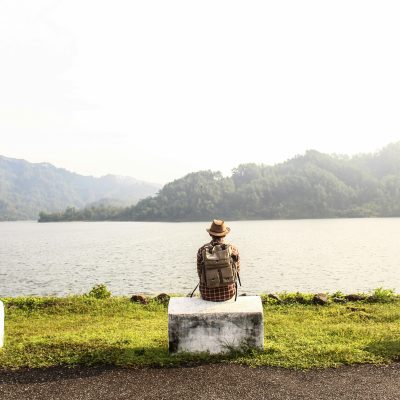
It all started on March 4th, 1987. To most people, it was just another Wednesday — a day for work, school, a day to hang out with friends, or catch a movie. However, for my father, Abdurahman Duldul, it was the day everything changed. It was the day he left Ethiopia and landed in Toronto, stepping into a country that he’d never been to before, but a place he believed was the beginning of a new life. A better life.

Photo by Anurag Jamwal: https://www.pexels.com/photo/romantic-sunset-over-toronto-skyline-33646106/
My father is the oldest of four brothers and five sisters and was the first to leave Addis Ababa, holding the weight of his family’s hopes and dreams on his shoulders. In his eyes, moving to Canada was to be the land of sunshine and rainbows, but in reality was the land of cold feet and busy streets.
My dad was alone in Toronto for two years before he brought the rest of his family to live with him. He had spent two years without my mom, as it took a while to get her papers sorted out in Saudi Arabia. Those two years he spent trying to figure out how to live in a country where he didn’t know anyone. Working multiple jobs to save up for the rest of his family to move in with him.
When my dad tells me these stories, I imagine the loneliness that must’ve filled his one-bedroom apartment. A kettle on the stove, a small velvet notebook for him to write his poems and thoughts into. The sound of the cars in the busy streets of Regal Road. I realize now that those stories aren’t from some fantasy novel; they are part of my family history and journey.
Moving to Canada wasn’t easy for my parents, because moving here had different rules, different traditions, and different people.
Back in Ethiopia, everything circles back to culture. The tribe you are from shapes the way you live – the way you speak, what you eat, how you dress, and who you end up with. For my family, being Harari means understanding the language, knowing the songs, wearing the clothes, and, of course, eating the food. However, when my parents moved to Canada, only a few of those traditions made it along with them. They held onto language and their food — the things that made them feel closest to home, and that they could assure would be passed down and preserved for their children.
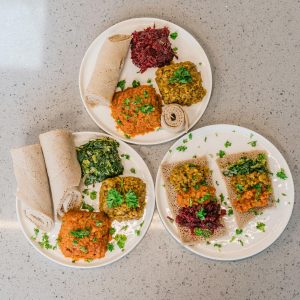
Photo by Deane Bayas: https://www.pexels.com/photo/breakfast-meals-on-plates-17486827/
In my family, that meant eating Ethiopian dishes weekly. My brothers, cousins, aunties, and uncles would sit cross-legged on the floor, roll out a huge rectangular plastic mat to put our food on (called a meekuh), and place one big plate in the centre. The plate was filled with doro wat or hulbut marakh (a spicy chicken stew thick with berbere and warmth) in the centre, with injera, lentils, and other vegetables. Everyone ate with their hands, each person claiming territory based on which corner of the meekuh they were sitting on. This was tradition. This was the tradition back in Addis Ababa, too. No matter where you were, this was the way of eating Ethiopian food. Even now, these family gatherings surrounding food are a way for my parents to bring us into their world.
At home, memory lived in the little things. The smell of berbere and sauteed onions sticking to my clothes. The songs of Atham Addus on our old cd player filling the kitchen as my mom calls us to the dining table to eat. My dad switching from English to gay-sinan to speak with us before we eat dinner.

Our house in Mississauga was a place that my parents built with traditions that one day I will carry with me to my own home too.
Outside those four walls of our home, it wasn’t as easy. It was a whole new world. Taking my cultural food to school wasn’t the same feeling as eating it with my cousins and siblings at home. There were stares and lots of questions.
“What is that? You know there’s pizza in the cafeteria today, right?” I didn’t say much either. “Oh, okay,” I said.
For a while after, I had a fear of eating in public. I eventually began hiding my face in my small Disney princess lunchbox to eat without fearing unnecessary comments or rude stares.
Moments like this put me in a small box that I wasn’t used to. Being uncomfortable with something I was so comfortable with was something I wasn’t expecting. At home, I was surrounded by family who spoke gay-sinan, and I was encouraged to eat with my hands. Yet, outside, I was expected to forget it all.
As I get older, I think about my parents’ legacy, how much it means to them. My father’s long nights alone in the city, and my mom’s effort on keeping our culture alive through food and traditions. Her courage on leaving everything behind and starting over, doesn’t go unnoticed. So everytime I eat kitfo or shurro, or speak gay-sinan to my aunties, or wear my cultural dress and gold neckalaces, I don’t just remember them, I’m continuing what they started.
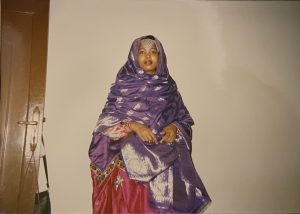
My mother
Maybe that’s what being the daughter of first generation immigrants really means: learning to find beauty in both worlds. Maybe I was meant to grow up here, so I could see and appreciate my culture with my own eyes, as it wasn’t the norm around me. Maybe the racist microaggressions made me stronger and brought me closer to my identity. And, when I dressed in the same traditional dresses my mom and aunties wore to weddings, I didn’t just feel beautiful because of the bright pink colours on my dress or the glimmering gold. I felt beautiful because it reminded me of her, of where I came from.