She sat cross-legged on a fluffy brown, floral-patterned Ethiopian pillow, tugging through long curls until, most days, she got blisters — until she cried. There was a perfection that little girl was chasing, though she couldn’t always name it.
On braid days, she picked out charms with care. Rainbows and sparkly headbands were her favourite in the fifth grade — that says a lot. A new hairstyle each week meant joy and excitement; it meant showing up to school with something proud to show all her friends. Her hair was part of how she existed in the world, how she was seen, and how others noticed her. Her family named her the “Black Rapunzel” — the little Black girl with the freakishly long hair. Her relatives back in Ethiopia would ask her mom how long her hair grew each time they talked.
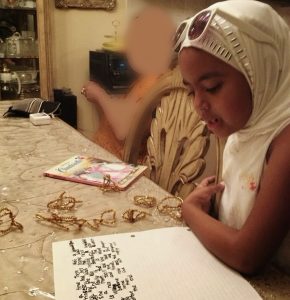
Image Source: Aisha Duldul
But as the years passed, her world began to shift. The whispers from family turned into firm advice: it was time to cover. Time for the hijab.
She wasn’t happy about it, and she certainly wasn’t ready.
What about the hairstyles her mom did for her? The unicorn charms in her box braids? The compliments in the hallways of her middle school? Or the fun times she had flat-ironing her hair? She feared all of that would vanish the moment her hair disappeared beneath a thin piece of fabric.

Image Source: Aisha Duldul
Her older cousin picked out a deep purple two-piece hijab. She wrapped it in paper and handed it right to her. She told her this was the beginning of a very long and tough journey.
For the entirety of sixth and seventh grade, that was the only hijab she wore. She loved it. She felt beautiful and different.
High school was louder, faster and more judgmental. And slowly, that fear she once had started to come true. She was the odd one out, not because of her faith but because of how others saw her.
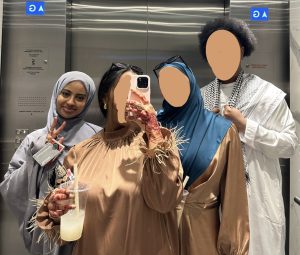
Image Source: Aisha Duldul
The boys she had crushes on? They liked girls who showed their hair. Girls who dressed like they were in a TMZ Magazine shoot, not the ones who walked through the halls with their hijabs pulled tight. She was the only girl in most of her classes who covered. And for the first time, that made her feel exposed.
So she started showing more. Just a little at first.
She stopped fully wrapping her hijab. She plopped it loosely on top of her head, letting a few curls peek out. She swapped her loose jeans for ripped jeans and cropped hoodies. Eventually, her hijab came off entirely, replaced by a beanie and a hood.
It was subtle at first. Little compromises turned into habits, and slowly she became someone she didn’t quite recognize.
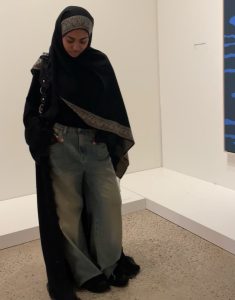
Image Source: Aisha Duldul
It took me years to admit it, but that little girl with the rainbow charms and deep purple hijab? She was me. That’s when I started wearing the hijab again. Properly. But this time, it wasn’t because anyone forced me to. It wasn’t to please my family. I chose it. I chose myself.
I wanted to cover. I wanted to stand out as a representation of Islam. I wanted to take up space, not in spite of my hijab, but because of it. I didn’t mind being the only one covered in the room, because that was what made the hijab so powerful.
I did it for her, the little girl I was, who felt beautiful in her purple two-piece hijab.
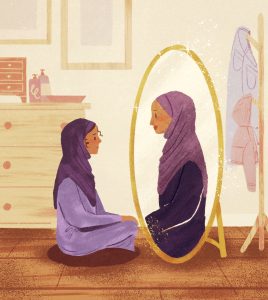
Image Source: Vivian Van
I did it for her, the one who thought she had to shrink herself to be accepted.
I did it for her, the woman I am still becoming.
The first time I wore an abaya — a long, loose dress that drapes down to the ankles — it swayed around my legs like water. The fabric moved wherever I moved, soft and breezy. For the first time in a long time, I didn’t feel the need to shrink into something I wasn’t.
I began to feel beautiful again. And somewhere in that decision, I found the version of myself I had been quietly missing since the sixth grade.
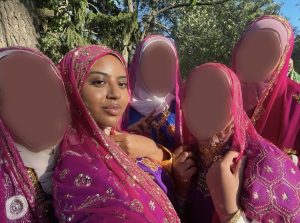
Image Source: Aisha Duldul
Featured Image Source: Vivian Van