When was the last time you saw human trafficking talked about in the media? Was it about the Sean “Diddy” Combs trial? Though this particular trial may seem like an isolated incident of human trafficking, as of 2019, there were an estimated 45 million victims of human trafficking worldwide. In Canada, 90% of human trafficking victims are Canadian citizens, not immigrants. Human trafficking is, therefore, a very common crime that can happen to anyone.
However, in her dissertation for Abraham S. Fischler College of Education and School of Criminal Justice, scholar Alicia Terwilliger points out that there is a lack of data on human trafficking. In the United States, many states only passed legislation that criminalizes human trafficking around 2015, making it difficult to track the prevalence. This means that there have not been nearly as many studies on human trafficking as there should be. If the Diddy case has shown us anything, it’s that social media can spread awareness about the issue of human trafficking. However, this raises the question: is this awareness positive and educational, or more harmful to victims?
When used correctly, social media has the power to educate, aid, and empower individuals. Its outreach is vast, overwhelmingly so, with approximately 5.2 billion users daily, with 82% watching videos and 76% reading the news. Given that social media has a large influence, it makes it the perfect platform for spreading awareness on important issues, such as human trafficking.
In the case of the Diddy trial, social media was both a tool to raise support for victims, while also giving Diddy and his supporters a platform to spread negative ideas capable of endorsing human trafficking. An Instagram post circulating after the trial concluded shared how the internet reacted to the outcome of Diddy’s trial. Most people were astonished that Diddy was not convicted of sex trafficking or racketeering, while also showing support for the victims. This post shows that most of the general public is aware of the severity of human trafficking, despite there not being the legal outcome many were hoping for.
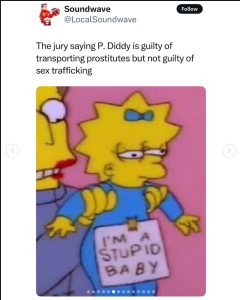
Image source: Instagram post by @rap

Image source: Instagram post by @rap
Despite the support shown for victims, the scope and reach of social media shows there are also some people who have taken to social media to dismiss victims. An Instagram post following the trial shed light on how one of Diddy’s victims fainted following the trial’s outcome. Comments on the post mocked the victim, hinting that she was simply upset she was not awarded millions in settlement as another victim of Diddy’s abuse was. This comment received over 9,000 likes. Though this was likely a joke, it is still harmful that social media is so quick to diminish the experiences that victims and survivors of abuse and human trafficking endure.

This post demonstrates that people in the comment section on Instagram are quick to make jokes about victims rather than showing support (Image source: @theshaderoom, Instagram)
Social Media Villainizes Victims
In more severe cases, people have also used social media platforms such as X, Instagram, TikTok, and YouTube to belittle the victims of Diddy’s trial. These platforms have become spaces for independent content creators to enable harmful narratives surrounding the case and its victims. Influencers such as Myron Gaines, Boosie Badazz, and Greg Adams have used their platforms to challenge the allegations made against Diddy, painting the trial as an attack on powerful men. Victims are depicted as manipulative and money-hungry, in search of fame rather than justice.
Cassie Ventura, one of the most recognizable victims in the trial, has been mocked relentlessly across numerous social media platforms by multiple male influencers. Youtuber, Greg Adams, has pushed back against Cassie’s testimony, stating, “There’s no accountability on her part…Everything is: My brain still ain’t developed, he slipped me a drug, he tricked me…when it should’ve been…I was 21, Diddy was a damn near millionaire kabillionaire, and I was upgrading.” Comments and narratives like this one painted Ventura as an irresponsible, gold-digging woman lacking integrity, while disregarding her pursuit of justice. It also places all blame and responsibility on the women involved for having “put themselves” in a bad situation, when in reality they were manipulated and taken advantage of.
Getting the Right Representation
Social media has also provided countless platforms for people to raise awareness and educate themselves on human trafficking. Nowadays, many TV shows, particularly medical dramas, try to educate viewers on the experiences and realities of victims of human trafficking. The ability to post clips of these shows on YouTube allows people to have online conversations about human trafficking and what can be done to better support victims. The TV show New Amsterdam has an episode in which the doctors and nurses help a human trafficking victim escape her situation, and the perpetrator is caught by the police. In a YouTube short with clips from the episode, most of the comments are about the joy people experience from seeing the victim escape. However, some comments discuss how escaping human trafficking situations may not be as easy as this show portrays. For example, one comment reads, “Only if it was this easy to help the victims of this horrible act.” Nonetheless, most comments on that clip discuss human trafficking in a way that raises awareness and demonstrates how glad most people are that the victim escaped. This shows that social media can help educate people about how to help someone who may show signs of being a victim of human trafficking.
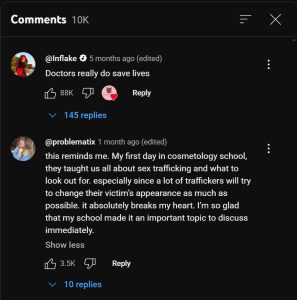
Image source: YouTube comments on a post by @MovieLuxeShorts
In contrast, social media’s reaction to an episode of Grey’s Anatomy that discusses human trafficking shows that social media can contribute to victim-blaming. On YouTube, clips from the Grey’s Anatomy episode depict a young female human trafficking survivor who was coerced via Snapchat. The top comment on this video expresses the disgust the commenter feels after reading other comments that blame the victim for being “stupid.” In the comment, the user says, “Yes, she did something stupid. That doesn’t mean she deserved or was responsible for being trafficked. Putting yourself in a vulnerable position doesn’t equal forfeiting your rights. Saying so is just victim-blaming.” This shows how many people believe the survivor was behaving illogically, which places the blame on the victim rather than the person committing the crime. While this comment highlights that people can use social media to address victim-blaming, many people are quick to victim-blame rather than understand the situation and blame the people involved in the crime.
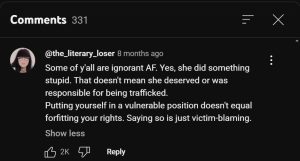
Image source: YouTube comments on a post by @GetawayMovie-k5v
In fact, one of the biggest downsides of social media when it comes to topics of abuse, and specifically human trafficking, is victim-blaming. Academic scholar and Illinois Criminal Justice Information Authority Jaclyn Houston-Kolnik says that “media portrayals of violence against women may also perpetuate victim-blaming because patterns of abuse are normalized and may shape the public’s perception and attitudes of violence against women.” For example, violence against women in TV shows can be normalized by visually showing abuse, such as women getting beat up or strangled. These depictions of violence against women in the media only help to further desensitize people to the horrors of violence women experience in the world. As a result, Houston-Kolnik affirms that portrayals of human trafficking in the media should also focus on survivors as survivors, not victims. Focusing too much on the violence survivors endure creates a disconnect for the audience, as see survivors as victims rather than human.
Gender and sexism play an important role in understanding the validity and misrepresentation of human trafficking victims on social media. Women and girls make up 96% of Canadian human trafficking victims. Although women are statistically the majority of human trafficking victims/survivors, assuming that all victims are women can be harmful to other targeted groups. Many victims of human trafficking identify as LGBTQIA+, and some victims are also men; therefore, proper representation is important in highlighting that human trafficking can affect anyone.
Houston-Kolnik stresses the importance of accurate media representations of human trafficking, as this not only increases knowledge about human trafficking, but also its reality. If people can understand that human trafficking impacts everyone and can happen to anyone, they can notice and help more people – especially those who stray from the “typical victim” portrayal shown in the media. For example, an episode of the TV show Chicago Med represents a male victim of human trafficking. While TV shows may not always represent every aspect of human trafficking accurately, having a diverse presentation of victims sheds light on the reality that anyone can become a victim of human trafficking. In turn, this helps people be more open to seeing warning signs and become more knowledgeable about how to aid anyone in this situation.
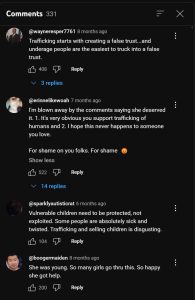
More YouTube comments on the clips from the Grey’s Anatomy episode on human trafficking display victim-blaming, and that most people want to protect youth from human trafficking (Image source: YouTube comments on a post by @GetawayMovie-k5v)
When looking at the responses to human trafficking in social media, it is important to note that the public’s reactions do not happen in a vacuum. People’s responses to celebrity trials, TV shows, movies, and documentaries are shaped by how these issues are represented. The content that social media spreads is already filtered through entertainment media; the ideas, images, and narratives people share about human trafficking often originate from or are shaped by the media they consume.
Fictive media has many strengths when representing human trafficking accurately, such as raising awareness, empowering survivors, educating viewers, and creating public discourse. When done incorrectly, however, it can simplify complex issues, perpetuate stereotypes, promote savior narratives, or favour one group of survivors.
These portrayals become people’s first and strongest reference points when they think about what human trafficking is. Then social media starts to get involved. When these films and shows are released, they garner media attention – people post clips, reactions, hashtags, and takes. However, if the original media was flawed – dramatic, oversimplified, stereotyping, erasure, or objectification – that same flawed view gets spread.
Before diving into what the media can get wrong, let’s take a look at what the media can and has done right. The Sound of Freedom, a 2023 film directed and co-written by Alejandro Monteverde, delves into the subject of child trafficking, urging viewers to pay attention to the ever-growing and urgent problem. In its depiction of trafficking, the film emphasized that trafficking is not a result of simply kidnapping, but a result of calculated grooming as well. A violent kidnapping is not always the way that human trafficking victims fall into these situations, but more commonly, it’s through deception, manipulation, and trust-building through false promises.

Image Source: Theatrical release poster from Wikipedia
The film grossed over $100 million worldwide and created widespread conversation about child trafficking. For example, according to the National Human Trafficking Hotline, there was a reported 1,800% increase in online exploitation reports since 2021, including a significant spike since the film’s release. There was also increased curiosity amongst the public, with Google search data showing a dramatic increase in questions related to human trafficking, exploitation, and ways to assist following the weeks of the film’s release. Moreover, anti-trafficking organisations reported unprecedented visitation to their websites and educational resources. Linda Smith, founder of Shared Hope International, reported “skyrocketing” website numbers in people interested about learning more.:” Similarly, Brittany Dunn, founder of Safe House Project, said that she has been contacted daily since the film’s release with people asking questions and trying to learn more about the issue.

Image Source: JustWatch
In contrast, the film, Taken, starring Liam Neeson, follows a father’s struggle to track down and find his daughter who was kidnapped and forcibly sold into human trafficking. Despite the film’s popularity, making 200 million worldwide, it has become an example of what not to do when handling themes of human trafficking. The film feeds into common misconceptions surrounding the nature of human trafficking, such as its emphasis on human trafficking only being about sexual exploitation, only happening to young women and girls, and traffic-related exploitation being rooted in cultures other than our own.
When human trafficking is portrayed as only a foreign issue, it creates a false sense of security and further promotes stereotypes. What these movies end up doing is making people believe that issues like human trafficking are only a problem in other countries, and that it could never happen in their country. In reality, human trafficking happens everywhere, and it is not always perpetrated by a random stranger, but often by individuals whom the victim knows and trusts.. As a result, these narratives seep into social media and shape public understanding.
In many short clips on YouTube taken from the Taken film, multiple comments express a newly instilled fear when travelling to a foreign country. One comment from the trailer of the film reads “This movie made me scared of when I have a kid that wants to travel abroad.” Another commenter wrote: “My dad is forcing me to watch this movie before I ever travel alone before 25, like okay now I understand.” These comments highlight just how influential TV and film portrayals are in how people view and understand important issues, such as human trafficking, in their lives.
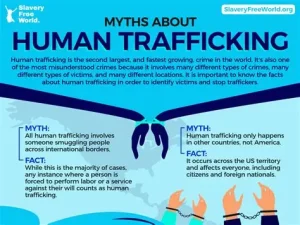
Image Source: Slavery Free World
Moreover, a common theme in social media is the perpetuation of victim blaming, however, the victim-blaming narrative doesn’t simply stem from the comments on social media. It is a trope that has time and time again plagued our television screens, with shows and movies playing into the “she was too naive, it’s her fault trope”. These kinds of stories often frame the victims and survivors’ actions as the main cause of their exploitation. From modelling gigs gone wrong to chatting with strangers online, the victim is painted as being at fault for their circumstances. Films and TV series such as Trust and Law & Order, while not primarily focusing on human trafficking, maintain similar themes of coercion, manipulation, and abuse that victims can experience in cases of sexual exploitation, while simultaneously feeding into a victim-blaming narrative.
In the film Trust , which centres around a young girl who is groomed online and sexually abused by a much older man, the protagonist’s friends and family question whether or not she was truly harmed by her attacker or willingly went with the man.
Similarly, the series Law and Order has been a topic of conversation, surrounding its handling of sexual assault and human trafficking cases. Several critics have noticed instances where the episodes’ narratives have led to a “victim-blaming” perspective, where victims’ actions are portrayed as being contributing factors to the crime.
What results from this is the public’s internalization that human trafficking is a result of being reckless, flirty, clueless, and unintelligent rather than something done through grooming, manipulation, and control. To counteract this, TV shows and films must responsibly portray cases of trafficking and sexual assault by centering the perpetrator’s culpability, and accurately depicting the psychological and complex emotional trauma that survivors endure. To move forward, there needs to be a conscious effort to move away from sensationalism or stereotypical tropes that reduce victims to complicit or irresponsible figures, and instead focus on the resilience, strength, and humanity of survivors.
Safe Space for Victims?
Many scholars and human trafficking survivors agree that social media can be a great tool for educating people. For example, Alicia Terwilliger promotes the use of advertising to spread awareness for human trafficking, as she believes that knowing how to recognize a potential victim or perpetrator can literally save lives. Many human trafficking survivors also appreciate stories of human trafficking that centre the survivors, as they can describe what happened to them more accurately, as well as share more hopeful narratives about escaping human trafficking. Without showing hope for a better future, survivors are only represented as victims when they should be celebrated for being strong and resilient. Though many survivors are aware that a lot of media inaccurately displays human trafficking, Houston-Kolnik writes that inaccurate popular media can be used to educate people. Thus, when media about trafficking becomes popular, people can discuss why it is popular and what about it is inaccurate.
In 2020, a survey conducted by CivicAction Leadership Foundation, found that almost 75% of Canadians believed that trafficking starts with an abduction off the streets, which is a common misconception. In response to these results, CivicAction launched the Under the Influence Campaign, an awareness campaign that partnered with Canadian actor and social media content creator Keara Graves. The campaign consisted of Graves spreading awareness through fictional storytelling on her Instagram, where she went on to highlight how traffickers typically target, lure, and groom victims online. This was a powerful campaign, as teenage girls often spend more than 27 hours a week on the internet, and almost 60% of them have admitted they have a friend online who has done things on social media that are not safe.

Cassandra Harvey, a survivor of human trafficking, shared her story and how she worked with TD’s Reclaim Project to decrease her debt and change her life (Image source: TD Stories)
The media can be helpful in raising awareness for programs that prevent human trafficking. For example, the Region of Waterloo International Airport is creating new rules for employees to better recognize potential victims of human trafficking. The Region of Waterloo Chair stated that human trafficking is one of “the fastest-growing crimes in Canada,” thus emphasizing the importance of taking action. While this particular article does not focus on survivors, it sheds light on the need to take action against human trafficking. It demonstrates that Waterloo is actively raising awareness among airport employees by educating employees and the general public about how to actively prevent human trafficking. It also recognizes the seriousness and reality of human trafficking. This kind of media attention is a step in the right direction to bring more awareness to programs that can help survivors and victims of human trafficking.
When used correctly, social media has the power to educate, aid, and empower individuals. Its outreach is vast and wide, overwhelmingly so, with approximately 5.2 billion users daily, with 82% watching videos and 76% reading the news. Given that social media has a large influence, it makes it the perfect ground for spreading awareness on important issues, especially human trafficking.
In 2020, a survey conducted by CivicAction Leadership Foundation found that the majority of Canadians (73%) believed that trafficking starts with an abduction off the streets, which is a common misconception, as victims of trafficking are often lured, groomed, or recruited by someone online or someone they know. In response to these results, CivicAction launched the Under the Influence Campaign, an awareness campaign that partnered with Canadian actor and social media content creator Keara Graves. The campaign consisted of Graves spreading awareness through fictional storytelling on her Instagram, where she went on to highlight how traffickers typically target, lure, and groom victims online. This was a powerful campaign, as teenage girls often spend more than 27 hours a week on the internet, and almost 60% of them have admitted they have a friend online who has done things on social media that are not safe.
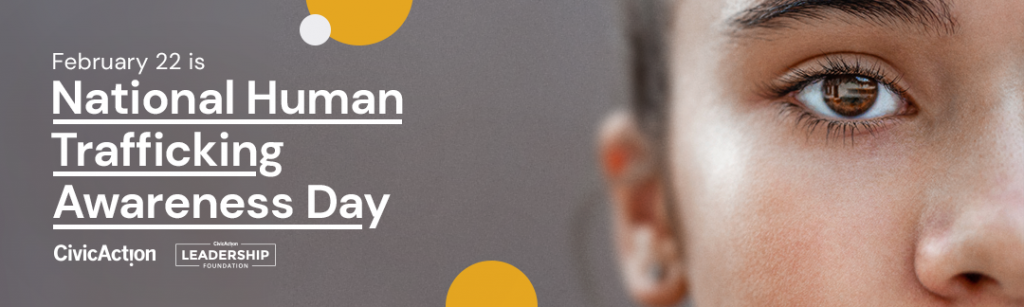
CivicAction National Human Trafficking Awareness Campaign. (Image Source: CivicAction Leadership Foundation)
Campaigns like Under the Influence are crucial for helping young girls and people everywhere understand what human trafficking is, what it can look like, and offering ways to remain safe.,. When you sit on a train, you can almost always find someone scrolling on Instagram, Facebook, or TikTok. Social media has the power to educate the masses and bring attention to important issues. It is the way to reach people and prompt them to care about important causes, because even if they aren’t directly affected by it, they can be indirectly affected.
While the media can help and harm survivors/victims of human trafficking, media, social and entertainment, is not going anywhere. Therefore, we should be more aware of how we can utilize it to support survivors and victims. This begins with reaching out to organizations that directly work with survivors and understanding how social media can help garner solidarity among potential victims and educate people. Additionally, technology and social media are only becoming more accessible to children of young ages, thus it is important to teach internet safety to children now more than ever. Internet safety and education are two of our strongest weapons in the battle against human trafficking in a day and age where social media can both help and harm victims and survivors.