On the day Luce tells me she’s dying, the sun sets at 4:38 pm. I know this because when I arrive at the bus stop, I can still just barely make out her form, sitting cross-legged on the curb. She’s staring directly into the streetlight above her, wearing only tights and her dead mom’s Eeyore sweatshirt. I toss a chunk of ice at her; it lands on the ground and doesn’t even shatter.
“You didn’t wait for me,” I say. After school, we usually walk together to hang out in the abandoned bus shelter by the highway. It’s pretty great. Nobody ever comes and we can use the bench as a table. In the winter, we bring sleeping bags and hang windchimes in the corners and pretend that Luce’s candles are warming us up.
“I came early,” Luce says, still looking upwards. She’s been doing that lately – skipping last period to come and sit here alone. She used to say it was to meditate, but now I have trouble telling when she’s meditating and when she’s just sitting down. She stands up and I join in her puddle of light.
“Okay,” she says. “I don’t want you to freak out.”
“About what?”
She holds out her hand. Her skin is grey. Or, no. It’s not grey. It’s a completely different texture, like she’s got a metal sheet just below the surface pushing up, up, up. Light gleams across her hand sleekly.
I pull in a breath. “What the fuck, Luce.”
She’s staring down at her hand like it’s a newborn, turning it left and right. “Isn’t it beautiful?”
“It’s hypothermia. Or — frostbite? Are you iron-deficient?”
“No. It’s none of that.” She looks up again, her hair catching on her eyelashes. “Have you ever actually looked at them before?”
“At what?”
“The lights.”
I look up at the streetlight. It’s grey and curved, hanging its bald little lightbulb head. It looks like every other streetlight in this parking lot, in the whole town, in the whole world.

Image Source: Catherine Lanctot
Suddenly, she grabs my wrist. Her fingers are so cold they burn, and I want to pull away, but then she’s pressing my palm flat against the metal of the streetlight, placing her own hand next to mine, and I can see it, suddenly. What she is showing me. That my skin is skin, but her skin isn’t. Her skin is glinting like some robot chameleon against this streetlight, both of them made, somehow, from the same material.
“I don’t understand,” I say. I’m whispering for some reason, and about to cry.
Luce just shakes her head. “It’s been happening for a while.”
“Aren’t you — do you feel any different? Are you in pain?”
Luce shakes her head again, biting off a piece of her lip. Her voice is paper-thin. “I’ve never felt better.”
I look at her. All her edges are so clear and sharp, it’s almost painful. Like she’s rendered in high definition while everything else in the world is still loading. Like she’s the only thing that’s real.
“Okay,” I whisper. Then: “Maybe we should tell someone.”
Finally, she looks back at me. Her eyes are huge, unnamed planets, reflecting back light that isn’t there. There’s a buzzing noise, but I can’t tell where it’s coming from.
“No,” she says firmly. “ But I do need your help.”
***
First, we need to decide whether Luce should be killed or run away. She’s leaning more towards being killed. I remind her that this option runs the risk of my going to jail.
“For what?” Her mouth is open like a laugh, but she’s not laughing. “For killing me? No one’s going to think you killed me.”
“I’m your only friend. I’d be a prime suspect.”
She ignores the only friend thing. “How?”
“What?”
“How would you kill me?”
“I’m not going to tell you.”
In the end, we decide she’ll run away. Easier, cleaner. That night, she rearranges her bed sheets over a clump of pillows, performatively clears her closet of all essential items, and leaves her window wide open so that by the time her dad comes in, the story will tell itself. I say maybe she should leave a note. She says, saying what?
On Wednesday, instead of going to school, Luce will just walk to the bus stop and stay there forever. Luce says it’ll probably take her dad three days to realize something’s wrong and she makes me promise not to come visit her until then. So that when they ask when I last saw her, it won’t be a lie.
For three days, there is a terrible acidic fruit growing inside me. First it’s the size of a cherry, then a plum, then a watermelon. On Friday, two policemen come into class to ask me and some other kids questions. When did we last see Luce? Was she acting strange? Was there any reason she might want to run away? While answering these questions, I invent and portray a character who is kind of stupid and knows Luce only from chemistry class and is largely unaffected. This seems to satisfy the policemen because they leave and that’s it. I keep on waiting for Luce’s dad to call, but he probably doesn’t remember my number or last name.
When I get home, Mom is watching Mad Men. “Shame about your girl,” she says, not moving her eyes from the screen. She was always suspicious of Luce; she thought she was too pretty to be my friend.
I go into my room and lie on the bed. The fruit is a full tree now, ripening its branches into all my limbs. One more day until I can see Luce. She had been right. No one thinks I killed her.
***
Part of me believes that after being outside for three days, she really will be dead. On the fourth evening, I run to the bus stop so hard I feel like puking, but there she is. There she is, standing tall in the light, skinnier, scarier, yes, but still there.
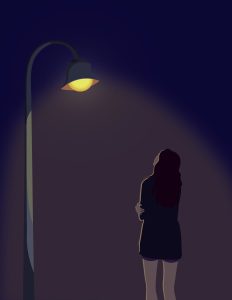
Image Source: Catherine Lanctot
I stop and stand near her, breathing hard. She doesn’t notice me until I say her name. Then she blinks, turns, smiles in my vague direction, and for a single second, it’s fine. It’s all fine, actually.
“It worked,” she breathes, glowing. “It’s going to work.”
***
There are several things we can do to help facilitate her transition. These are her new words. Facilitate. Transition.
First, she must eat. But only cold things. Every day I go to Foodland and steal her cold cuts, potato salad, ice cream. By the fourth day she will only accept ice cubes; after that, she eats straight from the snowbank. She stops losing weight at a certain point. I never hear her stomach growl.
Next, her hair. She wants none of it. With rising dread, I watch her collect curls into a long ponytail. For some reason, I had this idea that if she ever cut her hair off, she’d donate it to me as if I were a bald and cancerous child. Instead, she just wordlessly hands me a pair of kitchen scissors and turns around. When I hesitate for too long, she takes them back, chops through the ponytail herself, and holds it out limply beside her like a dead snake. “Okay?”
After that, things seem to happen in slow motion. I watch hands that are allegedly mine cut the rest of her hair close to her scalp, then run through it with her dad’s electric razor. When I’m done, she grabs the razor from me and quickly shaves off one eyebrow, then the other. Zrrt. Zrrt.
She turns to me, bald, beaming. She looks like a toddler’s crayon drawing of a person: head too big, smile too wide, generally unrealistic.
Below us, the snow is riddled with little pale worms of hair. When she’s not looking, I pocket one, bring it home, and hide it between the pages of a boring book so I never have to see it again.
***
Luce says my presence is becoming less necessary to the integrity of the metamorphosis. I ask her what the fuck that means and she says I don’t have to come every day anymore. So I come every other day, then every third day. When I do see her, we don’t talk. She just stands there in her underwear and tank top, chin raised to the sky, looking like nobody’s business. Every day, her skin becomes harder to look at, like a car in the sun. She never shivers.
“Luce,” I try one evening. She doesn’t open her eyes. “Luce.”
She opens her eyes but doesn’t look at me. I walk to her, lifting my fingers.
Her mouth barely moves. “Don’t.”
I do anyway. Her skin is radioactive with cold, repellent. I pull away.
She’s looking down at me, nose upturned. If I let myself, I can make her into a stranger. But then I blink and she’s her again, and it hurts again.
“I said you don’t have to stay,” she says. Her voice is a radio station I am slowly losing access to. I nod and turn around. I know that she’s not watching me leave.
***
That night I sleep with my window wide open. I wear three sweaters and pull the blanket around me, but it’s still not enough. When we were younger, I would beg Luce to play a game called Blanket. Blanket involved me lying on the ground and her lying directly on top of me, all of her limbs covering all of my limbs. “I’m crushing you,” she would say into my shoulder, but I’d shake my head, mute with delight. I’d make her stay until she rolled off, claiming she could hear my bones breaking. We stopped playing Blanket when we felt her fingertips stretching past mine, when our knees no longer knocked together. I wanted us to stay the same size, but she was always growing so far past me, fast, faster than either of us really knew what to do with.
***
In the morning, my room is covered with a thin layer of frost and my breath comes out in clouds. Outside the window is only white. I think of Luce, luminescent in her underwear, and feel nauseous. There’s no way. I grab my coat and run.
Across the parking lot, her small body blends so well into the landscape that I almost lose her. I stumble through the ice, falling over myself. But she’s still there, still standing, her chest barely moving. I can feel the force field of cold radiating from her. Getting close is like walking through deep water.
“Luce,” I say.
Her skin is not a colour I can name anymore. Like pencil lead. Like she’s been shaded in by a heavy hand. Looking right at her makes my eyes ache, and I’m suddenly so, so afraid. I grab her wrists. “Luce, let’s go.”
She shakes her head, just barely. She seems to be generating her own wind that is adamant on keeping us apart. I push back against it, closer to her.
“You’re not changing,” I say. “It’s not working. Let’s go.”
I watch her throat move. She opens her eyes, but I know she doesn’t see me. Finally, as if through deep snow, her voice comes. “It’s okay,” she says. “It’s okay now.”
Tears form and immediately crystallize in the corners of my eyes. I can’t wipe them away because I don’t want to let go of her, but the wind is so strong and the cold is so cold and she looks so unreal that it’s hard to convince myself that any of this is even happening and maybe it’s all a dream and nothing matters anyway, so I push forward through the pressure and kiss her.
Immediately, the cold is music. It’s everywhere, and I’m moving with it. I’m vaguely aware of the pain, but mostly I am with her, in some big place where there’s space and nothing else and everything actually is okay, just like she said. But then slowly the world starts to leak back in at the edges and I know I’m connected to Luce only through my mouth again, through my lips which are against her, but it’s not her anymore. I don’t have to open my eyes to know. I can feel it: the flat press of cold against my tongue. It tastes like metal, and it feels like forever.
By the time I can pull away, it’s light outside. I stand back and look up. She looks like every other streetlight in the parking lot, in the whole town, in the whole world. I stand there for a really long time, my tongue bleeding, the cold sun rising further and further into the sky. Even though it’s daytime, the lightbulb is still on, buzzing a soft hum you can hear if you listen to nothing else. Actually, none of the bulbs in any of the streetlights ever go out, day or night. There must be somebody for that, somebody whose job it is to say when the lights go on and off. I wonder who controls it. I guess I should have asked Luce. I guess now it’s just something I’ll have to hold with me on the walk home and hope I remember to look up later.
Featured Image Source: Catherine Lanctot