Humans are social creatures. Technologies such as social media and SMS have facilitated our social connections, but with their widespread access comes the expectation to remain as connected as possible. Furthermore, the development of surveillance technologies has led to the accumulation of personal data by various third parties as a by-product of security and algorithm needs. While these technologies are productive towards tracking down missing persons, is it possible that being monitored and datafied motivates a desire to go missing? A recent study by researcher Laura Huey and criminologist Lorna Ferguson positions “going missing” as a “maladaptive coping behaviour“ for stress, low self-esteem, or helplessness. Does surveillance technology apply these stressors to the average citizen, and should we all simply…disconnect? To better answer this question, we have to look at the history of surveillance technologies, how they work and who uses them.
The term surveillance technologies encompasses the tools, devices and software used to monitor and gather data on human behaviour. They were initially used in national security and espionage contexts. The earliest form of technological surveillance was wiretapping, which gained widespread use in the late 18th to early 19th century. Wiretapping allows an outside third party to listen in to private lines of communication, by telegraph (then) or by telephone (now). Closed-circuit television systems (CCTV) are another form of surveillance technology and were invented in the mid-19th century and used in the second World War.
The September 11, 2001 attacks on the World Trade Center and the subsequent War on Terror accelerated the use and development of surveillance technologies. Biometric information gathering through facial recognition technology (FRT) and fingerprinting, drone surveillance, telecommunications monitoring and social media network analysis were all techniques utilized to elucidate the hierarchy of terrorist groups and the identities of their supposed members. The September 11 attacks also increased the amount of CCTV implemented in public spaces, and strict protocols of Internet surveillance were created by police and security agencies.
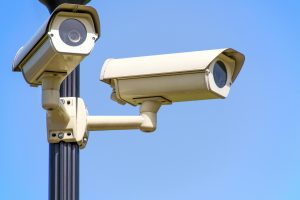
Image Source: AS Photography, Pexels
Further significant events in the history of surveillance technologies include the 2013 American National Security Agency (NSA) classified document leaks by whistleblower Edward Snowden, which revealed that the NSA worked with intelligence agencies in Australia, New Zealand, Canada and the UK to gather American user data from companies such as Google and Yahoo. Surveillance in policing — such as the use of drones and social media monitoring — has also become more conspicuous following the 2020 Black Lives Matter protests.
Similarly, surveillance technologies could potentially be used to enable the current United States Immigration and Customs Enforcement (ICE) raids and crackdown on ICE protests across America. With a court order, federal agents could apply FRT to photos available on the Internet or camera footage purchased from CCTV companies. Until recently, Geofence warrants allowed law enforcement to gain a record of every mobile device that was in a particular area at a particular time. A landmark decision by Google, one of the main distributors of this information, has made user location data more difficult for third parties to access. Still, as the demand for data grows, companies that compile large datasets and governments that need to monitor their citizens will work together.
Let’s explore how some of the surveillance technologies we’ve observed so far function. The International Mobile Subscriber Identity (IMSI) is your phone’s unique identifier. (IMSI) catchers are the devices that allow for both wiretapping and tracking a phone’s location. Your IMSI allows your phone to connect to mobile networks through an authentication process where the cell network requests it. IMSI catchers impersonate a base station (a.k.a a radio receiver) that is part of a cell network. Like real base stations, they request nearby phone users’ IMSI. IMSI catchers can then initiate downgrade or denial of service attacks by having limited configuration settings, forcing the phone user to either use an older, more insecure network like 2G or barring them from connecting to any service at all. Using measures of cell signal strength and the locations of base stations, IMSI catchers can then provide precise device location information. Finally, advanced IMSI catchers can also imitate a phone user’s identity by using its IMSI to access a real mobile network.
Social media analytics involve mapping a user’s social network or cataloguing the user’s sentiments (topics of interest and opinions). Machine learning algorithms are commonly used to classify social media data, either based on a fully-labelled training dataset or using a supplementary algorithm that continually learns off of and labels new data. Sentiment analysis, for example, involves flagging “opinion words”, or arrangements of words that signify allegiance to certain groups or beliefs. Sentiment analysis can be used to detect spam and bot-generated content, but it is also used to characterize anomalous or malicious user activity. Webpages also collect and track user data. When we accept a website’s cookies, we permit the website to transfer a small file to our device’s hard drive, which may last or accumulate to quantify a user’s visits to that webpage. Furthermore, many cookies contain IP address information that can reveal a user’s physical location.
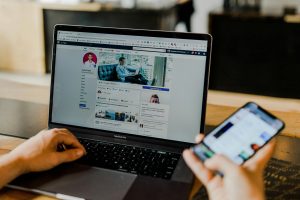
Image Source: Austin Distel, Unsplash
Facial recognition technologies comprise many methods of identifying an individual’s face from a static image or video footage and usually involve artificial intelligence such as deep neural networks, a type of machine learning where multiple layers of processing nodes concentrate data. The first step is detecting a face found in an image. Feature analysis, the specific identification of common facial features, may be difficult due to poor resolution or lighting in the footage. Therefore, the more popular approach is representing the entire face as a series of layered image vectors which can communicate textural information and define the edges of features. Unique data about the face is then extracted by quantifying measurements of facial features. Finally, the face is compared to an existing set of faces.
Both the complexity and availability of surveillance technologies are concerning. However, it’s important to remember that many such technologies are implemented with altruistic ideals and are still useful. Surveillance technology allows for predictive policing, which is intended to prevent crime before it happens. Corporate surveillance of customer activity allows advertisers to recommend products consumers may enjoy. FRT has even been employed to streamline disaster relief and find missing persons. Additionally, a study by a team of UK researchers at the University of Nottingham revealed that observation by a passive, unknown observer actually increases prosociality, behaviour that leads to the benefit of others.
This result correlates with the philosophical concept of the Panopticon, conceptualized in the 19th century by Jeremy Bentham. The Panopticon is a prison structure with a guard tower in the middle, theoretically allowing all inmates to be monitored at all times. The Panopticon is purported to increase self-regulation and self-directed rehabilitation. Still, like with modern surveillance technologies, the cost is decreased privacy. Our growing lack of privacy ensues as surveillance technologies are applied in contexts that they weren’t originally intended for, which is a phenomenon called “function creep” — like when surveillance meant for counterterrorism is used to surveil law-abiding citizens.

Image Source: Blue Ākāśha, CC BY-SA 4.0, Wikimedia Commons
Nevertheless, surveillance has the potential to be paranoia-inducing, and it seeds mistrust between citizens and their governments. Each of us, as a consumer, has the potential to be a security threat or to be a helpful data point. Either way, it’s exhausting to constantly be assessed as such. We’re ascribed responsibilities we didn’t ask to fulfill, and while it may motivate us to be good, rule-following members of society, it can also feel like you have to censor your speech or change your desired lifestyle. Surveillance doesn’t make it easy to live the way we might want, because we might be deemed significant outliers warranting further study.
Behavioural studies have demonstrated that being surveilled results in heightened sensitivity to surroundings and an increase in the flight-or-fight response. However, as mass surveillance is becoming normalized, this idea might actually decrease our negative feelings towards it, according to a 2012 study involving CCTV from Finland. Ultimately, surveillance exists whether we mentally navigate around its prevalence or not. It may not be enough if we try to uproot ourselves, and the cost of losing contact with our peers and family may be too steep. Author Peter Bloom advises protecting one’s personal data when possible in his book Monitored: Business and Surveillance in a Time of Big Data, reminding us that even funny filters or AI image generators could retain your information. Be aware of the companies behind these websites and what other organizations they work with. Diversify your online presence and rely on physical or external methods of storing information. Above all else, know that you don’t have to disappear to regain control of your personal life.