From her win at the Grammys for Best Pop Vocal Album, to her appearances at the VMAs, to hitting number 1 on the Billboard Top 100 for her songs “Please Please Please” and “Manchild,” Sabrina Carpenter’s exploding popularity has captured the attention of pop culture enthusiasts and the general public alike. Her catchy hits play on the radio over and over again. Clips of her magnetic performances are all over social media. Her distinctive personal style has turned into inspiration for makeup tutorials, haircuts and outfit guides. For a while, with her cheeky sense of humour and innuendo-filled lyrics, she was the internet’s pop princess to admire and root for. However, when Carpenter revealed the cover for her newest album, Man’s Best Friend, which showed her on her knees with her hair being pulled by a man, the tides of public opinion shifted drastically. Discourse began filling comment sections, forum threads and discussion boards, with her even being labelled as “anti-feminist” for portraying herself as sexualized.
But Carpenter’s reputation wasn’t always this way. Before she was singing about her “me espresso,” Carpenter was a Disney starlet, co-leading the Disney Channel show Girl Meets World as Maya Hart, the rebellious, rough-around-the-edges best friend to Rowan Blanchard’s peppy, positive Riley Matthews. She launched her music career soon after with her debut album, Eyes Wide Open, which sold 12,000 copies in its first week of release. Small, notable successes, such as her roles in The Hate U Give and Tall Girl, as well as her growing discography, helped her garner a fan base that has grown beyond her Disney Channel days.

Younger Sabrina Carpenter at an Autograph Signing (Image Source: Wikimedia Commons)
However, in 2020, Carpenter was pulled into public attention with the release of Olivia Rodrigo’s Driver’s License. In the heartbreaking ballad, Rodrigo sings about losing a romantic interest to a “blonde girl,” and internet sleuths quickly put together the aforementioned blonde’s identity: Carpenter herself. Droves of online hate and slut-shaming followed, which inspired Carpenter’s song “because i liked a boy” on her 2022 album, emails i can’t send. In addition to its lead single garnering sympathy for her, emails i can’t send also showcased something new to Carpenter when she toured it: a fun, clever sense of humour that was most apparent during her unique outros for her song “Nonsense.” She would change them based on the location of her show that night. They soon quickly evolved into increasingly explicit sexual innuendos, such as Chicago’s “Perhaps I am a dick aficionado / Windy city blow, I’m gonna swallow / Now he calls it giving him Chicago” and Sydney, Australia’s “When you go down under, do you miss me? / He’s so big, I felt it in my kidney / Screamed so loud, they heard it here in Sydney.” In her 2024 album Short n’ Sweet, Carpenter got even more unabashedly sexual with songs like “Juno” and “Busy Woman.” When performing “Juno” on tour, she would mimic a different sex position each night after saying the line, “Have you ever tried this one?” Being cheekily sexual became a part of her persona, which even seeped into her brand collaborations with Dunkin’ Donuts and Redken.
On June 11, 2025, Carpenter announced her next album with Island Records, Man’s Best Friend, via an Instagram post. The cover art for the album depicted Carpenter kneeling at the foot of a man. All the man’s features are cut off except for his leg and his hand, which holds a fistful of Carpenter’s hair. She stares at the camera with her mouth slightly open, one hand on his leg. Both Carpenter and the man are fully clothed, but Carpenter’s outfit is more skintight and revealing.
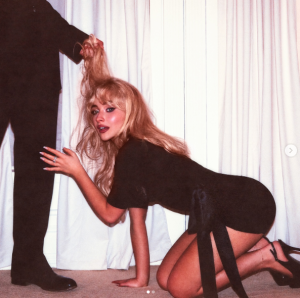
Man’s Best Friend Album Cover (Image Source: Sabrina Carpenter)
Not a second after Sabrina Carpenter announced her album of the summer, she was immediately met with criticism. Thousands of commenters flocked to her Instagram comments to give their two cents. Some defended the album cover, excited for the release of Man’s Best Friend. “It’s clearly meant to be ironic,” they wrote. “You’re all just missing the point.” Yet, many more pushed back with criticism of the album cover, accusing Sabrina of degrading women and pandering to the male gaze. But does any of this even matter?
Since then, Man’s Best Friend has become something of an internet controversy, with the debate reaching far beyond Sabrina’s comments and fanbase. Man’s Best Friend even made headlines in prominent media outlets, such as the New York Times and Rolling Stone, and all of this for an album we’ve barely heard. All we have is a singular music video, “Manchild,” but it seems that the cover has already set the tone for what people expect to see in Man’s Best Friend. Upon looking through what people have to say on Instagram, Twitter, and Reddit, it seems that most debaters seem to fall into one of two camps. There are those who view the album cover to be a regressive and degrading image that plays into outdated gender stereotypes and those who believe the image to be a satirical commentary on those very same stereotypes.
Before Sabrina Carpenter, the phrase “man’s best friend” has long been attributed to dogs, highlighting a history of companionship. Man’s Best Friend then highlights an uncomfortable gender imbalance — all the power rests in the hands of the domineering man, while Sabrina is seemingly degraded to nothing more than a submissive pet, an animal, an object. Opposition to Man’s Best Friend tends to critique this dynamic at face value, disregarding the context of Sabrina Carpenter and her past discography. They argue, regardless of Sabrina’s intention, that the effect of the album cover speaks for itself. That is, this imagery is regressive in its perpetuation of harmful stereotypes and appeal to the male gaze. Some have also critiqued the album cover as being reminiscent of outdated misogynistic ads, and still others claim that Sabrina Carpenter is glorifying domestic violence. Such criticism of Sabrina Carpenter has certainly been in no short supply lately, but is this entirely fair? Would people be as vocally critical of her male contemporaries? Probably not.
Sex and provocative themes have always been mainstays in popular music. Just take a look at the discographies of Britney Spears or Lana Del Rey, both of whom have been heavily scrutinized by media outlets for their provocative, explicit lyrics. But such themes aren’t inherently unique to female pop stars. Plenty of men also sing about sex, and they’re not met with the same criticism. Taylor Swift was constantly shamed by the media for dating around and writing music about her exes, while Kanye West didn’t nearly reach the same level of criticism for also singing about love and sex. Without Swift’s consent, West even featured a sex doll with Swift’s likeness in his “Famous” music video, and the backlash he received still hadn’t compared to that which was directed at Swift. Looking back, Sabrina Carpenter was not the first — nor will she likely be the last — female celebrity to face these harsh criticisms.
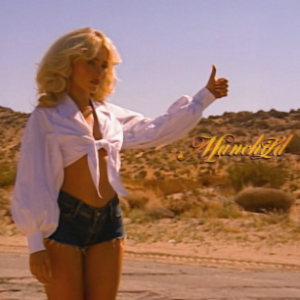
Carpenter’s lead single, “Manchild,” music video (Image Source: Wikimedia Commons)
Perhaps this backlash, not the album cover, is what is truly rooted in misogyny, as it highlights the double standards that have always existed in the music industry. Sabrina’s defenders seem to believe so. Sabrina’s approach is transformative, they say, and some people aren’t getting it. They argue that the cover is a clever and intentional satire of how women are perceived and treated by men in society, and Carpenter is intentionally portraying herself as submissive to highlight, mock and critique the uncomfortable power dynamic. Looking at the context of Carpenter’s past discography and the album’s lead single, “Manchild” – essentially a diss track against male immaturity and weaponized incompetence — this perspective provides a more likely theory for what Carpenter is really trying to say in Man’s Best Friend. Furthermore, Carpenter’s history of suggestive “twisted humour” indicates that it’s more than likely that this album cover could be a cheeky joke. Sabrina even met this backlash with a bit more of this humour, releasing a less suggestive variant cover that she described as a “cover approved by God.”
At the end of the day, this discourse about an album that the public hasn’t heard yet is indicative of the internet’s tendency to react first and then ask questions later. Without the full context of the songs, it’s impossible to form an informed opinion about the album cover. However, the reaction to the album cover is indicative of the misogyny and harsher criticism that female pop stars tend to receive compared to their male counterparts. Assumption of Carpenter’s anti-feminist submission when she has clearly shown in her music that she criticizes male incompetence, shows that many people are unwilling to give the artist the benefit of the doubt, especially since Man’s Best Friend continues to shine a light on such negative male behaviour.
In fact, many of the songs seem to point to the costs of being “man’s best friend.” For example, “Never Getting Laid,” “Nobody’s Son,” “Sugar Talking,” and several other songs on the album call attention to Carpenter’s repeated disappointment with her previous male partners. She calls out their lack of maturity and responsibility from male partners and how this behaviour affects her emotionally. She is not subservient; rather, she is calling out the way that men expect her to dutifully accept when they walk all over her and choose not to treat her with respect. With that context, the album art takes on a whole new meaning; one highlighting and criticizing the unequal dynamic between man and his so-called “best friend.”
Featured Image Source: Wikimedia Commons