One of our own
“That chocolate ice cream from Bachelorr’s seemed to be that innocent, sneaky and memorable initial action towards building a tradition.”
He concluded his story in a few lines when I told him I had visited Bachelorr’s—decades-old Mumbai landmark shop with its neon board and sticky pavement tiles—the night before. His eyes shone brightly as he started narrating about himself and his friend Rumba. Every day after school, they stopped at Bachelorr’s because it was on their way home, mostly to eat ice cream— mainly, the chocolate ones. There was no pre-existing plan, just a spontaneous decision to buy a small reward after a long day at school, all within budget. Gradually, it became a ritual—so reliable, they went every day unless there was a school holiday. It continued until he graduated, he told me.
“Therefore, it was a small tradition we had.”
“What happened to Rumba? Are you still in touch with him?” I asked, out of curiosity.
“No, he moved abroad as soon as school was over.”
“So, you categorized your ice cream sessions with him as a tradition. But now that it no longer happens, do you still call it a tradition?”
“Hmm.. yes, why not? Following it like a ritual every day, it easily qualifies as a tradition for my good old school days.” He grinned, convinced he just spouted wisdom.
An Icecream from Ice Japan, Phuket Old Town (Image Source: Author, Nivedita Sharma)
“So, ice cream was a tradition for you. Was it the ice cream itself? The act of going to the same place? The company of a particular friend?”
He didn’t answer immediately, and it appeared that my strange follow-up took him by surprise. While he usually thinks on his feet, I took quiet pleasure in how he now had to weigh his words, carefully shaping what he meant .
“You know, before any of my football matches, I prepare by listening to the same set of songs— The same playlist I listened to before my first win, when I performed well. So far, it has been lucky for me, and it reminds me of my earlier victories and instills confidence. It’s a small, solitary tradition I follow,” He said, more to himself than to me.
“So, traditions can also be solitary, then?” I asked.
“Yes,” He replied, still in deep thought.
“So, it wasn’t just Rumba’s company that mattered?” I insisted.
“It’s not just the company. The context and timing matters….maybe.” He answered in rumination.
“So, it’s okay if I do something alone, and maybe something I used to do but no longer do could still qualify as a tradition?”
“Yes.”
Listening to him, I found myself thinking about my own traditions. “I get coffee after lunch every day. Does that count as a tradition?”
He said, “Umm, no, that’s something you do every day, it’s nothing special. That’s a habit, a routine to be more precise. It can’t really be a tradition.”
“So, define tradition for me, since you’re such a know-it-all?” I teased.
“It is something that carries familiar and nostalgic elements each time you experience it. It’s something you consciously choose to repeat—not just mindless repetition. There has to be a common link, a window into your past, something that gives you deja vu. Most importantly, it must bring you a kind of joy so that you keep coming back to it. Even if it’s a fifty-rupee ice cream, it has to make you happy.”
It made me wonder whether I, too, had any traditions. “Does eating the same meal out of stress during exam season count as a solitary tradition?” I asked, half-joking, half-serious. “My favourite breakfast before every exam used to be a bowl of sambhar immersed in mashed vegetables and fluffy idlis. It was oddly comforting and calmed my nerves.”
“Was it because you really loved it? Or because it eased your exam pressure?” he chuckled.
“Mostly exams,” I admitted. “But nothing else worked somehow.”
“Then it was a coping mechanism,” he said thoughtfully. “A reaction to pressure. You were relying on the food to give you comfort. That seems more like a compulsion rather than a tradition. If you would be sharing that hot meal with someone you love, or pairing it with something you enjoy at regular intervals, it could have been a ‘tradition’…” He even air-quoted the word tradition.
I asked, “You did the same thing for football matches. How is it any different?”
He laughed. “Food as a coping mechanism is very different from listening to songs before my football match. I didn’t listen to them because of stress, but because they brought back my best memories. See?”
“Maybe people repeat a particular ritual to relive the joy they felt the first time. They try to hold on to those moments when they felt safe with someone, or had the best meal,”I thought aloud.
“Yes, and there must be a common link between the past and present events for it to become tradition,” he reminded me. Then he asked, “What would you say is your tradition—for anything?” He asked, his voice at the edge of laughter at my perplexed face.
“Wait…let me think.” I became immersed in thought, my eyes fixed on the pattern of our footsteps, unconsciously aligning my pace with his pace as we walked back to our building.
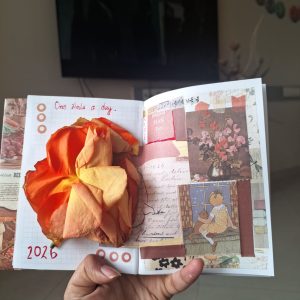
A page from the junk journal preserving orange rose (Image source: Author, Nivedita Sharma)
“Sometimes, I visit my favourite places over and over again to relive the moments I first had there— but with different people.”
“That’s okay. If you visit the same place, even with different people, it can still qualify as a tradition. Not having the same company doesn’t fade the beauty of your tradition, rather it makes it more flexible. It’s still beautiful and cherished unless you’ve promised someone you’ll only carry out that tradition with them. You can explore your favourite places with anyone you want. That becomes your own tradition in your mind. You do not have to tell anyone you’re doing it” He paused to gauge my reaction. Then, he added, “if that makes sense.”
“Tradition being a solo exploration makes sense to me. Yes, I enjoy my own company more than anyone else’s.” I laughed, and he rolled his eyes.
“But…do you think traditions have to be all about joy and happiness? What about the funeral ceremony we held for Ms. Lolita this year? We have been conducting a ceremony for the past three years to grieve for her. Everyone is sad, but we all come together,—not just to celebrate, but to fulfil a purpose: to grieve. Is that not a tradition?” I whispered. He stared at me, momentarily thrown, as if I’d just upended his entire argument. I continued, “What about the traditions like Muharram, where Muslims commemorate the martyrdom of Imam Hussein? It’s a story of grief and betrayal. I am not fully convinced that traditions are just about joy. If that’s the case, why do people participate in mourning, sadness, and death traditions?
He shook his head with a mix of disappointment and appreciation. “You are really getting into this, huh? Okay, maybe let’s define tradition this way: A connecting factor between past and present events, with the presence of any emotion that was felt when the act first occurred. The emotion could be anything—joy, grief, surprise, shock, birth, or death.” He didn’t sound triumphant with his new theory, just thoughtful.
“And traditions are allowed to evolve?” I asked aloud.
“Yes, they can evolve as people’s lifestyles change, or because of the weather or government regulations, haha.” We laughed. “But the essence remains. Like in coastal cities, they immerse idols in the sea, but in landlocked places, the gods stay indoors, tucked on mantels or balconies. The ritual bends, but the impulse to carry that tradition stays untouched.” He made sense.
While I was listening to all his wisdom about tradition, my brain was rummaging through every moment in my life to figure out whether I had my own tradition. As we arrived at work, we parted ways, both lost in thought.

The road not taken (Image Source: Author, Nivedita Sharma)
After I was done with my piece of work and some to take home in the office, I allowed myself to slip deeper into the conversation we had about tradition, memory and meaning.
After some research, I discovered that the word ‘tradition’ is derived from the Latin word ‘trans’ (meaning ‘across’) and ‘dare’ (meaning ‘give’). It implies the transmission of customs or beliefs from generation to generation like how fireworks have long been an American tradition on the Fourth of July.
The meaning in the dictionary was nowhere close to what he said. In his understanding, there was no society, just individual emotion. Maybe, when like-minded people come together, their shared emotions become communal emotions. The responsibility to keep these collective emotions alive falls on individuals. Those who don’t find joy in a tradition may still feel compelled to practice it for the sake of conformity. Over time, the tradition becomes mandatory—part of a culture, then a religion or belief system.
So if I do not have my own little tradition, I am not contributing to society in its tradition-to-keep-alive-for-future endeavour, I mused. Is tradition an inherent part of society, or is society born from small individual traditions coming together? I started to wonder—do traditions become a way of passing down societal expectations? Like buying festive lights, new clothes, and sweets during Diwali, competing with neighbours to see who did it better.
In some cases, those neighbors may be struggling to make ends meet and yet are pressured to preserve the festival’s materialistic essence. If I push back against these expectations, I will face a storm of resistance from family, neighbours, and every acquaintance who believes they have a say in my choices. I’ll be a blot on the pure white linen—stubborn, stained, and out of place. But if I surrender to inherited norms that don’t align with my will, I fear I’ll lose who I truly am.

Image Source: Author, Nivedita Sharma
Although I know, the great author T.S. Elliot would disagree. In Traditions and Individual Talent, he sees traditions and individuality in confluence. For him, traditions express itself through the personality of a poet, and “it is individuality that keeps a consciousness of separation from tradition.” *
It sounds charming in theory, but in practice, I often find myself having to choose between staying true to myself and the set of norms crafted by unknown people overshadowing my consciousness. I choose not to surrender. Maybe creating my own traditions will also simultaneously give me the freedom to express who I am. Maybe the set of norms created for myself will help my individuality thrive. However, they have to be truly mine. The moment they are imposed from outside, they stop nurturing individuality and start silencing it. Maybe Eliot wasn’t wrong to keep tradition and individuality side by side, but I would only agree with him when tradition is not inherited blindly, but created consciously.
The next morning, I shared these thoughts with him. He said, “You’re an overthinker. These theories suit you, but my question remains the same: Do you have a tradition that I’d actually call a tradition?
Maybe if I had celebrated something with frequency, it could’ve counted that as a tradition. I pouted. Maybe my life was so empty that I had no tradition to call it mine. As I was thinking, he winked at me and said, “it might be time to create new traditions.”
But, I didn’t want to accept the fact that I’ve gone twenty-five years without one. It felt like an embarrassing disaster.
“I had a friend from college, Rajjy..” I began, not knowing where the story was headed, but hoping that it would be convincing enough to win my case. “In Jaipur, I sometimes meet her now that both of us have graduated, whenever we are in the same city. We always meet at a café 9 km from my home, ‘The Tapri’, where they cook everything from scratch. It is our go-to place, even though I’ve been there with other people. But, Rajjy and I always go there first, before we plan anything else. I only meet her when fate brings us to the same city. I don’t always make an effort to be consistent, but it is one of our constant plans. And the result is always cherished friendship.”
As I concluded, a smile broke across his face.
“This can be called a tradition in your language, right?” I exclaimed.
He rolled his eyes as I said, “No one can tell me otherwise.” I pulled out my phone to text Rajjy and tell her about our unintentional tradition.
* T. S. Eliot, “Tradition and the Individual Talent,” in The Sacred Wood (London: Methuen & Co., 1920)