Imagine a bisexual woman marrying a man, only to hear whispers at the wedding that she was just going through a phase until she met the “right” guy. Had she married a woman instead, people might say she only claimed to be bi because she was afraid to come out as gay.
That’s society for you. If you’re in a straight-presenting relationship, you’re perceived as straight and can lose a sense of your queerness because of other people’s perceptions, especially if your partner doesn’t fully understand your queerness. You shouldn’t be afraid to mention your queerness to a potential partner as if it is baggage or something to be ashamed of.
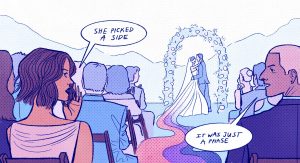
Image Source: Vivian Van
I’ve been in two straight-presenting relationships, one where I lost touch with my queerness, not just due to society’s assumptions, but because my straight cisgender boyfriend didn’t understand or seem to care about that part of me. Before we started dating, he asked me if being bisexual meant I’d leave him for a woman, and although that question made me angry and I explained my frustration, I didn’t walk away, not then anyways.
Instead, I explained myself the way society taught me to. When he jokingly took an “Am I Gay?” test and asked if it was okay, I shrugged and said, “Do what you want,” even though I felt disrespected. I reminded him I’d taken those tests seriously while figuring out my sexuality, but still fake-laughed along to avoid seeming too sensitive.
Another time at my old restaurant job, a nosy co-worker noticed my rainbow bracelet and asked, “Why are you wearing that if you’re not gay?” I stumbled, then said, “I made it because I like the colours. It supports my community and I’m bi.” He was surprised and stayed quiet after, but it shouldn’t have happened. He assumed I was straight because I had a boyfriend at the time and called me out publicly. I’m open about my sexuality but what if I wasn’t?
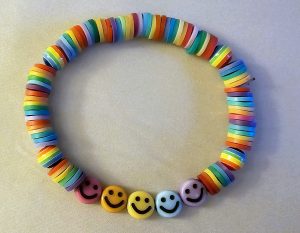
The bracelet I made that I was called out for wearing at my restaurant job. Although it caught me off guard and I didn’t feel the most comfortable in that moment, I didn’t let it stop me from being authentic and expressing myself. Funnily enough, I stumbled upon some cute bracelets with the bi flag colours at the mall, which almost felt like a sign. I wore those to work shortly after without a care in the world. (Image Source: Julia Vellucci)
Benjamin Steeves, a bisexual man who was a year below me in Humber’s Journalism Advanced Diploma program, said he wishes people saw bisexuality as the default from birth and I really wish that too.
“It would be nice to just date who you date, like it doesn’t need to be this thing or anything. I understand people are curious and want to ask me, ‘Are you talking to girls?’ Or they’re trying to be inclusive when I don’t answer and say ‘Are you talking to any guys or anything?’,” Steeves said.
“Ask me if I’m talking to anyone, period, like why do you have to put this gender on it for instance?” he asked.
When Steeves was first coming to terms with his sexuality, he didn’t understand what he was feeling and felt like he was disappointing everyone in his life. He felt that if he dated one gender or the other, he was doing a disservice to the word “bi.” He remembers dating a girl who he really liked, while also being attracted to other same-gender individuals. This made Steeves question how valid his relationship with a woman was.
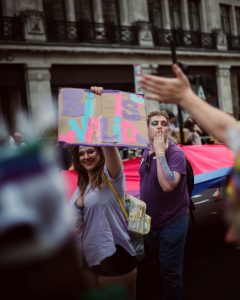
A powerful moment of unity as individuals proudly hold signs at a Bi Visibility celebration in the UK, highlighting the importance of bisexual representation and recognition. (Image Source: Pexels)
People didn’t make Steeves’ internal battles any easier, especially when a former female friend told him that if she found out her man was cheating on her with a guy, she’d kill herself.
“She looked me dead in the face and said, ‘I would rather he got another woman pregnant. Because if it’s a woman, it’s just cheating. But if it’s a man, then I know I’m the problem,’” Steeves said. “Her whole thinking was because he’s dating her and he likes both men and women, and he still chooses a man over her, it must mean something’s wrong with her. That’s not how that works,” he added.
As he told me this story, I felt his words. Everything he said reminded me how there needs to be more education and awareness as to what it means to like more than one gender.
I didn’t understand why I felt the way I did when I was first coming to terms with accepting my sexuality. What I did notice very quickly was that I instantly felt how society perceived me, “not straight enough but not gay enough either,” and it wasn’t just my internal biphobia.
I remember when I first started college, a group of girls in my program were taking turns choosing which guy in the program they thought was the most attractive. I felt so out of place because, although I could’ve just answered, there was also a girl in the program I found to be even more attractive. A conversation that should’ve been simple didn’t feel simple, and I went to my college’s LGBTQ+ resource centre in hopes of understanding how I felt. I was told queer people just hang out in that centre and can colour in colouring books if they’d like, which was not even close to the helpful advice and support I desired to seek.

Queer representation may not be as realistic as it should in books or movies. However, to admire queer couples out and in love is representation in its own way and hope for the future. (Image Source: Pexels)
Shows with queer representation helped me understand my thinking a little better, but there was still a huge gap with many lesbian and gay characters being present, but few bi or pan characters. Even when they did appear, it felt like an unrealistic representation of those identities. I watched comfort shows that had friend groups in them where everyone was queer and they all helped each other figure things out which, although is nice to watch, is rarely the case in real life.
Marni Panas is a Canadian Certified Inclusion Professional who has devoted her career and personal life to promoting equity, especially for marginalized groups, such as the LGBTQ+ community. She emphasized that educating service providers is key to overcoming assumption-based barriers.
“I remember having to go into the ER after experiencing significant back pain. The woman who I was on a date with accompanied me. The physician asked if she was my daughter. I had to disclose she was my date. This was problematic on many levels, assuming my sexuality and even an assumption of our perceived age gap,” Panas said.
“Sometimes when talking about my partner to others, I share that they are a doctor or a surgeon, then I’m asked “his” name or some assumption that my partner is a man. As a very public, open, lesbian, trans woman who was married to a woman for nearly 20 years, it shocks me when they completely disregard all that and then make the assumption that because my partner is a surgeon, they must be a man,” she continued.

The National Library of Medicine reported that a physician is as likely to be female as male, yet most people still picture a doctor as a man. A recent survey of 4000 Britons conducted by LinkedIn stated that only 5% of people presume a doctor will be female. (Image Source: Pexels)
Panas questioned what straight-presenting means, and by whose standards someone appears cisgender or straight. She emphasizes that just because someone appears “straight-presenting” doesn’t mean they are straight. They could be bisexual, pansexual, or not in a relationship at all.
Assumptions can lead to treating people differently, and no one understands this better than Nazanin Moghadami. Moghadami uses all pronouns, and like Panas is an LGBTQ+ advocate. Specifically, he helps make queer spaces more racially inclusive and settlement and immigration spaces more accepting towards queer and trans folks.
Moghadami described having a severe medical condition where their hormonal IUD is changed every three years and every time, she has to take a pregnancy test despite him being queer. There aren’t any questions about her sexuality, if he can get pregnant, or even if they’re sexually active.
“There are lots of assumptions about people that are based on the kind of a relationship that they are in and it’s not our relationships that make us queer. Queer is an identity,” she said.
These stories and experiences highlight how deeply rooted societal assumptions can erase, invalidate, or oversimplify bisexual and other queer identities, especially in relationships that appear straight to the naked eye. The discomfort, confusion, and even shame that can come from constantly having to explain or justify our identities is not something we should have to carry or justify.
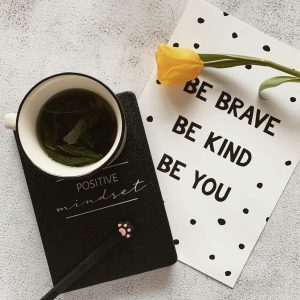
I stumbled upon an old handwritten creative non-fiction piece of mine that I thought would be the closest I’d get to understanding me but I was wrong. It touched on how terrifying it is when you discover parts of you that feel so raw, new, unknown, barely understand them yourself so you don’t expect others to. I wrote that piece three years ago and can now say it’s okay to look at yourself with eyes that may feel unfamiliar and smile at all the new, exciting parts of you you get to meet as you grow and experience life. (Image Source: Pexels)
It doesn’t need to make any sense to anyone else but us. It’s our life, our happiness, our love, and nobody else’s. No one should feel less queer or less valid because of who they’re dating or have their identity treated like a phase, a punchline, or a problem to be solved. It took me a long time to write an article I needed to read about three years ago, but I’m now at a point where I can confidently say bisexuality isn’t about proving anything to anyone.
After all, who you’re dating doesn’t make you more or less queer and you deserve to be respected regardless of what box society tries to fit you into.
Featured Image Source: Vivian Van