
Over the past few decades, through the work of many brilliant scientists worldwide, biotechnology, notably, gene editing and gene therapy have become more widely accessible to the general public and frequently used in the science and medical field. This proliferation has been met with some resistance from the general public as it is easy to feel hesitant toward seemingly breaching technology that is capable of altering our lives down to the cellular level. In my first year at university as a science student, I learned about numerous biotechnologies and gene editing methods such as CRISPR-Cas9 along with their applications towards treatments for diseases, such as cancer, blood disorders and even mental health disorders. I found them extremely intriguing and deem them to be tools that can greatly advantage humanity. When executed thoroughly and with ethics guidelines met, these advancements to science can change the world of medicine and the future for the better.
This article will highlight three instances of informative research and successful studies that demonstrate the positive potential of gene therapies and prove the significance of working towards conquering the resistance of gene editing advancements that can help humans everywhere.
Gene Editing: Treating Beta-Thalassemia
Hemoglobin is a protein and one of the most crucial parts of red blood cells as it carries oxygen. It is made of four subunits, one of which is called beta-globin (β-globin) in adults. Beta-thalassemia (β-thalassemia) is a disease that affects the gene that “codes for” the production of β-globin which is then used to produce hemoglobin. This disease results in a mutation in this gene, preventing the production of the important β-globin component and thus lowering hemoglobin production. Less hemoglobin means less oxygen being carried and transported through the body which can lead to life-threatening symptoms.
To treat β-thalassemia, Dr. Frangoul and colleagues have used CRISPR-Cas9 — a gene editing tool with numerous functions and the ability to execute various procedures. Most notably, CRISPR-Cas9 can make double-stranded cuts in the DNA using its scissor-like protein, Cas, and its guide RNA component, which leads the protein to the researcher’s desired destination in the genome, where they wish to make the cut.
These researchers used CRISPR-Cas9 gene editing to disrupt or knock out the enhancer region of BCL11A. Enhancer regions are located in the beginning of genes and are a regulatory region that activates the transcription of genes by acting as a binding region for proteins called transcription factors. BCL11A is a protein that halts the production of the gamma-globin protein, a component of fetal hemoglobin, and replaces it with the beta-globin present in the body after birth and in adulthood. Gamma globin has a higher affinity for oxygen and can bind it stronger than beta-globin.
By knocking out the enhancer region of BCL11A, the transcription factor called KLF-1 cannot bind to upregulate the creation of BCl11A. As a result, the cells responsible for the production of red blood cells and hemoglobin continue to make gamma globin which can effectively carry oxygen, counteracting the lack of β-globin in β-thalassemia, effectively treating the disease!

Red blood cells (Image Source: Photo by Roger Brown, Pexels)
Epigenomic Drugs for Disease Treatment
Epigenetics is a fascinating branch of genetics that studies the epigenome — the chemical compounds or tags above the genome which control gene expression without making any changes to the DNA itself. The epigenome is special as it is dynamic and can be affected by personal life experiences and our environments. There have been a lot of studies, such as Dr. Ueda et al. ‘s, that link epigenetics to common conditions and mental health disorders such as anxiety, depression and schizophrenia. The potential role of epigenetic drugs in these disorders has been a focus in recent research and this particular study.
Epigenome editing involves altering and regulating gene expression without changing the DNA sequence by modifying the chemical tags, often with gene editing technologies, such as CRISPR-Cas9. Dr. Ueda and colleagues state that while there are challenges to epigenome-editing approaches, there is also lots of potential that makes it deserving of further extensive research. Trials, such as those reviewed by Dr.Peedicayil’s study, are underway to enhance and further the development and clinical application of epigenetic drugs that can treat different diseases.
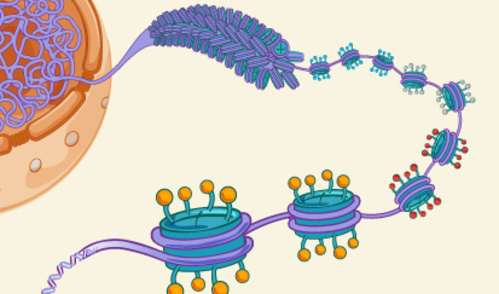
Epigenome – Chemical tags are represented by the small circles of varying colours (Image Source: Broad Institute)
Designer T-Cells: Treating Certain Cancers
An immunotherapy with a high success rate is performing CRISPR-Cas9 on T-cells. T-cells are a type of white blood cell called lymphocytes. They help your immune system fight pathogens and protect your body. T-cells can be edited using CRISPR-Cas9 to recognize proteins in cancer cells and thus eradicate the cells, often leading to tumour regression.
The PD-1 gene is a protein targeted and edited by CRISPR. PD-1 protects tissues from autoimmune attacks. While this may appear beneficial as it prevents our immune system from attacking its own cells, it also shields tumours from being attacked as it cannot get past the cancer cells’ disguise as normal cells. CRISPR-Cas9 knocks out the PD-1 gene by disrupting its function. This procedure allows the T-cells to recognize cancer cells as pathogens and attack them, as shown by a study done by Dr. Lu and collegues. This makes them a safe and feasible clinical application and treatment for cancers such as non-small-cell lung cancer. Further trials are recommended to improve therapeutic outcomes, as explained by Dr. Lu and the other scientists who conducted this study. However, it is evident that gene editing drugs can be revolutionary for the long-term efforts of finding a cure for cancer.
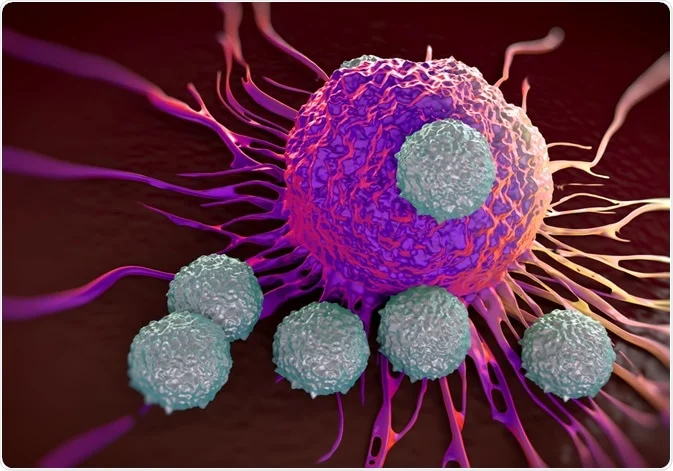
T-Cells (small blue-grey circular cells) attacking some sort of pathogen/cancer (Image Source: IStockPhoto.com)
It can be normal to feel apprehensive about new advances in genetic technologies and gene editing. However, we can challenge our doubts by learning about different procedures and how they can be used productively by researching credible sources. A future with ubiquitous gene-editing technologies has many benefits that can outweigh the potential drawbacks, and as more research is done, the more confident we can be in these technologies. Then, we can move forward together and welcome a future with gene editing technologies regularly used in healthcare to treat different diseases. It is critical to disrupt that resistance and apprehension on the path to accepting and supporting science that can be used to serve humans more and more over time.