

On November 29th, the 23rd annual Regent Park Film Festival (RPFF) ran its short program Tender Points, a series of short films written and directed by both emerging and established BIPOC filmmakers exploring the intimate, raw and tender moments that quietly shape our lives and identities, and mirror the socioeconomic landscape that youth must navigate today. The program consisted of seven screenings, followed by a short Q&A session with a few of the directors.
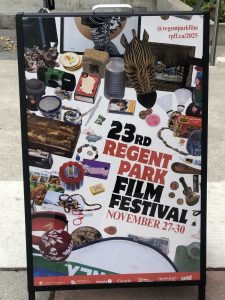
The 23rd Regent Park Film Festival is an award-winning, community-based charitable organization which includes Toronto’s longest-running, free film festival. It’s a space for people to reflect on the stories that shape our city and community.
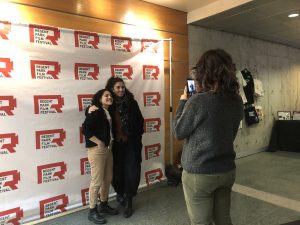 Where queerness meets tenderness
There’s no doubt that representation and exploration of queer experiences and characters have exploded in mainstream media in the last couple of years. Still, as a voracious consumer of queer media myself, I found myself struck by the way artist Tram Anh Nguyen, and filmmakers Halen King and Emma Zuck center queerness as something shaped by playfulness, memory and gentleness, as opposed to the stereotypical portrayal of queer lives as being marked by tragedy and tears.
In Nguyen’s short film Mother’s Spring, a young Vietnamese immigrant wrestles with the heteronormative cultural expectations imposed by their mother. Set against the backdrop of an unnamed city and a quiet, nuclear family, Mother’s Spring doesn’t shy away from the complexity — and sometimes, alienation — of how mothers pass on generational trauma. But as much as this is a story about navigating queerness and cultural-gendered expectations, this is also a story about a mother’s grief and pain as she must let her child move through the world with their own independence and boldness.
One particular scene near the end of the film stood out to me: after a heated fight with their mother, the protagonist’s mother picks them up from school. As the initial awkwardness subsides, the two begin to bond over a song on the radio. Though it pales against the explosiveness of the previous scene where the characters argue, it shows how shared laughter carries repair, and how joy quietly beats — like a heartbeat — even amidst the messiest moments of our lives.
And how does that joy feel from the inside? In Zuck’s documentary-style film Stubble, queer couples and youth experiment with their gender identity. Stubble feels intimate and evocative. There isn’t a driving plot or a great character arch simmering; there isn’t a climax waiting to reveal a grand truth. Instead, Stubble invites audiences into the spaces of reflection, playfulness, safety and joy that queer and gender-diverse youth inhabit: messy bedroom floors, the basketball court on a hot, sweaty, day and a beach towel littered with knick-knacks as you and your friend run to grab some ice cream.
In its own way, Stubble confronts the gendered expectations that befall queer couples; the idea that one person in the relationship needs to be the “dominant” and masculine partner, while the other is the feminine partner. In reality, Stubble shows how queerness totally rewrites the script of who should be who in a relationship. Much of this film feels like the camera just follows these individuals around, documenting the everyday-ness of queer life. And in-between questions and anxieties lie little moments of experimental truth-making and softness that resonates across space and time.
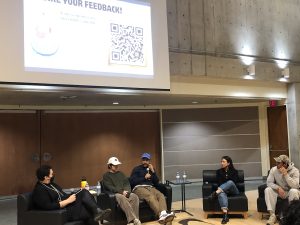
The screening of Tender Points was followed by a discussion and audience Q&A with the directors of Mother’s Spring, Sea Star, Niimi, and King’s Court.
A mirror to society
Tender Points also featured stories searing with subtle social commentary centered around BIPOC voices, perfectly balancing narratives of interiority with themes of sexual violence, urban living and masculinity. “By highlighting emerging and established BIPOC filmmakers from Canada and abroad, this year’s programming underscores how film and collective art making work to bring forth the futures we’ve imagined both for ourselves and the world around us,” says Sarah-Tai Black in the RPFF’s press release.
Directed by Adam Mbowe, 8 Times follows Muhammed, a 39-year-old man navigating his life after six failed marriages. Set against the backdrop of several cities and inner-city neighborhoods, Muhammed recounts stories of his youth; bouncing around from city to city, Muhammed absorbs the urban chaos of city-life while seeking stability through marriage. Fast forward to the present, Muhammed is simultaneously married to both his 7th and 8th wives.
My first instinct of 8 Times was that this was a psychological exploration of a man who couldn’t be faithful; a man carrying the consequences of his choices as he attempts to venture into new areas of adulthood: matrimony and fatherhood. In fact, in hindsight I wished the film had put more of a spotlight on Muhammed’s past and current wives so that audiences could understand how Muhammed’s personality has touched their lives. By the end of the film, I couldn’t make up my mind about Muhammed: am I rooting for him? Should I condemn him? But despite its surprisingly short runtime of just five minutes, the film approaches the polarizing figure of Muhammed with much curiosity and care, allowing his personal triumphs and tribulations to colour the scene more than third-part voiceovers.
In filmmaker Dana Solomon’s Niimi, an Indigenous Anishinaabe ballerina, Sky, attempts to rebuild her passion for dance following a sexual violence incident with her previous coach. One day, Sky comes across a group of girls dancing freestyle at her local studio. Invited to join them, Sky declines but comes back another day. One step at a time, Sky relearns her body supported by the care of other Indigenous women dancers. Freestyle dancing is much different from the tight postures and pointed toes of ballet. It lends itself to mistakes, messiness and a choreography that makes Sky feel sexy again, and more importantly, whole.
Niimi’s dialogue is limited and the scene’s simple; yet the film manages to capture the complicated emotions that mar us as we grieve and transform, of how we must break at the seams to become anew again. A central theme Solomon captures is that movement is medicine.
For Sky, confronting her past demons and rebuilding her relationship to dance among the care of women proves that movement is healing; that, in a society that demonizes a woman’s sexuality and freedom, dance is power — to feel one’s body on one’s own terms.
These short films reflect society by capturing its values, tensions and lived realities, offering a mirror to how people understand themselves and others. At the same time, it reshapes society by introducing new perspectives and subtly shifting what feels possible, visible or worthy of care.


![Wikimedia Commons. (n.d.). Wabanaki wampum belts [Photograph]. Wikimedia Commons.](https://cdn.inkspire.org/wp-content/uploads/2026/02/Wabanaki_Wampum_Belts-400x400.png)
