In Gestalt psychology, the Zeigarnik effect describes how we tend to remember unfinished or interrupted tasks better than completed ones. For adults with unmet childhood needs, this translates to subconsciously repeating cycles that reiterate patterns of past trauma. Even when the danger is over, we keep returning to the scene of the crime in an attempt to change the outcome. Usually, chasing a corrective experience digs us deeper into a hole; it’s the recipe of a self-fulfilling prophecy. Kinds of Kindness (2024) takes a perverse look into what happens when victims of manipulation get what they want; what they believe they will achieve from appeasing an abuser.
Each vignette in the Kinds of Kindness anthology exemplifies this central theme. Each film centres around a relationship where one party is hopelessly devoted to another. A promise is broken or an expectation is unmet, so the devotee is cast out from the relationship and must find a way to redeem themselves. We watch the devotee become desperate (denouncing personal morals), self-destructive (severing their limbs) and villainous (murdering, kidnapping). They are at their most driven when the object of their devotion is out of reach, overriding every aspect of their lives to gain validation from the manipulator.
The director, Yorgos Lanthimos, expertly conducts his signature uncanny tone in Kinds of Kindness. Lanthimos allows audiences to peer into a perverse dreamscape through this film. What are the building blocks of this filmic language? Firstly, we hear an unnerving atonal soundtrack alongside suspenseful, droning operatic vocals. Paired with this is the eerie dialogue. The dialogue is a cocktail of stilted, play-like and monotone inflection — with lines that include inconsequential details and explanations of every thought process. The characters act like children and are treated as such, coaxed with doting language by the objects of their devotion to commit increasingly heinous actions. They have no hidden intentions; our protagonists don’t know what it means to conceal. Their guileless hearts are bared and bleeding on the table. They don’t notice hidden motivations from their abusers, only faults within themselves.

Image Source: Unsplash
“I want someone to tell me what to wear every morning. I want someone to tell me what to eat. What to like. What to hate. What to rage about. What to listen to. What band to like. What to buy tickets for. What to joke about. What not to joke about. I want someone to tell me what to believe in. Who to vote for and who to love and how to… tell them. I just think I want someone to tell me how to live my life, Father, because so far, I think I’ve been getting it wrong. And I know that’s why people want someone like you in their lives, because you just tell them how to do it. You just tell them what to do and what they’ll get out of the end of it, even though I don’t believe your bullshit and I know that scientifically nothing that I do makes any difference in the end, anyway, I’m still scared. Why am I still scared? So just tell me what to do. Just fucking tell me what to do, Father.” Fleabag, Episode 4 of Season 2.
Is love not imposition? I think of Fleabag, played by Phoebe Waller-Bridge, in the confessional, begging Hot Priest, played by Andrew Scott, to tell her what to do. Kinds of Kindness amplifies this plea from Fleabag (2016) Season 2 to surreal extremes. Wanting someone to dictate how you live is the twisted pinnacle desire of weak-minded people. But also, isn’t that what love is? Choosing someone who can tell you what to do, asking for someone’s plans to become yours? Isn’t the instinct of loving someone; wanting to become them? (like Caroline Polacheck proclaims in Desire, I Want To Turn Into You).
I don’t know when we started thinking that putting someone on a pedestal was a bad thing to do. When did it become unhealthy to revere someone? We’re drawn to what we know we’ll never be able to replicate, only complement. I know I can only ever be a planet in your solar system, a knight in your guard. And that will be enough because you have given me somewhere to be. It can be an act of service to give someone else direction — but when does it become unhealthy, and what lengths will we reach to chain ourselves to that devotion? Exploring this, Kinds of Kindness magnifies our illogical, self-destructive desire to stay in abusive cycles.

Image Source: Wikimedia Commons
The first short film, “The Death of RMF,” opens with the song “Sweet Dreams (Are Made of This),” with lyrics that literally explain the theme:
Some of them want to use you.
Some of them want to get used by you.
Some of them want to abuse you.
Some of them want to be abused.
In the first short film, we see a man named Robert, played by Jesse Plemens, being controlled by his boss, Raymond, played by Willem Defoe, as if he were a child being helicopter-parented. Every hour of his day is planned for him. He has an eating plan, a reading plan and is scrutinized for how he enters his boss’s home and begins a conversation. He is warned not to disappoint if he truly loves Raymond. While we are not given such specific instructions in the real world, we may carry internal guides on these particularities for living. Living under Western capitalist expectations, we are socially persuaded to eat certain foods, be a certain weight, read certain books, and carry ourselves a certain way. This film magnifies that pressure. We are constantly surveilled. This is reflected in the film as a boss who can reach Robert’s wife, his hospital and the bar he goes to. This is the panopticon of capitalism, personified.
If this is such an excruciating existence, why doesn’t Robert want to leave it? When he is freed, he is made to feel like he has failed. Raymond orchestrated Robert’s whole life; the person he should marry, the house he lives in. When Robert goes to the bar on his own for the first time, he asks the bartender for a wine recommendation instead of anything else because he is so devoid of personal opinion. Robert is not his own man; he is a man dictated by capitalist expectations. At the end of the film, Robert overrides his own morals by killing a man to fulfill Raymond’s request.
When Robert is replaced by Rita, played by Emma Stone, this may allude to how expendable labour in capitalism drives competition. She excels Robert’s first attempt at murder by putting R.M.F., played by Yorgos Stefanakos, in the hospital. She finished Anna Karenina, which Robert hadn’t when still employed by Raymond. This threat of competition is the final straw for Robert to commit to killing R.M.F. In a way, perhaps Raymond knew how to manipulate Robert by replacing him. We know if we don’t meet or exceed expectations, someone else will.

Image Source: Unsplash
The second film centers around a police officer named Daniel, played by Jesse Plemons, whose marine biologist wife, Liz, played by Emma Stone, returns after a life-threatening seafaring expedition. Daniel believes the person who returned is a doppelgänger, not his actual wife. Right off the bat, we learn in the first scene that he is an unreliable narrator. He touches a suspect in an invasive way during an interrogation, leading other officers in the department to comment on his strange behaviour. In the next scene, switching the narrative in his head, Daniel claims the suspect was behaving strangely with his partner.
Liz, an ocean researcher, receives an award for attempting a daring research mission. She finds safety in her relationship with Daniel, claiming to her father that it’s “better to eat something dependable than something that runs out.” Among Liz’s successes, this second film may serve as a metaphor for one partner outgrowing another; about one partner feeling threatened by the other’s growth. From Daniel’s perspective, we do collect evidence that the Liz who returned isn’t really his wife. The cat doesn’t trust her, her shoes don’t fit, she smokes now, she doesn’t remember his favourite song, and she wants to “try something new” in the bedroom.
Daniel believes he is hearing his real wife call him on the phone. He believes, perhaps due to this, that Liz is hiding his phone from him. He begins to financially control her. Believing he found his phone in the pocket of someone he shot, Daniel ends up medicated for his delusions. Metaphorically, these delusions put us in the perspective of an abuser; Daniel can no longer trust his partner if she is not who she once was.
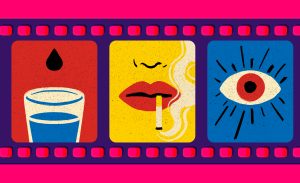
Image Source: Vivian Van
After being medicated, we switch to Liz’s perspective. She must now prove her devotion by limiting herself. We see evidence of her potentially being physically abused; Daniel claims she is hurting herself, and she claims Daniel is hurting her. The truth is withheld to keep us in a state of uncertainty, to give credence to the abuser’s reasoning. Liz must prove herself by literally shrinking herself by removing limbs and organs. When the “real Liz” shows up at the end of the film, we’re back in Daniel’s perspective. This outcome is what abusers hope to happen when limiting their partners; someone who will not change returns, someone who cannot leave.
The last film portrays manipulation in a religious setting. We see members of a cult who only drink from a water source that has been “purified” with the cult leaders’ (played by Willem Dafoe and Hong Chau) tears. The protagonist, Emily, played by Emma Stone, is on the hunt for the cult leaders for a female twin with a dead sister, with a specific height and weight, who can bring people back from the dead. When Emily is raped by her ex-husband, she fears that she will be expelled from the cult for losing “purity” more than she was of being violated. “Not everyone was cut out for this,” is what she is told when they find out she is “contaminated.” Once again, the abusers make expulsions the fault of the victims. Emily then kidnaps who she believes to be the true twin sister, played by Margaret Qualley, who can reanimate life, only to kill her when reaching for purified water while driving — her devotion becoming the thing that kills itself.

Image Source: Unsplash
Emily is the only protagonist in the whole film who is freed from her cycle of abuse and manipulation. The way the three stories are structured gives the viewer more understanding of the central theme. You understand what the victim wants in the first short, then you understand what the abuser wants in the second short. You watch the events unfold onscreen, knowing they’re unhealthy, but you’re rooting for them. Then, when a victim is finally freed from their abuser in the third short, it doesn’t even feel like a positive outcome. The stories in which the characters are not broken from their cycles of abuse seem to have “happy” endings, and the ones where the protagonist is actually freed are “sad.” When you are looped in an abusive dynamic, you are holding onto the fantasy that if “x” happens, you will finally be safe. When you break out of an abusive loop, it feels terrifying because you are breaking out of the only thing you know. The brilliance of Kinds of Kindness and how the three separate stories build on each other to create a thesis is covert and accurate to the emotional patterns of abuse. The real gut punch only hits you upon further processing of the events. It’s a genius example of taking advantage of the anthology format by making something greater than the sum of its parts.
Featured Image Source: Vivian Van