
Once standing as a symbol of cultural and artistic brilliance, the two Buddhas of Bamiyan bore witness to centuries of history, religion and heritage. The colossal Buddha Sculptures of Bamiyan are located in the remote valleys of the province of Bamiyan in Afghanistan. The Bamiyan Buddhas lie between the Hindu Kush mountains, carved into the Bamiyan Cliffs.
The majestic sculptures, once considered the largest in the world at 55 meters and 38 meters, have, for centuries, captured the amazed gazes of both Buddhist and non-Buddhist visitors from around the world. Although, like many ancient sculptures, the exact details of when the Buddhas were carved is not quite clear, it has been estimated that the Bamiyan Buddhas were carved around the third to sixth century.
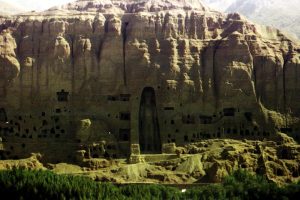
The larger Bamiyan Buddha before destruction. (Image Source: Flickr)
The existence of the two magnificent Buddhas points to the significance of Buddhism in Central Afghanistan at the time. Bamiyan being located close to one of the largest branches of the Silk Road made it a prime location for traders to stop and rest. This also points to the fact that during this time period, most of the traders along the Silk Road were Buddhists, thereby explaining the choice of location for the Bamiyan Buddhas.
The Bamiyan Buddhas, also an emblem of international connection, were attacked and partially demolished by the Taliban regime in 2001. Despite the global resistance and outcries, these sacred relics were destroyed by Islamic extremists who viewed the sculptures as blasphemous. This destruction provoked disbelief, outrage and dismay from the global community, but the loss of such culturally significant relics brought on resilience and resistance. Different organizations, both local and global, came together in solidarity to rebuild and restore the ancient relics and talk of reconstructing the Buddhas, thus promoting community, collaboration and unity in the face of destruction.
Not only did the destruction of the Bamiyan Buddhas bring forth efforts of preservation by activists, artists and historians to record the remaining memories of this treasure. It also encouraged the addition of Bamiyan Buddhas as symbolism within the artworks of many artists. Local sculptors and artists have paid homage to the Bamiyan Buddhas and have commenced their efforts towards the revival of such legacy. Their artistic endeavours and hard work spoke to their creativity, endurance and advocacy with regards to the arts.
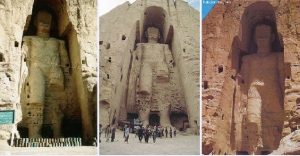
Large statue of Bamiyan, from different angles. (Image Source: Flickr)
While the loss and the destruction of the Bamiyan Buddhas serves as a reminder of the delicacy with which relics are to be handled, signifying the fragility of cultural heritage, some argue that the revival, reconstruction and preservation of the Buddhas would portray resistance and bravado. Although this would be a powerful message and an act of resilience against the disruption of cultural heritage, the idea is one to be wary of as it promotes possible revolutionary action. This could result in the inadvertent perpetuation of terrorism and war or violence and destruction in Bamiyan.
Nonetheless, both local and international supporters of the reconstruction of the Bamiyan Buddhas make continuous efforts in revitalizing the sculptures through different mediums of art. In an effort to showcase the Buddhas — illustrating the Buddhas in different mediums — two Chinese documentary film makers projected a 3D hologram of the life-sized Buddhas in the original location of the Buddhas in 2015, as covered by the Daily Mail. Furthermore, before the return of the Taliban, the government of Afghanistan had considered the reconstruction of the smaller Buddha for the sake of cultural heritage as well as the promotion of tourism in Bamiyan. However, such efforts have been abandoned due to the Taliban regime taking over the government once again.
The hollowed spaces where the magnificent Buddha sculptures once existed are now a representation of the cultural history of Afghanistan’s long enduring pain and suffering through the wars. The scars of Bamiyan Cliffs signify the continuous oppression of the people of Afghanistan by the extremists who deny Afghans any representation of cultural diversity or artistic expression. The echoes of Bamiyan reverberate powerfully within the vast Bamiyan Valley through time and space to encourage us to resist both the intolerance of cultural diversity and the oppression that seeks to silence our voices and efforts of artistic expression in the past, the present and the future.
The story of the Bamiyan Buddhas is not merely one of loss and destruction, but of resilience and resistance in the face of adversity. Their destruction has transformed them into symbols of unwavering determination, igniting a flame of resistance within the realms of art and activism. As long as the memories of the great Bamiyan Buddhas persists, the ideas of resistance against destruction will serve as a guiding light in inspiring us to safeguard cultural heritage and uphold artistic freedom wherever it is threatened. Although now hollows carved into the Bamiyan Cliffs, the Bamiyan Buddhas represent a beacon of hope in a world often darkened by the shadows of ignorance and intolerance.
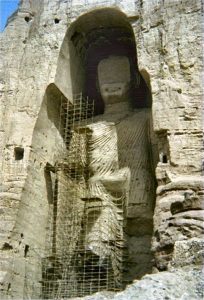
Efforts to preserve the Bamiyan Buddhas. (Image source: Flickr)
Featured image source: Flickr