DaVinci, the Mona Lisa, and pretentious love poetry––to most, this is the legacy of the Renaissance––a period marked by its foreign connection to love and beauty. What could be more different from the present—an existence plagued by an impending sense of negative change, extremism, and regression? According to Psychology Today, many North Americans feel “gloomy” when considering the future (and present) due to “social-political issues, financial crises, and climate change.” However, it is a similar state of uncertain change that inspired the artistic climate of the Renaissance––“artists are supposed to be tortured” is a sentiment that was created and perpetuated by perhaps the first Renaissance scholar Walter Pater’s Studies in the History of the Renaissance when analyzing DaVinci, Michelangelo, and the cast of Italian painters. The Renaissance saw a series of social, political, and intellectual transformations; some progressive like the printing press, others conservative such as a retreat to the classics, and many challenging shifts in perceptions of life, like the Protestant Reformation. These transformations were inherently classified as a period of rebirth, a renaissance. I feel we are in a similar place in history, if the Renaissance even ended at all.
Looking at North America, we are in a similar position to the Renaissance with regards to social, political, and intellectual transformation, with much of the future feeling uncertain. Technological progress is advancing, there is a rise in conservatism, and “unprecedented times” feels never ending as geo-political conflicts and domestic issues being the centre of attention on every social media platform, radio station, and news article. In short, the Renaissance is not as foreign as one might expect. From a literary analysis perspective, I will provide some historical, ideological, and theoretical context to compare and contrast the present to the 1500s. With these, I hope to provide some reassurance about the future by acknowledging that what is happening has happened before. Therefore, not only can people get through it, but the period—this contemporary Renaissance––can be remembered for something greater than its hardships (and maybe get a cool name to go with it).
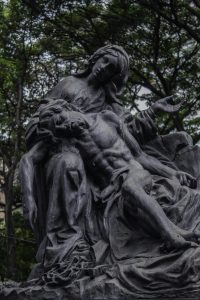
Renaissance Art — Pietà-style Sculpture Image source: Pexels — potsclam
The most crucial aspect of the Renaissance is the understanding of humanism. Humanism was an Italian ideology that championed human nature within the natural world, syncretism–– “stressed the unity and compatibility of the truth found in all philosophical and theological schools and systems,” and “emphasized the dignity of humankind.” Accepting purpose, morality, and religion as intertwined with life seems uncontroversial to general modern perceptions of society––life and its pleasures are meant to be experienced now, not exclusively reserved for the hope of an afterlife. The idea that nature, human condition, and aligning religion with reality seem obvious now considering that “The effect of [Renaissance] humanism was to help men break free from the mental strictures imposed by religious orthodoxy, to inspire free inquiry and criticism, and to inspire a new confidence in the possibilities of human thought and creations.” However, at that time, humanist ideology challenged the idea of scholasticism. Scholasticism aimed to rationalize classic philosophies and human nature through religion, whereas humanism tried to resolve them alongside theology; therefore, the wide adoption of humanism led to a secular understanding of the world and a rejection of rigid, traditional religious beliefs. Scholasticism was actually so rigid in its understanding of the world that, according to the Oxford English Dictionary, after 1797, it was formally defined as “Rigid or narrow-minded adherence to traditional doctrines and academic methods.” The mindset of a century is seemingly reborn in the adoption of humanism, but rebirth does not happen overnight. Humanism’s appeal to criticism of all systems included the church, subsequently inspiring Martin Luther to nail the 95 Theses to the door and spark the Protestant Reformation, changing connections and perceptions of Christianity and religion forever. Again, this change feels like a necessary step in history, but it came with immense polarization, religious wars, and violence between the different doctrines and traditionalists. Is this not reminiscent of the present? Somehow, the bloodshed that occurred all over Europe in the name of understanding theology and humanity is overshadowed by the art and prevalence of innovations, both technological and ideological.
Although there is not an increase in religiosity within North America, according to the Religious Landscape Study, what was an indefinite decline has stabilized in 2025. However, evangelism has been on the rise and the effects of this loud minority have planted the seeds of separating the church and state with theological underpinnings creeping into policy, law, and supreme court rulings, such as the overturning of Roe v Wade. Additionally, geo-political wars have also been waged in the name of religion, with a particular increase in conservative Biblical sentiments being adopted in the innocuous, such as the “trad-wife,” “crunchy,” or “old money” aesthetics. Like the Renaissance, political polarization is baked into all aspects of life. Neighbours turn on neighbours, and extremism is getting worse. The Renaissance means rebirth, but rebirth requires a drive for change first––a desire mixed with a need for mass ideological change, and I feel we are in the early stages of this mass mindshift as the Renaissance was the inspiration and predecessor to the Enlightenment; a period that saw intense progress in science, reason, and individual liberties. The Renaissance’s prompting to rethink what were considered “common sense truths” inspired the chain reaction of both hardship and prosperity that came from the desire for a better life outside of spiritual salvation and expectations of the church. Scholasticism saw an Augustinian rationalization of life on earth being the painful predecessor to a perfect life in heaven, but humanism tried to balance both by advancing that a good life could be achieved in the natural world without damning you to hell for partaking in the human experience. This sentiment resembles what both extremes of the present are trying to implement: a better life for myself now.
Renaissance Art — A book page depicting a woman and children Image source: Pixabay
This push and pull of conservatism and progress, and an inability to conceptualize the future, is present in pretty much everything that came out of the Renaissance, from paintings, to scholarship, and even poetry. As a result of the socio-historical transition, literary theorist Erich Auerbach’s “The Renaissance” describes the writers, poets, and artists of the period as “[i]ndividuals of an almost superhuman creative power, drunk on new ideas and new visions, appear… and exert their influence in almost all domains.” To Auerbach, Renaissance literature is characterized by its assertion of genius and worldview, unique in construction to the period’s transition and, in turn, possibility. This phenomenon can be seen in the Renaissance’s most famous work, Romeo and Juliet. What makes Romeo and Juliet resonate is the feeling of possibility, despite the play starting with the lovers’ destiny’s fixed. The prologue’s sonnet illustrates both transition and fate – the audience is being informed of the climax and conclusion “[a] pair of star crossed lovers take their life” as well as the presence of transition “[d]oth with their death bury their parent’ strife.” Fate means Romeo and Juliet must die, but the surrounding feud and the flexibility of language paradoxically implies a possible narrative in which the lovers do not die. What is in a name? Possibility, and it is this theme that keeps their “love” story transcendent despite everyone having seen multiple adaptations and inspirations of Romeo and Juliet, while balancing the pessimism of the period through great tragedy. However, this stroke of genius did not come from nowhere, it is reflective of the experience, writing, and criticisms of change that came from earlier periods of the Renaissance.
In conclusion, by barely scraping the tip of the iceberg, we can see that the Renaissance and the present share at least one striking thing in common, change and all that comes with it. The world feels uncertain. I’m sure the doom scrolling, unending news of unprecedented times, and historical comparisons to some of the most bleak moments in human history are just as unsettling to you as they are to me, but the world has not come to an end. The Great Fires of Rome and Tyrant Nero must have felt like the sky was falling, but time marches on, things change, and eventually times get better––they may get worse before better, but still better. Currently, we are in the mid-early stages, with intense polarization still prevalent, anti-intellectualism barring new ideas and criticisms, a retreat to conservatism in lifestyle and media finding popularity––but this has all happened before, and what came after the Renaissance? The Enlightenment, which may have already started. I can’t tell you who our Shakespeare or theorists are, nor define the dates of this modern Renaissance (yet), but one day in the hindsight defining our period they will be solidified in the historical canon. The world progresses through instances of mini-Renaissances, rebirths. A shift in mindset leads to intense polarization, and not only a desire, but a need for progress to continue. People are more educated and socially aware than ever. Science and research are like time––unstoppable.
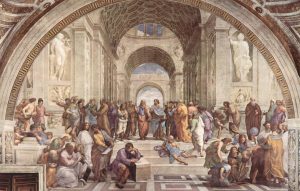
Renaissance Art – Nativity Painting of People Inside a Dome
Image source: Pixabay