The photo booth was charming and quaint, a compact cube tucked away in the corner of the rundown marketplace in Shanghai. Shiny and reflective plastic lined the booth’s outer surface, where an array of potted plants sat on the right side. Among them was a penjing tree, its foliage frayed and overgrown, a wild tangle of leaves, no longer contained within its pot. On the left side stood a slender, full-length mirror, its surface decorated with smudged fingerprints and bright streaks of marker graffiti. The front of the booth was covered in strips of Polaroids and links of three descending pictures, each one a triptych of the same subjects with slightly altered expressions.
My maternal grandmother was standing next to the machine. She flapped her hand at me, waving in the direction of the booth. “来,来,来,照相,照相!” Come, come, let’s take a photo!
My grandfather was beside her, holding our bags, filled to the brim with rice cakes and red bean patties. He too smiled at me and called for me to come to the photo booth, and so I did.
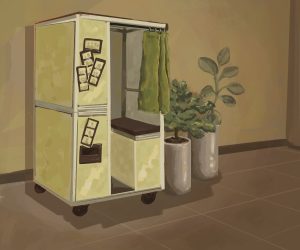
Image Source: Chloe Hand
My grandparents and I squeezed into the cubicle: me in the middle, them on either side. They stuck the coins into the slot and pushed the buttons. I could hardly see the panel of controls. I was young, maybe a meter tall at most, and the control panel glimmered above my head as I stood on my tip toes, straining my hardest. I copied their poses when the camera clicked, winking when they did and making peace signs with my hands, and I was certain I blinked when the lights hit, so bright a flash it seemed like the sun’s rays on an early summer morning.
The booth ejected a string of photos afterwards. It turned out I did close my eyes. But with my cheerful smile, I appeared exuberant, not sleepy.
My grandfather folded up the photos and tucked them into his pocket afterwards. Then we walked home, holding hands, the papers in his pocket a small reminder of the time we’d spent together that day.
It’s this very memory which surges to the forefront of my mind as I peruse the box in which my family’s old photo albums are stored. The series of pictures from that photo booth is taped to the front. The colours are fading, but our smiles still shine through. Lifting it from the lid, I graze my fingers over our faces, wearing a smile of my own though bittersweet.
I let it fall and flutter to the bottom of the box. Another picture, and this one is torn. It was taken on a cellphone—whose, I can’t remember—and printed in poor quality on a flimsy sheet of paper.
A strong wave of nostalgia rushes over me as I smooth out the wrinkles on the page. Despite its blurry lines, I can recall the scenery as vividly as when I first beheld it.
A little creek ran merrily alongside the oak-planked road. Then, ahead, they parted, the street turning left, the river going right. At the point they separated, there was a row of one-story houses, sandy in colour and very plain. They possessed no chimneys, balconies or porches. The front of the house had a single door and window. In the back, I recall, a set of three windows. The sloping roof was tiled in shades of ashen brown. All in all, it was a beautifully simple house which did not distract from the rocky crags, flourishing greens, and azure skies above.
I briefly visited the rural countryside where my ancestors grew up, only once, in the summer when I turned sixteen. It was simple and natural, and I was a city girl, accustomed to street lights so bright they blocked the starlight. The backcountry of China could not have been more different. The moment I stepped foot off the taxi and sank my feet into the mud and silt of the rice paddies, I felt a sense of estrangement. The water lapped at my ankles and splashed onto the hemline of my pants. I felt pinpricks of pain against my legs. Later, the locals told me that the paddies had leeches in them. I, armed with only my mosquito repellent, had stared at the rice paddies in shock.
The countryside was strange to me, even though it was all natural. The crickets created a symphony at night, unlike any city jabber or traffic honking I was used to, and the air, there was a persistent moisture within which clung to the body as a needy pet would. Perhaps I had been too steeped in the artificial. I remember disliking the place, thinking it was backwards and inconvenient. I stayed indoors whenever possible and kept up a constant stream of complaints about the weather.
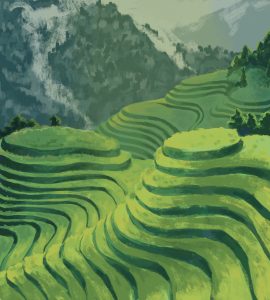
Image Source: Chloe Hand
After a long hike up a hill, my grandparents brought me to the peak captured in the picture. It was the entrance to the village where they lived, of which they had sent so many photographs that the view felt nostalgic despite it being my first time there. I recognized the beige stone walls of the simple houses, the cheery little stream running to the rice fields and the long, winding road, which was constructed from nothing but plain planks and had stray bits of straw strewn around.
I don’t remember anything particularly eventful occurring that summer. The days all seemed to pass in a blur. We woke up early, usually before the sun, then we dressed ourselves and ate congee with 榨菜 (pickled vegetables) before heading to work in the fields. We’d add fertilizer, pick off the weeds, and adjust the water levels. When the sun set, we went into the houses for dinner—rice with leafy greens and fried meats.
Time and time again, we repeated the same actions, day by day, over and over again. Slowly, the days became shorter, the nights colder. Then, in the blink of an eye, the summer had passed, and I was on the plane leaving my home in the countryside, staring out the window at the idyllic village, wondering when it had become so familiar to me.
The last picture is blurry; I dropped it in the water shortly after it was taken. It is actually a photo of me capturing another picture of the aquarium, which we had visited.
The water was a light turquoise green. Rays of sunlight shone through it, brightening the areas where they touched and creating beams of golden, yellow-green. Great columns of giant kelp, their canary colour turning gold under the light, sprang from floor to ceiling, swaying in the current. Fish of all colours fluttered in the foreground, brilliant flashes of yellow, orange and red which darted in and out of the pink and purple coral.

Image Source: Chloe Hand
My back was to the camera, head tipped back in wonder, stirred by the sight before me, dark hair falling to my waist. I was holding up my phone, on which you could clearly see the camera open.
I was thirteen years old, on the precipice of adolescence, on a trip to our local city aquarium with my grandparents. They walked behind me, holding our bags and taking pictures on their old flip phones.
I dragged them to the exhibit, jumping for joy and gesturing excitedly at the fish. At the time, it had seemed supernaturally beautiful to me, like a painting conjured out of a fantasy world. I could stare in amazement and hope to capture its radiance in a photo, even though its magic couldn’t be contained in a small screen. You had to be there. There was something in the air, in the light and glass, that made it different.
Even now, as I stare at the picture, my memory seems to be a more honest representation. I set it down and place it back in the box with the other photos. My heart feels tight, bursting with nostalgia. Emotions churn in my chest, the sadness and melancholy and the happiness and joy, all swirling together in a whirl.
The photos could hardly compare to reality, each one a small piece in the tapestry of my life, but it is the memories held within, the reminder of the lessons I’ve learned, the experiences I’ve had, the stories of who I am.
Featured Image Source: Chloe Hand