In the midst of a drought near the Yamuna River, the village of Kalajini suffered the most. Cracks split the dirt, wells ran dry, and the villagers resorted to begging in nearby villages. A little boy passed out from heatstroke, lying in the dry husk of his farm. Pitying his plight, a goddess descended onto the earth. She gave him the Pavitr scythe, a scythe with special abilities, and told him to use it on his village’s crops. Within minutes, the crops grew as if watered for months, and food returned to the village. But because the other villages had refused to share their resources during Kalajini’s time of need, the descendants of Kalajini kept any information about the scythe hidden within the townspeople.
They alone were chosen by the gods. They alone were chosen to wield the scythe. They alone were to protect the Pavitr scythe from the outside world.
***
Knock. Knock. Knock. The sound rang in Arjuna’s ears like the pounding of a mortar and pestle.
Knock. Knock. Knock. His slumber evaporated, quickly replaced with an acute awareness of the present moment.
Knock. Knock. Knock. Immediately, Arjuna thought of the Pavitr scythe— the most prized possession of the village of Kalajini. Gifted by a deity to Arjuna’s ancestor over two centuries ago, its magic ensured Kalajini’s crops remained eternally abundant, elevating the village to a status of wealth far above the surrounding villages, despite its harsh desert location.
Frantically, Arjuna sprang out of bed and crouched to the floor. His knees hit the hard tiles so abruptly that a sharp pain shot through him. Too distracted to acknowledge the pain, Arjuna fumbled at the base of the bed until his fingers found the snath of the scythe, which had been carefully fastened beneath the frame. Per his lineage, he was the rightful guardian of the Pavitr scythe, sworn to keep it safe.
It was not uncommon for someone to come to Arjuna, the village head, even at this time of night. His constituents often came through his gates and walked up to his house seeking answers. There were arguments to be moderated and arrangements to be made for next month’s harvest season.
Knock. Knock. Knock. Slightly fearful but mostly irritated, Arjuna crawled out of his position under the bed, careful not to hit his head and stood. With a sigh, he took a sip of water and splashed some on his face to appear less drowsy than he was. Steadily, he made his way through his courtyard. Outside, rain poured mightily on Kalajini. A thick brume coated the outdoors, and the wind was so strong that Arjuna, for a moment, figured that it was the wind that had caused the knocking sounds.

Image Source: Pexels
Then, emerging out of the mist, Arjuna saw a frail silhouette standing before him. Dull, watery eyes, creased with age, looked up at Arjuna from beneath an orange headscarf. The old woman’s neck strained as she tried to look up, her back bent so severely that Arjuna instinctively straightened his own.
“Excuse me, sir,” spoke the woman in a quivering voice.
“What do you want?” Despite himself, Arjuna let his irritation slip through.
The old woman fiddled nervously with the hem of her shawl, which was in the same fiery orange colour as her headscarf. She spoke slowly and timidly, “Some bread… please.”
Another day, or another time, perhaps, Arjuna would have taken pity on the desperation that rang through the old woman’s voice. But the moodiness that had already begun to seep through Arjuna’s demeanour struck him into an unusual, yet not uncharacteristic, outrage.
“How dare you bother me at this hour of the night over such meaninglessness! I don’t have bread for you. I don’t have food for you. And anyhow, why should I have to pay for your idleness!?!”
The old woman stayed quiet for an instant, as if at a loss for words. Looking back, Arjuna often wondered why he simply hadn’t closed the door then, but there was something so transfixing about the way she looked at him that for a moment, he almost forgot his rage. She seemed… disappointed.
“Please…” She tried again. The sound of her voice snapped Arjuna out of his momentary trance and awoke a more profound anger. He looked at her plainly, consciously choosing to ignore the big brown eyes that seemed to will a different answer from him.
“I will not help you,” he said sternly. “I do not owe you anything.”
Then, a new emotion flickered across the old woman’s eyes: rage. So profound it instantly sent goosebumps across Arjuna’s skin.
“Fine,” she answered coolly. “I suppose I have no choice but to help myself.”
In a flash, the Pavitr scythe appeared in the old woman’s hands. Panic struck Arjuna. No, no, no, no, no. How!? How was this possible!?
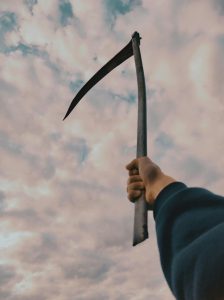
Image source: Pexels
“Stop! You have no right! The scythe belongs to me — to us!” At once, Arjuna lunged forward to retrieve the scythe, but was met with a sudden force that hurled him backwards.
Collapsing on the floor of his entryway, Arjuna looked up to see the old woman still standing in his doorway, but no longer was she slumped over; her back had inexplicably straightened so that she towered mightily over him. She looked upon Arjuna with such regalness that for a moment, he wondered if he was seeing the same person.
Electricity hummed in the air. The lamps inside flickered on and off, swinging from side to side. The scythe cast shadows in the lamplight, shadows swinging with gusts of wind that suddenly poured in through the open door into Arjuna’s home.
The old woman’s shadow seemed to grow, bringing her to a height far above ordinary. Her shawl fell off her shoulders, uncovering an extra four arms. The jewelry she wore made her wrists and neck glimmer. Her dark eyes suddenly seemed to glow in the dark, staring into Arjuna’s soul.
“For decades, your family has broken its promise to the deities. Hunger and poverty ravage the neighbouring villages as you laugh at their ill fortune.”
She held her hand out, and something clattered behind Arjuna. The scythe whizzed past him, grazing his cheek. A drop of blood slid down his face like a tear. The goddess watched it trail down his cheek with a smirk. Arjuna’s eyes widened in horror. First, from the shock at seeing a deity standing before him, then at the accusation. The scythe belonged to his family, to this village. They had been chosen.
“You were not chosen.” The goddess answered, as if reading into Arjuna’s thoughts. “The scythe was a present from the Gods to spread prosperity across all the lands. Your family grew cruel and selfish to hoard the wealth to itself. Using it to raise their status as leaders of a wealthy village that thrived while those beyond its borders starved. What was meant to be a blessing became a chain of greed, binding your bloodline to its curse.”
“No,” answered Arjuna, “you’re wrong.” Tears began to form in Arjuna’s eyes, blurring his vision. He wasn’t sure what made him feel this way, whether he was scared, confused or simply overwhelmed by the deity and the information she presented. Arjuna blinked away the tears, and when he opened his eyes, his surroundings had completely transformed.
He saw images flash before him as the tale of a story he knew all too well was recounted, but this time… differently.
Image Source: Pexels
Centuries ago, the tail end of the Yamuna River dried out, sending a dozen villages into a horrible drought. The people prayed to their gods day and night, and yet there was no appeal to the sweltering sun.
After weeks of dry weather, a farmer’s son, barely ten years old, became faint and collapsed in the middle of his dried-out farm. He laid in the sweltering heat for an hour, not having the strength to lift his arm to cover his eyes from the sun.
Barely able to move, he slowly moved his hands together and tearfully mumbled broken prayers upon cracked lips. He thought of his parents, who had given themselves less to eat than their children. How they started to lie that they’d eat later once they were asleep. The boy thought of the elder who collapsed on the road. At the funeral, he could see how everyone’s grief was mixed in with an anticipatory fear of dying next. He thought of his baby sister, who spent the energy she had crying in hunger every night when she was barely old enough to say the word for “food”. He prayed for relief from his pain. Mercy. For one less mouth to burden his hungry family. For that mouth to be his. For his family to forgive him for giving them pain in exchange for release.
The young child looked up to the sky and begged for the gods to let him die.
A goddess came down from the heavens to help him. She disguised herself as an elephant and made her way towards him. She offered him food, and water to help the boy regain his strength. He remained weak, so she carried him on her back. When he could stand, she led him to mounds of food – rice, curry, fruits, rotis, and deserts – freshly laid out on a dozen banana leaves. He picked out small portions of everything for himself and put it on a singular banana leaf, and then carefully packed the rest of the food away. Satisfied that the leafy parcels wouldn’t fall apart, he finally sat down and ate the portion he left for himself.
The boy left the food by his door, then trudged into his farm. After moments of rustling, he returned with several branches dotted with withered fruits. “It’s a bit shriveled, but it’s all my family has. I hope you don’t mind,” the boy said, placing it in front of the elephant.
Seeing what the boy gave her from the little he had, tears came to her eyes. She reverted to her normal form and thanked the boy. In exchange for the dried fruits, she gave him a magical scythe.
“You know what it’s like to struggle for food. With the Pavitr scythe, it’s your responsibility to ensure that nobody near you struggles for food again. Take this scythe and share it amongst the other farmers and villagers. You only need three swipes per property for the crops to revert. I’ll help with the rain; you must ensure that everyone pulls through this hardship together.”
The boy made sure to follow those teachings when he became a man. In his lifetime, he ensured that the scythe was brought to all the nearby villages for each harvest. He imparted all of his teachings to his sons. But somewhere along the way, words of community turned into exclusion; words of helping turned into hindering. The descendants only sowed for egos and reaped for profit.

Image Source: Pexels
As if it had never happened, Arjuna found himself back in his home’s entryway. The goddess had transformed herself back into the form of the elderly woman. She leaned on the Pavitr scythe as if it were a crutch.
In the moments he acted, he swore he was doing things that were beneficial to everyone. He was an advisor, a father, a leader. He swore that he was a good man too, but his hindsight was starting to paint a tapestry of greed. Arjuna felt himself become engulfed by the shattering revelation that everything he believed was a lie.
He looked at her sunken eyes and frail body and could only think of that malnourished boy in the field. and suffering. How unfair was it that a child was praying to the gods for his swift death. How – if fate differed – his childhood could also have been marked with famine if the Pavitr scythe wasn’t his. Nausea creeped into his bones. Arjuna’s son was sleeping with his mother in his bed. What if something happened for him to be thrown onto the streets? The image of his plump son reduced to hollow cheeks and bony limbs sent shivers down Arjuna’s spine. His legs felt weak at the thought.
How many other children nearby were living the nightmare of poverty? How many families were starving now because he hoarded the effects of a scythe that spent most of its time under his bed?
How many deaths could his family – he — have prevented if he had known the scythe’s purpose? Why did he need to have known the purpose to have empathy for the hungry?
How did he stray so far towards greed that a deity needed to teach him humanity?
Arjuna burst into tears in such a way he hadn’t done for decades. “I’m sorry,” he muttered, “I’m sorry.” His knees finally gave out underneath him. Six strong arms swiftly caught his two and gently lowered him to the floor.
He was now sure he’d deserve it if she used the Pavitr scythe to slash through him and disappear into the night. The air warmed. He slowly looked up at the goddess, not knowing what look of anger or retribution might stare back at him.
As the old woman again, she looked deeply into his eyes. Her gaze was not consoling, but not unkind either. The howling wind slowed into a gentle breeze.
“Stand,” she said unwaveringly.
Despite only being in his forties, Arjuna stumbled as he rose. He staggered towards her, failing to meet her gaze.
“Here,” the old woman said calmly, as she handed him the Pavitr scythe.
Arjuna took the scythe tentatively, confused as to why the old woman would return it to him.
Arjuna looked down at the Pavitr scythe as if for the first time. The wood and stone now bore the weight of generations of willful inaction. This object, which he had once looked upon with unparalleled pride, now felt shameful in his hands.
Again, she answered his thoughts. “Your family is the one who betrayed the scythe’s purpose, and now it is up to your bloodline to fix what is broken.” She paused before clarifying, “It is up to you to fix what is broken.”
“You know what to do,” spoke the old woman’s voice, but when Arjuna detached his gaze from the scythe to look up at her, she had disappeared.
“You know what to do.” The old woman’s voice rang in the back of Arjuna’s head. “You know what to do.”
You know what to do.
Header image by: Khaviya Skanthan