It has been six months since Donald Trump took office, and since then, there have been significant changes regarding American immigration policies. Specifically, the Trump administration has been largely focused on detaining and deporting many members of the Latin community, including both American citizens, and even children. These deportations are often carried out without evidence or proper due process, targeting the most disadvantaged and vulnerable communities.
In May of 2025, the Trump administration had a goal of carrying out 3,000 arrests of illegal immigrants daily, this target has led to many detentions in protected areas such as courthouses, schools, and hospitals. Many children have been stripped away from their families, and many individuals have become fearful of leaving their homes. Additionally, these deportations not only affect those being directly deported, but also have a drastic economic impact on industries, such as agriculture and hospitality, where a large number of workers are from these communities.

Ice police (image source: CNN US)
The people vs. Trump
The Immigration and Customs Enforcement (ICE) is a federal law enforcement agency in the United States in charge of the detention and deportation of immigrants and migrants, and has received additional funding from this term’s presidency. This has generated fear within the Latin community, as there have been several documented incidents of detentions with brute force, and countless stories of detained individuals being held in overcrowded centres. According to Physicians for Human Right, these individuals can face serious health risks, as they are not provided with timely medical support and care, which has already resulted in eight preventable deaths.
With crippling anxiety and uncertainty plaguing these communities, it doesn’t help public perception when President Trump continuously paints these communities as a “problem” to America, commenting that they are only committing crimes and smuggling in illegal substances. When in reality, many of the immigrants or migrants held in these centres come from hard-working families, who have come to build a better life in America. In fact, immigrants are 60% less likely to be in prison as opposed to U.S.-born individuals, according to research published by Stanford University.

Protests in the United States of America (image source: Vox)
Deportations At What Cost to America?
One of President Donald Trump’s key campaign promises was the mass deportation of immigrants and migrants living in America without legal authorization. He and his team have repeatedly praised the many benefits of his deportation plans, claiming that doing so will help the government conserve money, since there will be fewer people using government services such as public schools and temporary residences. They have also argued that it will result in more jobs for American citizens.
Trump has stated that there is “no price tag” for these deportations. He has deemed them necessary for the nation’s safety, justifying them by once again painting the idea that those unofficially entering the United States have contributed nothing more to the country than crime and harm to its citizens.
However, there is considerable evidence against these arguments.
Firstly, the Trump administration’s mass deportations are extremely costly to carry out. According to the Latin Times, in the three month period after Trump began his presidency, from the beginning of 2025 to March of 2025, the mass deportations had already cost the U.S. government roughly $330 million. Of that amount, $289.2 million was spent on security operations at the U.S.-Mexico border, while the remaining $39.3 million was spent on operations at Guantanamo Bay. More specifically, the average cost for a deportation flight per person is about $4,675, according to the Economic Times.
Yet, spending is set to increase sharply in the future, as the Trump administration’s Big, Beautiful Bill, which was signed into law on July 4th, 2025, sets aside $168 billion towards immigration and border enforcement agencies.
Aside from the high deportation costs, there is also the economic impact of losing several undocumented migrant workers. Despite only making up around 5% of the U.S. workforce, unauthorized migrants play a key economic role in many industries. Without their presence, these industries are likely to struggle, resulting in widespread economic consequences for the entire country.
One of the most impacted industries would be agriculture, which, as a result, could drastically increase food costs for all Americans. According to The Conversation, approximately half of the farmers in the United States are living in the country without legal authorization.
Another impacted industry is construction, where nearly 25% of its workers are migrants without authorization, many of whom are highly skilled, specializing in multi-faceted areas in construction. Given their diverse skill sets, it would be difficult to replace these workers promptly with other employees who are just as qualified. Therefore, the deportation of illegal migrants could hinder the speed of residential and commercial construction projects, which could then impact housing prices and availability.
In the past, state legislation targeting immigrant workers has led to the loss of billions of dollars. In 2011, Alabama laws instructed police officers to question the immigration status of drivers who were stopped for speeding and further restricted immigrants without legal authorization to work or live in the country from renting properties. These laws prompted many immigrant workers to flee the state, and their departure caused an estimated $2.3 billion to $10.8 billion loss to Alabama’s economy.
With all this in mind, Trump’s mass deportations will likely have the same impact on a national level. According to the American Immigration Council, the U.S. would suffer a 4.2 percent to 6.8 percent decrease in GDP if it deported one million people every year until all the undocumented migrants in the country were relocated. For comparison, the Great Recession, which lasted from 2007-2009 and was caused in part by the 2008 financial crisis, led to a 4.3 percent decrease, meaning the Trump administration’s deportations could cause an economic downturn worse than the Great Recession.
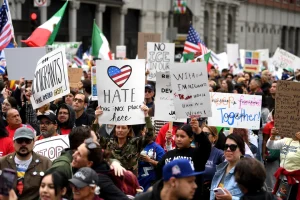
Los Angeles protests the Trump administrations hard line approach to immigrants (image source: Los Angeles daily news, photo by Axel Koester)
How the people are fighting back
These series of events have alarmed the community especially in the media. Many people are documenting the detentions of ICE and posting them online to raise awareness of their poor behavior. In May, a neighbourhood in Massachusetts tried to stop the detention of a Brazilian mother who was with her sixteen year old daughter and newborn baby. The community chanted that ICE did not have a warrant. Regardless, the woman was detained along with the arrest of her older daughter and a community member Ashley Spring for disorderly conduct and interfering with a police officer.
In other videos, immigration lawyers such as Naiara Testa warn the community on what documents to carry with you as well as the rights every individual has. The right to remain silent, to call a lawyer and to enter your home they need a judicial warrant signed by a judge not an administrative warrant signed by an officer.
On the streets, there are reports of protests in major cities such as New York and Los Angeles against Trump’s new immigration policies. In California Labor groups, immigrant advocates, and workers gathered in palm-tree-dotted MacArthur Park are protesting to put an end to the raids and release the detained immigrants in addition to stopping the expansion of private detention centers. In Philadelphia 150 protestors gathered outside the detention center, in Chicago a crowd gathered outside of immigration court chanting “no more deportations!”, and in Denver a group marched with cardboard signs.
The spread of protests across the country is how the community is raising their voices together to push for change and fight back.