William Shakespeare is a globally-renowned superstar in literature, theatre and even (nowadays) film. It is quite rare to see an author’s work remain so famous even after having been written approximately 400 to 500 years ago. Throughout his fame, Shakespeare’s work has undergone several adaptations; some adaptations change the setting slightly by adding lighting, while other adaptations are more drastic in that they incorporate modern technology, costumes and change the original Early Modern English. Despite these changes, all modern performances and references to Shakespeare contribute to his legacy. Thus, Shakespeare’s works have stood the test of time because his themes, writing and theatrics are relatable to any person in a progressive world. Having said that, these adaptations embrace different elements of Shakespeare.
When examining some changes made to Shakespeare’s work, we can first look at changes to the Early Modern English he used. At the moment, the earliest found translations of Shakespeare’s work are from the 1740s in Italian and French. This means translating Shakespeare is not new to this particular era. Further, British sailors in 1607 report watching performances of Hamlet and Richard II off the coast of Sierra Leone, and, in 1964, Julius Caesar was translated into Krio – a language spoken in Sierra Leone. This suggests that Shakespeare’s global fame began while he was alive, and there was an international interest in understanding his plays. Shakespeare has been translated into many different languages in the Globe Theatre alone, such as a fictional language like Klingon, and other real languages like Maori and German. The many translations and circulation of Shakespeare’s texts increase the global exposure to Shakespeare, cementing his legacy.

Image Source: Chloe Hand
Despite Shakespeare’s international fame, there have been notable critiques of translating Shakespeare. Direct translations miss the same rhymes, iambic pentameter and sometimes the same meaning of the play. However, some scholars believe that translating Shakespeare allows his plays to take on new meanings. For example, Brendan Cole, who researched and interviewed many scholars and professors on Shakespeare translations, astutely points out that the ending of Romeo and Juliet may seem depressing and emotional for a British audience, but may seem honourable to a Japanese audience. In this way, the ending may take on a new meaning, or a translation may need to change some part of the ending to evoke the same emotions in a different culture. In addition to Romeo and Juliet, Hamlet takes on a new context depending on the culture and time, as a Chinese theatre director translated Hamlet with a stronger display of political undertones after the Tiananmen Square massacre in 1989. Translations, then, allow people to interpret Shakespeare in their own way and apply their modern values and perspectives to themes already present in Shakespeare’s plays.

Image Source: Pexels
In addition to translating Shakespeare into different spoken languages, Shakespeare is able to remain relevant because he is being translated into sign language. During the summer of 2024, The Globe Theatre’s production of Antony and Cleopatra was translated into British Sign Language (BSL). Some deaf actors would perform their scenes entirely in sign language, some scenes were performed with a mixture of English and BSL, and a few scenes were performed entirely in English. In fact, half of the actors in the cast of 14 people were deaf and used BSL. Having watched this performance live, I believe the actors who were deaf incorporated body language heavily into their sign language, making their performances more believable and encompassing the dramatic performance required to perform Shakespeare successfully. According to Nadia Nadarajah, the lead actress playing Cleopatra, BSL was used to honour the conflict in the play between the Romans and the Egyptians; the Egyptians used BSL, and the Romans spoke in Present Day English (PDE) and Early Modern English. Nadarajah highlights that Shakespeare’s plays are adaptable to people of different abilities, and that the themes present in his plays can represent modern issues/occurrences, such as trying to be more inclusive and accessible in theatres. Making Shakespeare more accessible, therefore, allows more people to experience, perform, and understand his work.
Throughout the process of translating Shakespeare’s Early Modern English into BSL, Nadarajah had undergone many steps. She translated each line at a time, took videos of the sign language and transcribed the sign language onto her script. As a result, translating Shakespeare takes a lot of time and effort, thus Shakespeare remains cemented in his legacy because people want to take the time to translate him. An article from the Utah Shakespeare Festival outlines that Shakespeare’s works dealt with themes that were relevant in his time and persist today; that is why people continue to study Shakespeare. The class differences in Hamlet, the tyranny in The Winter’s Tale, and the familial betrayal in Romeo and Juliet are relatable to a modern audience. Nadarajah, too, says that she grew to love and relate to Shakespeare once she translated and understood his work. In this way, people can love Shakespeare and try to read Early Modern English after they understand what he was writing about. Translations are, therefore, crucial to Shakespeare’s fame.
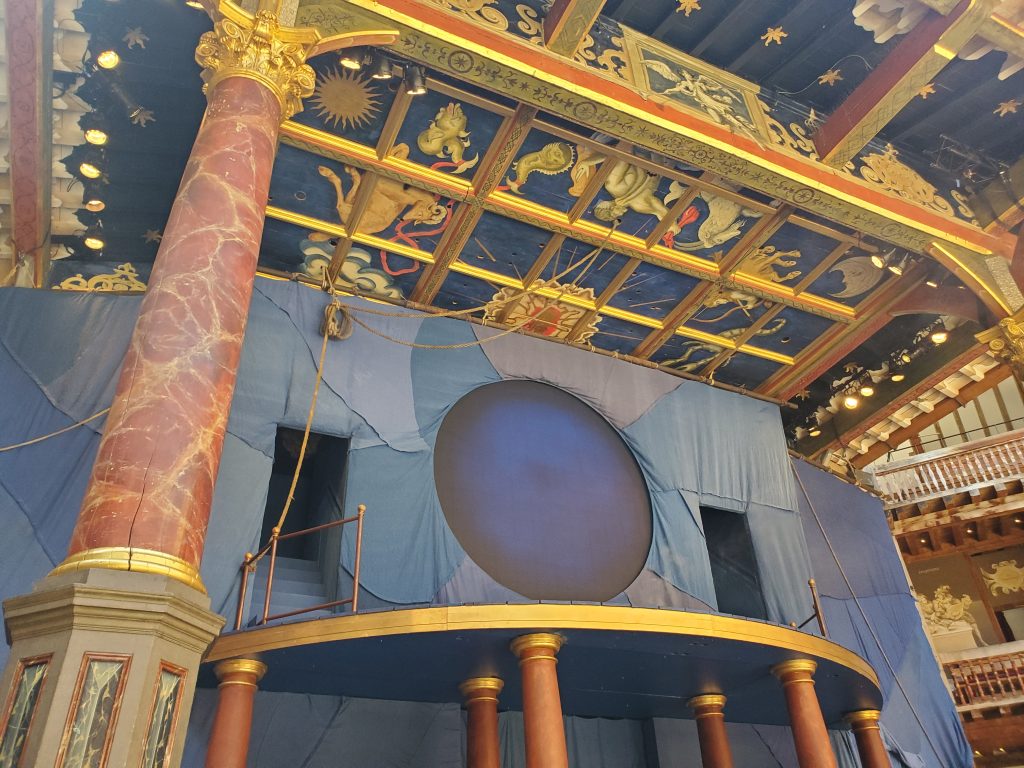
The Globe Theatre stage setup before an August 2024 performance of Antony and Cleopatra featuring Nadia Nadarajah. (Image Source: Teresa Cardoso)
English words were projected onto the dark blue circle. On top of translating Shakespeare, costume design is another key element in Shakespeare’s plays that directors have the freedom to adjust. Often, when we watch a Shakespeare play performed today, we either see the actors wear costumes meant to mimic the clothing of Shakespeare’s time or we see characters in modern attire. While keeping the same costumes Shakespeare would have used brings the audience back to the late 1500s and early 1600s, the costumes during the Elizabethan era were sometimes expensive; they were meant to reflect the society of that specific era. Thus, using Elizabethan costumes might not actually reflect what Shakespeare wanted his characters to portray in the Globe Theatre. He wanted to demonstrate wealth, and he often used clothes that royalty would wear. Thus, it is more likely that, if Shakespeare were alive today, he would want his actors to wear modern attire. While directors can use their own vision and input in a Shakespeare play today, honouring Shakespeare’s legacy exactly in the way he wanted may involve adhering to his values of using expensive clothing. Having said that, there is no right or wrong way to honour Shakespeare, as introducing people to Shakespeare’s history with Elizabethan costumes can teach the audience about Shakespeare’s life. In this way, costuming is important when discerning whether a director wants the audience to feel transported into history, or whether they want to focus on making the play more relatable to a modern society.
In addition to costumes, one significantly different aspect of performance that was not allowed in the Elizabethan era is the inclusion of women on stage. Though modern performances of Shakespeare’s work include women, the Globe on Screen’s 2012 production of Twelfth Night features male actors playing female characters. In the opening credits, they call this “an original practices production.” In this way, Globe on Screen indicates that their goal is to have a performance that adheres to the same values, costumes, and presentations that the original Globe Theatre would have had, thus transporting the audience back into history. While this honours the original ways Shakespeare plays were performed, this may not necessarily honour how Shakespeare wanted women to be portrayed.
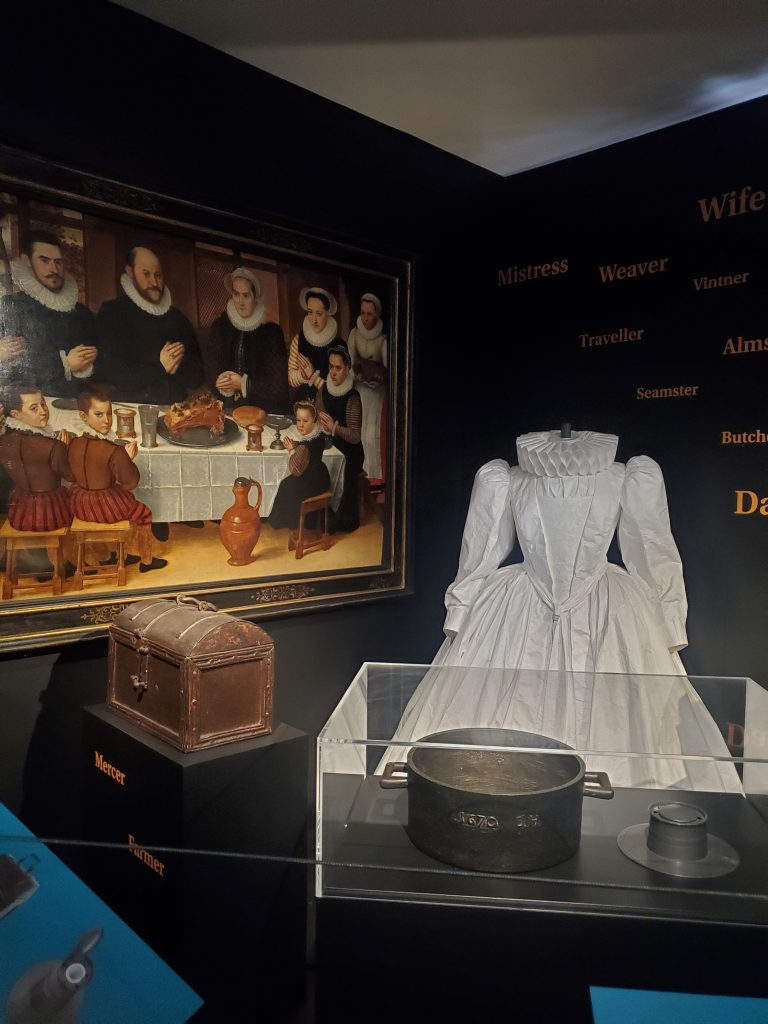
Women in the Elizabethan era would wear dresses such as this. This photo was taken in Shakespeare’s New Place in Stratford-upon-Avon, UK. (Image Source: Teresa Cardoso)
Many of Shakespeare’s female characters were strong despite experiencing amplified challenges because of their gender. For example, Rosalind, the lead character in As You Like It, and Imogen in Cymbeline endured struggles when they were part of the royal family, and had to dress as men to survive outside of the safety of a castle. These plays demonstrate that high class seems to be the only way a woman can survive. Further, in Cymbeline, Imogen was not free when she had wealth and royalty because she could not choose to be with the man she loved. These two characters suggest that Shakespeare was a proto-feminist, as he knew women were not treated equally in society, thus they were presented as strong for coping with their struggles. Scholar Hailey Bachrach, who often reviews Shakespeare performances, wrote for Johns Hopkins University regarding the feminism in Shakespeare’s plays. Specifically, she added that, despite the lack of lines and the minor roles women in Shakespeare’s plays had, they all express courage that reimagines the strength, influence and power women in England held. In this way, Bachrach affirms that honouring Shakespeare in a modern context may mean allowing women to play female roles.
One of the biggest changes directors choose to make to Shakespeare’s plays in modern performances is translating Early Modern English to PDE. There are many Shakespeare performances that keep the original Early Modern English, including those from Soul Pepper Theatre, The Royal Shakespeare Company and the Globe Theatre. When directors choose to move further from Early Modern English, graduate from Brigham Young University, Erin Ritchie, says that these adaptations embody Shakespeare’s innovative use of the English language by incorporating modern language and slang. Although Shakespeare’s language cements his writing as important to history and literature, people know and relate to Shakespeare because of the themes he presents in his plays. For example, if you were asked to explain Romeo and Juliet, you would likely talk about the plot rather than specific words Shakespeare used. Scholars believe that the construction of his plays, plots, subplots and cleverness when creating scenes allowed Shakespeare to remain relevant. Ritchie even argues that if changing the language can allow a wider audience to understand Shakespeare’s plays, then this suits Renaissance ideas of language: being able to communicate to as many people as possible. Modernizing Shakespeare’s language by including slang words and PDE could also increase the age of people watching Shakespeare. Despite learning about the plot and missing the original language, this allows people who may not be open to learning about Shakespeare to warm up to his plays, and could lead to a further desire to read his original work.

Image Source: Chloe Hand
In order to garner a wider audience of Shakespeare-lovers, Shakespeare’s plays are often adapted into movies, TV shows and media for children. From Gnomeo and Juliet to The Lion King, children are consuming media based on Shakespeare’s works. This exposes children of early ages to the kind of work Shakespeare wrote, thus preparing them for learning about him and piquing their interest in Shakespeare. Even children’s TV shows, like The Suite Life of Zack and Cody and Dance Academy, feature episodes wherein the characters study A Midsummer Night’s Dream. Shakespeare continues to be relevant because children learn about his plays well before they are capable of understanding his writing. In this way, children are almost conditioned to know about William Shakespeare, or at least be familiar with some of his most infamous works. This increases the age range of people who can, and often do, learn about Shakespeare.

Image Source: Chloe Hand
In addition to modernizing Shakespeare’s language, some directors take this a step further by adding modern technology to these plays. For example, in 2012 in New York, audience members were encouraged to use social media to take pictures and share their thoughts about the Roman tragedies performed, as this mimicked the spectatorship that would have occurred during Shakespeare’s era. In fact, since we are consuming Shakespeare in a modern era, it is almost impossible to remove modern technology from current reproductions of Shakespeare’s plays. One distinct example of this is the 2015 production of Hamlet featuring Benedict Cumberbatch, wherein many people tried to stream this performance illegally, and people who were able to watch it could discuss it on social media. In this way, theatre takes on a new meaning with the emergence of social media; people can advertise, discuss, and interpret theatre differently without needing to be in contact with physical theatre. Does this detract from the beauty of live performance? Yes. However, this highlights the many forms Shakespeare’s plays can take on. If Shakespeare, a writer from the 1500s to 1600s, has work that still resonates and can be transformed into a world where technology exists, this is the highest testament to his legacy.

A statue of William Shakespeare in Stratford-upon-Avon, UK. (Image Source: Teresa Cardoso)
Even over 400 years later, Shakespeare’s plays are still performed; sometimes with the intention of recreating the exact staging Shakespeare himself would have seen, and other times with cellphones and words like “bae.” Regardless of how a director chooses to embody Shakespeare, any trace of his work – including mere inspirations – has allowed Shakespeare to build and maintain such a strong legacy. Since Shakespeare’s works can mould to fit any era, even nowadays with smart watches and dating apps, his work remains relevant because people can relate to his themes of heartbreak, tyranny, and wanting a parent’s approval – just to name a few. Shakespeare’s works can speak to people of any age and any time period. As Shakespeare wrote, “All the world’s a stage,” and so long as people continue reading and watching Shakespeare, new directors will find new ways to turn the world into a stage upon which we can consume Shakespeare.
Featured Image Source: Gracen Pressaco