Elyssa’s world is dirt poor.
Her neck cramps as she looks up at her ceiling, full of tiny holes with no sunlight peering through. In her world, all she’s known are buildings stacked and cramped together like cages. Water droplets graze her cheek from the caved ceiling. She scrunches her nose and groans, stretching her arms. Her skin sticks to her broken plastic chair. Her dingy laptop illuminates the room in the otherwise dark space.
The screen is still frozen, and she suppresses the urge to smack it. Her articles may give her some income, but it would still take her years to upgrade her laptop. The model wouldn’t even be up to date and programmed with advanced technology. It would most likely be whatever model the Higher Society unceremoniously dumped into their city.
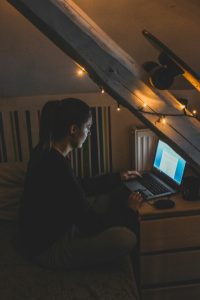
Photo Source: Pexels
She shudders at the thought of sorting through the city’s Trash Wells to find a computer in good enough condition. Then she’d have to take it to someone who can bring it back to life and wear out her voice to bargain for a decent rate.
Elyssa quietly does the math in her head. She’s written seven articles so far– most have been thought pieces and critiques of High Society figures and corporate scandals. They haven’t been received well, so she would have to write three dozen more to make enough money for a damn laptop.
Articles about microtrends, the latest breathable fabric perfect for parties, the most vibrant nail polish that pair well with skin tones, pay much more than articles about the bleak lives of Lower society.
It’s an unfortunate reality that she hasn’t come to accept.
She stands up and paces around her tiny flat, keenly aware of the camera from the corner tracking her every move. The camera stands out in her dirty, packed unit. Shiny, pristine, and always up to par with Higher Society’s trends. There’s one in every corner of the city, including every living room. Though there’s a certain hostility Higher folks have towards Lower people like her, they still can’t help but control everything their hands can touch.
She sighs, grabs her umbrella and satchel, and heads out the door. A short break will do.
Roads are a luxury for Elyssa. Sidewalks, too. Here, there are only dark alleyways where the sun couldn’t reach and dripping pipes connecting every unit. She adjusts her umbrella, feeling droplets of whatever strange liquid are travelling throughout the tunnels.
The alleyways reek of sewer water. It doesn’t faze her at this point, though now and then, she notices how pungent the odour has gotten. She turns right, breathes a little easier, and continues walking down a street that allows her more space.
Going to her favourite quaint shop should help her relax a little. Her shoulders are tense, her mind exhausted as she thinks about how to stretch the income from her last three articles. Being a journalist is considered one of the well-off jobs in Lower Society, but she still struggles almost just as much as everyone else.
A crackling grabs her attention, and she stops in her tracks. She turns around, and right behind her, a large projector appears in the sky. It must be time for the day’s mandatory viewings. It’s almost always about the one rare thing in her world, something folks of Lower Society can never afford: high Scores in modified gene options.

Photo Source: Pexels
She raises an eyebrow as she waits, the familiar curl of disgust ramping up in her stomach. On the screen, a man reeking of self-importance and arrogance makes an appearance. Ronan, the caption reads. His suit is polished and ironed without a single wrinkle. The fabric would be featured on a magazine, on an article that could afford her modest technology.
He walks across the platform as he speaks, face pinched with awe and confidence as he gestures wildly, “Gene modifications are humanity’s saviour. Our society does not have to suffer through diseases, and modifications ensure our full potential—” Elyssa scoffs and continues walking.
She had written a piece on Ronan not too long ago. It was another critique piece that gathered little attention. The man constantly tells the story of how his family climbed the ladder from Lower to Higher, as if it was as easy as that. She’s watched countless neighbours gamble their life-savings on their kids’ Scores, only to dig themselves into deeper debt.
To Elyssa, it feels like a mockery. To see Ronan on the screen preach about Scores and Premiums, knowing that all he had was his ancestry. They could be easily switched. Ronan could see Elyssa on that same screen one day and feel the same loathing brimming in her stomach.
Cramped buildings don’t leave much room for actual streets that could fit more than two people. Some are so tight that it feels as if two walls are slowly closing in on you, trapping the surrounding air. She groans, feeling every small step she takes. When she reaches the shop, she crashes in, loudly slamming the door that’s barely hanging onto its hinges.
The owner, an elderly man, glares at her. “Break my door and you’re banned,” he threatens.
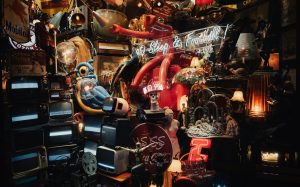
Elyssa smiles sheepishly, closing the door gently, patting it as if it’s something precious. The shop is an exact miniature version of her city. Bookshelves filled to the brim with old magazines and textbooks with spines barely hanging on. Baskets stuffed with old technology and gadgets that High Society dumped on them. A leaking ceiling resulting in mould and foul odour.
(Photo Source: Pexels)
But to Elyssa, this place is special.
She crouches down and pulls out a plastic basket, carefully placing a hand to prevent the clutter on top from falling over. Rummaging through the basket, she finds old videotapes and searches for one in good enough condition to play on the weary TV the old man owns. Underneath the pile, a tape catches her eye. It’s clean, barely a scratch on its surface, and its label still firmly intact. Before Time, it reads. Walking over to the small table where the TV sits, she puts it in the player.
Upbeat music. People freely roaming around, no barrier separating them. Neighbourhoods with houses that aren’t stacked against each other like a toddler’s building blocks. The people in the footage hold themselves like they weren’t drained by a system that thrives off their hard labour. They look alive. More colourful.
But they don’t look entirely rich either. Not like Higher Society that flaunts their superior genes, mansions that span numerous acres, and those who make it mandatory viewing to broadcast their unattainable fortune for Lower Society. No, the people here look normal, as if there’s no extreme. As if they aren’t confined to two strict categories. A place that doesn’t determine everything with Scores or Premiums. Elyssa’s brow furrows at the thought.
“What’s this?”
She jumps and scowls at the old man suddenly standing behind her. “Don’t just sneak up on people.”
The man pays her no mind, glancing at the screen. “Ah. It’s Before Time, I see.” At her incredulous look, he clarifies. “The time before gene modifications was a thing. Pretty self-explanatory.”
Elyssa nods, feeling her throat constrict as curiosity rises within her. But she doesn’t know where to begin, or even how to ask. This isn’t like anything she’s seen before.
“You’re curious, aren’t you? As to how the world turned out this way?” the old man asks, amused. He groans as he gets up, slowly walking back to the counter. Elyssa takes the tape out of the dispenser and follows him. He shakes open a drawer and hands her a small piece of paper. It’s crumpled, with little tears around the edge, yellowed with age, and on it is an address written in faded blue ink.
She recognizes the street name instantly. It lies beyond the cramped streets of her home in High Society and past the Gate. Even in the times she’s managed to get permission to go beyond those walls, the guards at this address have resisted her at every turn.
“You’ll find answers there.”
Elyssa frowns, “Why do you have this?” He ignores her, fiddling with the drawer to close it. “And how can I get past the Gate anyway? I need special permission.”
“You already have permission,” he glances down at the tape in her hands. “And nothing gets past the officials in Higher Society.”
She nods, feeling the weight of the paper in her hand. This might be her big breakthrough. A chance for her to uncover a long-held secret. Elyssa feels a rare thrum of excitement for something new.
If she cracks this story, she may even afford a new laptop before the day is over.
She stuffs the tape in her satchel and stumbles out to the tight and suffocating alleyways. The air is rancid, and she is definitely not meant to gulp so much of it, but she lacks the will to care.
If she’s allowed out, this could be her chance. She feels the cameras following her every move. Higher Society already has their eyes on her. This is her chance to uncover more than the suffering of Lower Society. A chance to crack the system that has grabbed every neck of her people and determined their lives.
People of Lower Society are often not allowed outside of the city unless they are granted permission. The barrier that separated the Higher and Lower societies was tall and imposing. It’s meant to be unbreakable, to deter any Lower folk from climbing up. Elyssa has spent years staring up this same wall, wondering how good the Higher folks have it that any area near the borders is considered unlivable to them.
The Gate is patrolled every hour, with guards roaming around and controlling the flow of people coming in and out. She always found the guards useless, since no one was ever allowed out, and no Higher folk would come near the borders.
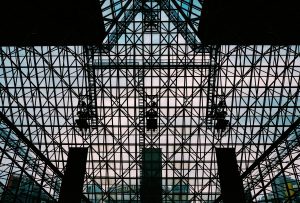
Photo Source: Pexels
But as she reaches the Gate, she grabs a guard, demanding to be let through. The guards are Lower like she is, and like everyone else, they don’t get paid enough to care. He takes one glance at her and his eyes widen in recognition. For the first time in her life, Elyssa’s eyes aren’t met with dirty streets littered with trash.
Beyond the Gate is luxury. More than luxury, in fact. Sky towers that disappear into the clouds. Pristine and sleek vehicles. Silk dresses, perfectly tailored suits. Roads and sidewalks where she wouldn’t have to squeeze up the wall if she were walking beside someone else.
Right on the other side of the Gate is a man dressed in a black suit staring at her, displeased. He shifts on his heels, and she thinks this might be the most uncomfortable he has ever been in his life. This is the nearest he can come to experiencing how Lower folks live. But this sight in front of him wouldn’t even amount to a quarter of their experiences.
“You’d like to speak with him?”
Murphy’s Law states that anything that could go wrong will go wrong. Ronan is aware that it’s an outdated fad, but he still can’t help thinking of it while watching the camera footage.
Anything that can go wrong, will go wrong. Ergo, this underpaid journalist got her hands on video footage from the Before-Time. It could ultimately remain harmless, but Elyssa’s profile shows her Strong-Will Score is unbearably high, which does not bode well. Her parents are uncomfortably placed in the low-income bracket. Why they spent all their funding on the Strong-Will Score rather than anything else, Ronan can’t fathom. Everyone knows the Strong-Will characteristic is really just another word for stubborn. Nobody likes stubborn.
The light of the camera footage flickers in the dark, only succeeding in illuminating the man’s frown and sharp brows. It’s a good thing that he’s well-versed in fixing whatever Murphy’s Law throws out. He has a high Strong-Will Score of his own.
Right on time, a knock on the door.
“Sir?” someone calls, muffled. “Someone is waiting in the lobby. She doesn’t have an appointment, but she insists that you would like to see her.”
He pauses, “What’s her name?”
“Elyssa.” The journalist. He should have known — what with that Strong-Will Score of hers.
“Let her in,” he says. The doors, hand-carved and wooden, swing open, revealing a plain face. Elyssa is everything he imagined, if not underwhelmingly less. She stands out alarmingly against the red velvet carpet and Icelandic blackout curtains — anyone with eyes can tell that she’s standing in a place she does not belong. Her features are a default mix of a straight nose, slightly crooked teeth, olive skin, and murky brown hair. Elyssa’s parents couldn’t afford any of the Aesthetic Premiums, Ronan assumes.
Her eyes are fixed in a glare, even when her lips are grimaced into a polite smile.
“Hello, sir,” she says, “my name is—”
Ronan stands up from his desk, strutting around it with his hand outstretched and his Charisma Score fussing. “I know who you are,” he replies with a matching grin, “and I know what you stole, and I’m sure you know that I won’t be telling anything to the likes of you.”
She glances over at his wall-length projector, which still illuminates her face, along with many other faces of interest. Let her see it all, Ronan muses, testimonies from powerless people tend to go nowhere.
“The likes of me,” she echoes. The woman bypasses his offered handshake and takes a seat at his meeting table. His meeting table, which could fit about 30 people at a time, was a collector’s item. A slab of wood cut from one of the oldest trees in the world. It maintains its tree ring shape, with the divots and splinters fixed over with clear resin, as perfectly authentic. It was Ronan’s favourite piece.
And now this woman is sitting at it, uninvited. He brushes off the rejected handshake with only a tinge of annoyance.
“Other people that are ‘like me’,” she says, swaying in her chair, “live in houses that are the same size as this room.” Elyssa pulls out her own travel-sized projector and places it on the table as it unfolds stiffly. In between them, the footage of Before plays— the very same footage he’s been looking to get rid of. “I live in the slums where there are no sidewalks, or roads, or forty-foot high walls. But it looks like you’ve observed that already, haven’t you?”

Photo Source: Pexels
He has, in fact.
Three generations ago, Ronan’s family were also scraping by in the Lower Society. His grandfather would never let them forget it. The man had scrounged all of the family’s money, putting them into near debt so that they could gamble it all on designing Ronan’s mother. They maxxed out her Strong Will Score, Charisma Score, Intelligence Score, and the Aesthetic Premiums. She brought them from slums to a comfortable middle class, and Ronan pulled their family up even higher.
Now, Ronan looks at families in the slums and only sees a lack of strategy. “I’m aware of your circumstances,” he says, “and I’m sorry to hear it. But your tone implies that I had something to do with it when I didn’t.”
There’s a pause as they watch the Before Time projection on the table. Elyssa starts, “What I really like about this video is how there are no slums at all, is there? In the Before Time, there weren’t places like your gigantic office and my shitty apartment in the slums. It was all middle ground. Middle-class houses, randomized Aesthetic Scores, Skill Scores were never decided at birth in the first place.”
“It may not look like it on the surface,” says Ronan, “but it was just as bad as it is now. It was just better hidden back then.”
“So you admit that it’s bad now?”
“I admit that every system has its flaws.”
Elyssa leans forward. “And who pays for those flaws, if not people like me?”
His jaw flexes. “This is a system based on competition, just like it was in the Before Time. If you don’t want to pay for the flaws of it, then you must simply choose to compete.” The footage from Before autoreplays before Elyssa reaches over and shuts it off. They eye each other warily, bright blue to murky brown.
“And what happens to the people who can’t afford to compete?” She asks.
“Everyone can afford to compete,” he replies. “Competing means food, shelter, a better future for your children.” Ronan pauses, correcting himself. “They can’t not afford to compete. There’s as much punishment as there is incentive for choosing otherwise.” The man gestures over to Elyssa’s projector, too far in the middle of the oakwood table to grab it himself. “I doubt you’re here to lecture me on the dangers of capitalism, so I’m just going to give you an offer. If—”
“I don’t want your offer,” Elssya cuts in.
He raises a brow. “I haven’t finished making the offer.”
“Don’t care. I don’t want it.” Ronan is suddenly reminded of her alarmingly high Strong-Will Score. It certainly checks out. He’s almost impressed to see it in action. She leans over and swipes the projector herself. “How about I make you an offer? This footage will spread no matter what you do, taking into account how easy it was for me to obtain it. I’ll give you a chance to put out a statement before the fire gets too out of control.”
“You want to interview me.”
A smile, a genuine one, breaks out on her face. It’s a little more crooked than the preprogrammed default. “What was it you said in your last speech?” The journalist takes on a mocking tone, voice deep and posh, “‘Gene modifications are humanity’s saviour. Our society does not have to suffer through diseases, and modifications ensure our full—’”
Ronan cuts her off. “I know what I wrote in my own speech.” It was one of his better ones, he thinks, so he won’t sit around and let this random girl make fun of it.
She takes out another device from her satchel. A recorder clicks on. She is really determined to do this.
Photo Source: Pexels
“Your speech,” says Elyssa, “praises modifications as a way to reach our full potential as a society. But the part you omitted is the rising pay wall behind—”
“—I never agreed to your damn interview—”
“—the features that actually fulfill this arguably subjective definition of potential. It holds back someone’s work potential, defining one’s capitalistic value before one can even speak. Do you think this is fair? Can you really take credit for your success when it’s been predetermined for you?”
“I said,” Ronan grits his teeth, “that I haven’t agreed to your damn interview. If this footage gets released no matter what I do, then you’ve lost any leverage you have against me. I don’t have to agree to anything you say.”
“If this footage gets released, no matter what, then you will have to do damage control, no matter what. I’m helping you.”
“And why the hell are you helping me?”
A pause. “You said that everyone needs to compete. I’m competing.” She gestures to the space between them. “I’m just playing by the rules you’ve set.”
It is undeniably clever of her, Ronan is willing to admit to himself, despite her average Intelligence score. She’s surpassed his expectations. Outsmarted him, even. He shrugs his shoulders a bit, leaning forward.
“Alright then,” he says. “Whether you release the footage or not, I can have it buried in a second. You act high and mighty about being from Lower Society, but you don’t realize that this—” he gestures to the air, “—is only an evolution of what you found in that footage.
“Parents will do everything to secure a better future for their children, whether it’s paying for higher education or buying a perfect Intelligence score. They shaped their children’s talents and personality through nurturing, and we’ve simply upgraded it to nature.” Ronan taps the wooden table. “People tend to think the Before Time was better because it’s easier to wrap their heads around. But disease, human weakness—”
Elyssa scoffs. “I don’t need more of your talking points.”
“But they’re not just talking points!” He cries. Ronan shoots up from his chair, circling back to his desk. He taps the control remote, switching through camera angle after camera angle. The projector flicks through every place beyond the Gate. “See how everyone can walk without trouble? There’s no one coughing, or on ventilators, or begging on the streets so they can afford a shot of insulin.” The man laughs bitterly. “You don’t even know what insulin is, do you? It’s an outdated, overpriced medicine. You’d have blamed me for it, too, if it were still around.”
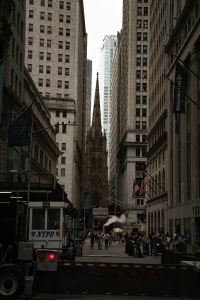
Photo Source: Pexels
The journalist doesn’t reply, simply moving around the table as well to stand beside him. For a moment, they both watch the footage in front of them. A surveillance state — another similarity between now and the Before Time, even Elyssa would have to admit that.
“If you really believe this is simple evolution,” she says softly, “then why are you hiding the past from us?”
“I’m not answering that. This still isn’t an interview.”
“Go fuck yourself. You clearly believe in this cause, even if I don’t agree with any of it.”
“I do believe in it,” he replies, “but in the end, we are still a business. We need to make money somehow. And one of the most effective ways to sell…”
“…Is to make sure no one knows there are other options out there,” Elyssa finishes, her face twisted in vague disgust. “I’m not going to let that happen.”
He’s not going to let her get any further in the thought. Ronan walked into this visit unprepared, or overly confident, or both. Elyssa proved herself beyond just the metrics he dug up in her birth report.
That makes her dangerous.
“I’m going to mark you as a person of interest,” Ronan says idly, “which means that you will be surveilled for any threatening movements. And any threat you follow through with will be buried, one way or another.”
He turns his head towards her and observes that plain face. She doesn’t look surprised at all. The comment has only brought back her crooked grin.
“I’ll find a way,” she says. “Thank you for the interview, Ronan.”
Cover Photo Source: Pexels